Tabla de contenido
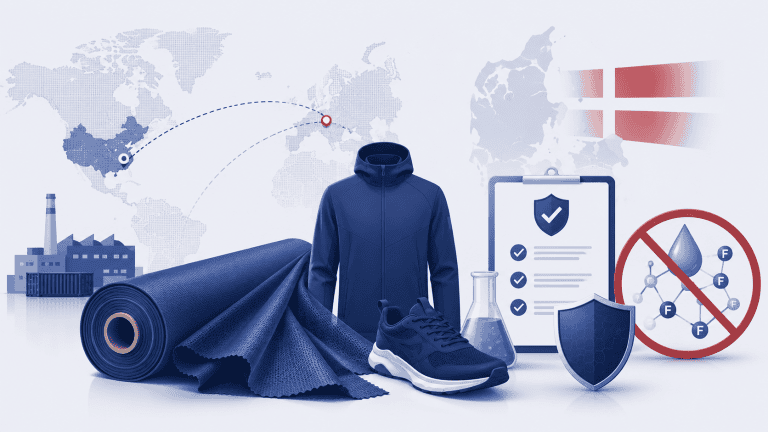
PalancaDenmark now prohibits the import and sale to consumers of specified clothing, footwear and impregnating agents when at least one covered article contains total fluorine at 50 mg F/kg or more. Executive Order BEK No. 464 of May 2, 2025 entered into force on July 1, 2025, and its prohibitions have applied since 1 de julio de 2026. A limited sell-through period allows traders to sell qualifying stock already held until 1 de enero de 2027.
For textile buyers, the decisive change is not simply a longer restricted-substance list. The Danish rule uses total fluorine as a broad screening threshold. A declaration limited to PFOA and PFOS, or a supplier’s general “PFC-free” claim, does not by itself demonstrate that the finished product falls below the Danish threshold.
Key takeaway: qualify the complete product and production route—not only the salesman’s swatch or one finishing chemical. Fabrics, membranes, coatings, prints, adhesives, foam, trims, leather components and aftercare treatments can each affect the result.
Denmark’s PFAS Rule at a Glance
| Artículo | Current requirement |
|---|---|
| Legal instrument | Executive Order BEK No. 464 of May 2, 2025 |
| Status | In force since July 1, 2025; import and sale prohibitions applicable since July 1, 2026 |
| Threshold | Total fluorine of 50 mg F/kg or more |
| Clothing and footwear scope | Clothing or footwear for private use where at least one included article reaches the threshold |
| Other covered products | Agentes de impregnación para prendas de vestir o calzado destinados a uso privado. |
| Who is affected | Traders importing or selling covered products and private individuals importing covered products |
| Stock transition | Traders may sell covered stock already held until January 1, 2027 |
| Main exemptions | Reuse; recycling; specified PPE; PPE where PFAS provides a safety function; agents used to re-impregnate that PPE; medical devices; transit goods; documented non-PFAS sources of fluorine |
| Supervising authority | Danish Environmental Protection Agency |
The official Danish text is available in BEK No. 464 on Retsinformation. The European Commission’s TRIS notification 2024/0646/DK provides the regulatory background and impact assessment.
This article is a supply-chain guide, not legal advice. Product classification, test strategy and documentation should be confirmed for the specific product, market channel and date of import or sale.
What Products Does the Danish Ban Cover?
The order applies to clothing and footwear for a person’s own or another person’s private use. It also covers impregnating agents intended for privately used clothing or footwear. Both commercial import and sale and private import are addressed.
The threshold applies where at least one article included in the clothing or footwear has total fluorine of 50 mg F/kg or more. This component-level wording matters. A low result for the product as a whole should not be assumed to neutralize a high-risk membrane, coated panel, trim or other constituent article.
The order defines PFAS broadly by chemical structure: a substance containing at least one fully fluorinated methyl carbon atom (CF3) or methylene carbon atom (CF2), without hydrogen, chlorine, bromine or iodine attached. It also contains specific exclusions for certain structural elements and does not duplicate PFAS already regulated under applicable EU REACH or Persistent Organic Pollutants rules.
Products and situations outside the prohibition
The listed exemptions include:
- reuse of clothing or footwear;
- recycling of clothing or footwear;
- personal protective equipment intended to protect against risks in Regulation (EU) 2016/425, Annex I, category III(a) or III(c);
- PPE where PFAS content performs a safety function for the consumer;
- impregnating agents used to re-impregnate that exempt PPE;
- medical devices;
- goods in transit; and
- cases in which the fluorine comes from a substance that is not PFAS.
The last point is not an automatic exemption. The Danish Environmental Protection Agency may request supporting documentation. A business relying on it should have a technically defensible explanation and evidence before the product is released.
The Agency may grant exemptions in special cases, but buyers should not build a normal sourcing program around the expectation of a discretionary exemption.
Why the 50 mg F/kg Total-Fluorine Threshold Changes Testing
Targeted PFAS testing looks for selected named substances. Total-fluorine screening measures fluorine more broadly. These approaches answer different questions.
A total-fluorine result at or above 50 mg F/kg triggers the Danish prohibition unless the relevant fluorine can be documented as coming from a non-PFAS substance or another applicable exclusion applies. Conversely, a total-fluorine screen alone does not identify which PFAS is present, its source or whether detected fluorine is PFAS-derived. Follow-up analysis and a review of the material and chemical inventory may therefore be necessary.
This is why the following statements should not be treated as equivalent:
- “PFOA/PFOS-free” addresses only named substances.
- “PFC-free” is an imprecise commercial phrase unless its definition and scope are supplied.
- “No PFAS intentionally added” addresses formulation intent but does not by itself rule out contamination or legacy inputs.
- “Fluorine-free” is useful only when the claim covers the finished product and is supported by appropriate evidence.
- “Below 50 mg F/kg total fluorine” addresses the Danish screening threshold for the tested sample, but the report still needs to be representative of the actual product and lot.
Buyers should agree the laboratory, sample plan, test method, reporting limit, components to be tested and follow-up procedure before bulk production. The law sets the threshold; it does not prescribe a complete buyer-specific quality plan.
Where PFAS Risk Enters a Textile or Footwear Product
PFAS have historically been associated with durable water-, oil- and stain-repellent performance. Risk is therefore often concentrated in outdoor apparel, rainwear, softshells, footwear and performance constructions, but it should not be assessed by fabric name alone.
Review the full bill of materials and process route, including:
- durable water-repellent finishes and other wet-process auxiliaries;
- waterproof or breathable membranes;
- coatings, laminating adhesives and seam-sealing materials;
- prints, inks, foam and synthetic-leather layers;
- leather treatments and footwear component finishes;
- trims and small components that may be separate “articles”;
- recycled feedstocks with uncertain chemical history;
- re-proofing or aftermarket impregnating products; and
- shared equipment, storage or production lines where fluorinated chemistry is still handled.
Chinese fabric production followed by garment assembly in Vietnam, Bangladesh or another country does not remove the Danish product requirement. The question is whether the finished covered product imported or sold in Denmark meets the rule, not where the final sewing operation occurred.
For stretch and outdoor programs, buyers can review the Proceso de fabricación de tejidos elásticos en cuatro direcciones. to identify the stages at which finishing, coating, lamination and quality controls should be specified. Relevant developments may begin with material sampling from the categoría de tejido elástico en cuatro direcciones, but the exact construction, finish and evidence requirements must be communicated before quotation.
A Practical Evidence Package for Buyers
No single certificate automatically proves conformity with BEK No. 464. Build a product-specific evidence file that connects chemical intent, production control and the tested lot.
| Evidence | Que solicitar | Por qué es importante |
|---|---|---|
| PFAS declaration | Exact supplier, style/SKU, material code, covered components, date and signature; address finishes, membranes, coatings, adhesives, prints, foam and aftercare agents | Prevents vague declarations from being reused across unrelated products |
| Chemical inventory | Current SDS/TDS and formulation references for high-risk auxiliaries | Helps identify intentional inputs and investigate unexpected fluorine |
| Total-fluorine report | Competent third-party laboratory report tied to the tested component or finished lot, with method and reporting limit | Directly addresses the Danish threshold for the submitted sample |
| Targeted PFAS analysis | Method appropriate to the textile, leather or coated matrix when follow-up identification is needed | Helps investigate the substances or source behind a screen |
| Sample plan | Defined lot, roll, colourway, component and sampling frequency | Reduces the risk that a development sample is treated as proof for bulk production |
| Process controls | Approved-chemical list, substitution control, cleaning records and segregation evidence where relevant | Addresses change and cross-contamination risk |
| Traceability | Links among purchase order, material batch, dye lot, finishing lot, garment/footwear lot and laboratory sample | Makes evidence usable during a customer or authority review |
| Supporting schemes | Current OEKO-TEX, ZDHC or other applicable documentation, checked for scope and validity | Supports chemical management but does not replace Denmark-specific product evidence |
Testing by an ISO/IEC 17025-accredited laboratory can strengthen confidence in laboratory competence when the relevant method falls within the laboratory’s accreditation scope. Accreditation, however, does not make an unrepresentative sample representative and does not determine legal scope for the buyer.
Use a pre-shipment proceso de inspección de calidad de la tela to connect restricted-substance evidence with roll identity, colour, finish, physical quality and shipment release.
Buyer Workflow Before Sampling and Bulk Production
- Classify the destination and end use. Confirm whether the product is consumer clothing, footwear, an impregnating agent, PPE, a medical device or another category.
- Map every component and process. Include membranes, coatings, adhesives, trims, leather, foam, recycled inputs and aftercare products—not only the face fabric.
- Write the requirement into the specification. State the Danish total-fluorine threshold, prohibited intentional chemistry, evidence format, change-control rules and who pays for retesting or remediation.
- Screen development materials. Use testing early enough to redesign the finish or construction without delaying the production calendar.
- Approve the complete chemistry package. Freeze named auxiliaries and membrane/adhesive systems; require written approval for substitution.
- Verify representative bulk production. Tie laboratory samples to actual lot numbers, production dates, colourways and components.
- Control subcontractors. Dyeing, coating, lamination, printing and footwear component factories should follow the same specification and change-control process.
- Retain a technical file. Keep declarations, chemical records, reports, traceability and decisions for the period required by the buyer’s compliance program and applicable law.
- Manage remaining stock. Document what was already in traders’ stock and ensure the January 1, 2027 sell-through deadline is correctly applied.
- Monitor legal updates. Check Denmark and EU requirements again before repeat orders, because overlapping PFAS restrictions may change.
Actualización regulatoria y de mercado actual
Research cutoff: August 10, 2026. Denmark’s BEK No. 464 is no longer a draft: the order is in force and its import and sale prohibitions have applied since July 1, 2026. Traders’ qualifying existing inventory is in a transition period that ends January 1, 2027.
Denmark’s rule sits beside existing EU chemical restrictions rather than replacing them. The EU PFHxA restriction has staged application dates for specified uses, while the proposed broader EU-wide PFAS restriction remains a separate REACH process. In March 2026, ECHA reported that its Risk Assessment Committee had adopted its final opinion and its Socio-Economic Analysis Committee had agreed a draft opinion supporting an EU-wide restriction with targeted derogations. That committee work is a major procedural step, not itself the final EU restriction.
Buyers can compare the Danish national rule with FabricsTrades’ explainers on the La restricción universal de PFAS en la UE y la cadena de suministro de tejidos en China and the narrower Restricción UE REACH PFHxA. These resources provide supply-chain context; current official text and market-specific legal advice should control final decisions.
Commercially, brands are moving beyond declarations toward traceable chemical inputs and finished-product evidence. Non-fluorinated water-repellent systems are available for many applications, but performance, hand feel, wash durability, oil repellency, breathability, adhesion and cost can change when chemistry or membrane systems change. Alternatives should therefore be validated against the actual product specification rather than assumed to be drop-in replacements.
What FabricsTrades Can Support
FabricsTrades operates a four-way stretch fabric factory and works with international buyers on fabric sourcing, product development, customization and supply-chain coordination. For Denmark-bound programs, buyers can communicate the destination market, end use, bill of materials, finish, prohibited substances, testing plan and documentation requirements before sampling and quotation.
Support can include coordinating material selection, custom sampling, production-route visibility, specification communication and third-party testing requested by the buyer. Final compliance remains product-, batch-, component- and market-specific; it should not be inferred from a category page, a generic certificate or a previous order.
FAQ About Denmark’s PFAS Ban
When did Denmark’s PFAS clothing and footwear ban start applying?
BEK No. 464 entered into force on July 1, 2025. Its prohibitions on covered import and sale have applied since July 1, 2026. Traders may sell qualifying stock already held until January 1, 2027.
What is the Danish PFAS threshold for clothing and footwear?
The threshold is total fluorine of 50 mg F/kg or more in at least one article included in covered clothing or footwear. The same threshold applies to covered impregnating agents for private use.
Is a “PFOA/PFOS-free” declaration sufficient?
No. It addresses only two named PFAS and does not demonstrate that the product is below Denmark’s total-fluorine threshold. Request product- and lot-specific evidence appropriate to the complete material and chemistry route.
Does a total-fluorine result prove that PFAS is present?
Not by itself. Total-fluorine screening does not identify the fluorinated substance. However, a covered product at or above the threshold is prohibited unless an applicable exclusion applies, including documented evidence that the fluorine comes from a non-PFAS substance.
Should buyers test greige fabric, finished fabric or the final product?
Testing should follow the risk map. Greige testing may help investigate raw-material risk, but finishing, membranes, coatings, adhesives and assembly can introduce additional risk. The evidence plan should cover the finished components and product states most relevant to the legal threshold and production route.
Are OEKO-TEX or ZDHC documents enough?
They may support chemical-management due diligence, but they are not an automatic legal safe harbour under BEK No. 464. Check certificate scope and validity and combine supporting documentation with representative product evidence.
Does the ban apply to online orders imported by consumers?
Yes. The rule also prohibits private individuals from importing covered clothing, footwear and impregnating agents at or above the threshold, subject to the listed exemptions.
Are reused or recycled clothing and footwear exempt?
Reuse and recycling of clothing or footwear are listed exemptions. The precise facts and supply-chain activity should still be documented, particularly where a business handles both new and reused goods.
What happens if a business violates the order?
Violations may lead to fines. For intentional or grossly negligent aggravated infringements meeting the conditions in the order, penalties may increase to imprisonment for up to two years. Companies may also incur criminal liability under the referenced Danish rules.
Conclusión final sobre el abastecimiento
Denmark’s rule turns PFAS management into a product-control and traceability task. Buyers should stop relying on broad “PFC-free” language and instead connect approved chemistry, component mapping, representative testing, lot identity and change control.
Before developing clothing or footwear for Denmark, send FabricsTrades the end use, destination, performance targets, finish and membrane requirements, restricted-substance specification, sampling plan and required evidence. This allows sourcing and product development to begin with the regulatory target built into the program rather than added after bulk production.