Bamboo Fabric: Properties, Production, Types, Uses, and Sourcing
Bamboo fabric is an umbrella term, not a single fiber specification. In today’s market, most textiles sold as “bamboo” are regenerated cellulose fibers—usually viscose or rayon—made with bamboo as the cellulose feedstock. Less common options include lyocell-type regenerated cellulose and mechanically processed bamboo bast fiber, sometimes called bamboo linen.
That distinction controls the likely performance, environmental profile, labeling language, price, and evidence a buyer should request. A product described only as “bamboo fabric” is therefore not sufficiently specified for sourcing, testing, labeling, or consumer claims.
Key Takeaways
Most commercial “bamboo fabric” is viscose or rayon made from bamboo pulp, not intact natural bamboo fiber.
Softness, drape, breathability, absorbency, wet strength, stretch, and pilling depend on the fiber route, yarn, construction, blend, finish, and fabric weight—not on the word bamboo alone.
Mechanically processed bamboo fiber is uncommon and usually more expensive; buyers should require evidence before accepting that description.
Environmental and antibacterial claims require product-specific substantiation. The cultivation of bamboo does not automatically make the finished textile sustainable.
For the U.S. market, the FTC states that rayon produced from bamboo should be identified as rayon or viscose made from bamboo unless the product is directly made from actual bamboo fiber.
What Is Bamboo Fabric?
The term covers textiles whose raw material originated in bamboo. The finished fiber may, however, be chemically regenerated cellulose rather than a fiber mechanically separated from the bamboo plant. This is why two fabrics marketed with similar bamboo language can differ substantially in structure, strength, care requirements, cost, and environmental impacts.
Historically, bamboo has been used in East Asia for many purposes, including fibrous products. Modern soft apparel and home-textile fabrics became commercially practical largely through regenerated-cellulose processes. China remains an important center for bamboo cultivation, pulp, regenerated fibers, yarns, and finished textiles, but country-of-origin and processing claims should be confirmed for the specific supply chain.

Bamboo Fabric at a Glance
| Attribute | Buyer-focused summary |
| Common market names | Bamboo viscose, bamboo rayon, viscose made from bamboo, rayon made from bamboo, bamboo lyocell, bamboo linen |
| Typical composition | Regenerated cellulose made from bamboo pulp; occasionally mechanically processed bamboo fiber; often blended with cotton, polyester, nylon, or elastane |
| Common properties | Soft hand and fluid drape are common in bamboo viscose; absorbency and breathability depend on construction and finish |
| Stretch | Regenerated cellulose fiber itself is not a substitute for elastane. Fabric stretch depends mainly on knit structure or added elastic fiber |
| Pilling | Varies with yarn quality, fiber blend, surface construction, abrasion, and finishing |
| Common uses | T-shirts, underwear, socks, dresses, loungewear, bedding, towels, wipes, and blends |
| Care | Use the approved care instruction for the tested fabric or finished product; many regenerated-cellulose fabrics benefit from gentle washing and controlled drying |
How Is Bamboo Fabric Made?
The manufacturing route matters more than the plant name. Buyers should identify which of the following routes is used and obtain the corresponding fiber-content and process documentation.
1. Bamboo Viscose or Rayon
In the conventional viscose route, bamboo is reduced to pulp and purified cellulose. The cellulose is treated with alkali, reacted to form a soluble cellulose derivative, dissolved, filtered, and extruded through spinnerets into an acid bath. The regenerated filaments are washed, drawn, cut or kept as filament, spun where needed, and converted into yarn and fabric.
This route can produce a soft, smooth, absorbent fiber at commercial scale. It also involves chemical management, including carbon disulfide in conventional viscose production. Environmental and worker-health performance therefore depends on the plant’s recovery systems, emissions controls, wastewater treatment, chemical handling, energy source, and pulp sourcing.
2. Lyocell-Type Fiber Made from Bamboo Cellulose
A lyocell-type route dissolves cellulose directly in a solvent and regenerates it into fiber. Modern systems are designed to recover and reuse a high proportion of the solvent, but buyers should not assume that every product called “bamboo lyocell” uses the same technology or has the same verified environmental performance. Request the generic fiber identity, producer information, chain-of-custody evidence, and process-specific documentation.
3. Mechanically Processed Bamboo Fiber
Mechanical processing aims to separate fibrous material from bamboo using physical processing and, in some descriptions, enzymes. The resulting fiber is relatively coarse compared with regenerated filament unless extensive processing is used. It is uncommon in fine apparel fabrics, more labor- and time-intensive, and generally more expensive. Claims of “natural bamboo fiber” or “bamboo linen” should be supported by test results and traceable supplier documentation.
Key Properties of Bamboo Textiles
Bamboo-derived textiles do not have one universal performance profile. The following tendencies are useful for development, but approval should be based on the actual fabric specification and test results.
Softness and drape: Bamboo viscose is commonly selected for a smooth hand and fluid drape. Yarn twist, filament/staple form, knitting, finishing, and blends can change the result.
Breathability: Many lightweight knitted bamboo-viscose fabrics allow good air movement, but breathability is a fabric-construction property and should not be inferred from fiber content alone.
Moisture absorption: Regenerated cellulose is generally absorbent. Absorption is not the same as rapid moisture transport or quick drying; performance garments should be tested for the intended end use.
Strength and dimensional stability: Conventional viscose can lose strength when wet and may shrink, distort, or grow if construction and finishing are not controlled. Lyocell-type fibers often provide higher wet strength, but the finished fabric still requires testing.
Stretch and recovery: A knit can stretch because of loop geometry, and elastane can improve recovery. “Bamboo” fiber content alone does not guarantee stretch recovery.
Pilling and abrasion: Results depend on fiber length, yarn quality, blend, surface hairiness, knit or weave, finishing, and end-use abrasion.
Antibacterial claims: Properties of the bamboo plant should not be automatically attributed to regenerated bamboo textiles. Any antimicrobial claim should be supported by reliable testing on the finished material and framed for the intended market.

Advantages and Limitations
| Potential advantage | Important limitation or condition |
| Soft hand and attractive drape | Common for viscose constructions, but subjective hand feel and drape must be approved on samples |
| Absorbent and comfortable in many apparel uses | Can dry more slowly than some synthetics; moisture-management claims need testing |
| Versatile in knits, wovens, and blends | Performance changes materially with yarn, blend, GSM, construction, and finishing |
| Bamboo is fast-growing | Crop growth alone does not establish the impact of pulp production, fiber regeneration, dyeing, finishing, transport, or product lifetime |
| Lyocell-type processing may recover solvent | Recovery rate and process performance must be verified for the named producer and facility |
| Mechanically processed fiber avoids viscose regeneration | It is uncommon, coarser, costly, and may not suit fine apparel |

How Is Bamboo Fabric Used?
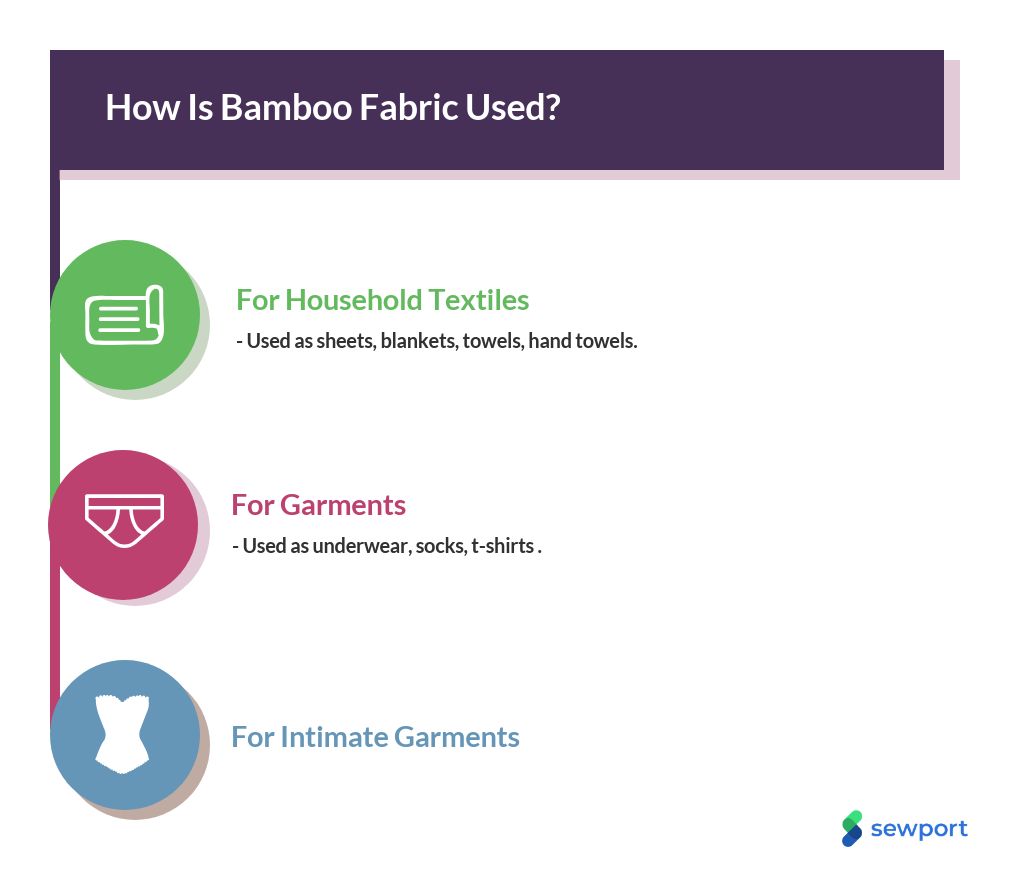
Bamboo-derived fabrics can be used in many applications also served by cotton, viscose, modal, or lyocell. Common examples include underwear, socks, T-shirts, tops, dresses, loungewear, sleepwear, baby textiles, towels, sheets, blankets, and wipes. Blends may be used to balance hand feel, strength, drying behavior, recovery, cost, and care performance.
For activewear, a soft bamboo-viscose blend may be comfortable, but it should not automatically be described as high-performance moisture-wicking fabric. Programs requiring stretch recovery, rapid drying, abrasion resistance, or repeated-wash stability should compare tested constructions, including appropriate synthetic or cellulosic blends.
Where Is Bamboo Fabric Produced?
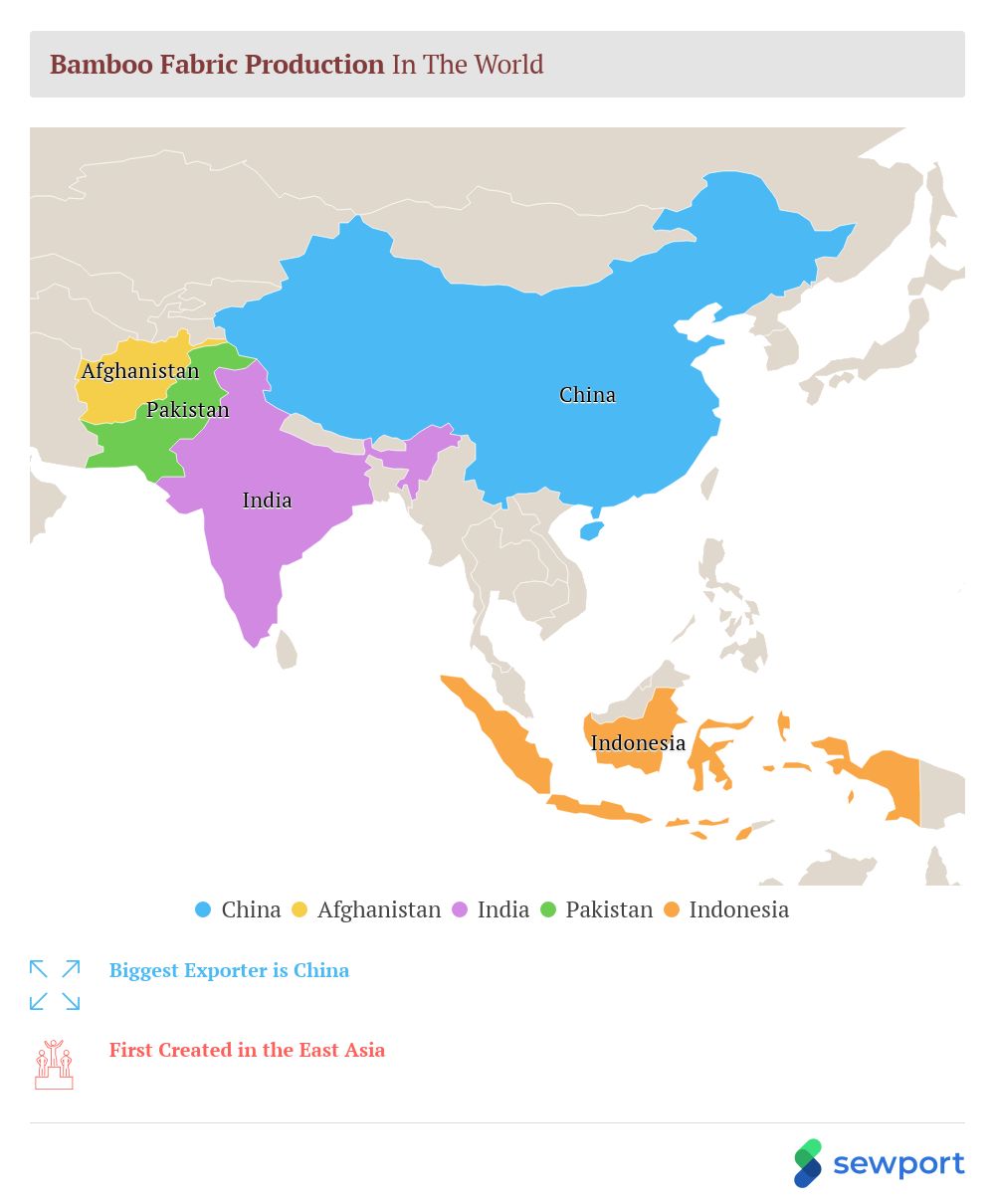
Bamboo and bamboo-derived textiles have long associations with East and South Asia. China is a major source of bamboo, pulp, regenerated cellulose fibers, yarns, and finished fabrics. India, Pakistan, Indonesia, and other countries also participate in bamboo cultivation or textile processing. A country-of-origin statement for the finished product cannot be inferred from the plant source alone; pulp, fiber, yarn, greige fabric, dyeing, finishing, and garment assembly may occur in different jurisdictions.
How Much Does Bamboo Fabric Cost?
There is no single bamboo-fabric price. Conventional bamboo viscose can be price-competitive with other regenerated cellulose fibers, while mechanically processed bamboo fiber is usually significantly more expensive. Quotation depends on fiber producer, blend, yarn count, knitting or weaving construction, GSM, usable width, dyeing route, finish, color quantity, minimum order, testing, certification scope, and delivery terms. Buyers should compare like-for-like specifications rather than a generic price per meter.

How to Source Bamboo Fabric: A Buyer Checklist
Before approving a quotation or bulk order, confirm the following in writing:
Exact generic fiber name and blend percentages—not only the commercial term “bamboo.”
Whether the cellulose source is bamboo and whether the route is viscose, lyocell-type, or mechanical processing.
Fiber, yarn, greige-fabric, dyeing, finishing, and finished-product origin where traceability is relevant.
GSM, usable width, yarn count, construction, shrinkage target, spirality or skew target, colorfastness, pilling, abrasion, bursting or tensile strength, and stretch/recovery requirements as applicable.
Care-label basis and dimensional-stability results after the intended wash and dry cycles.
Evidence supporting environmental, recycled, organic, antimicrobial, biodegradable, or chemical-management claims.
Destination-market fiber labeling, language, restricted-substance, documentation, and retailer requirements.
Pre-production sample, lab dip or strike-off, approved hand feel, bulk shade tolerance, inspection plan, and retained reference sample.
For a broader procurement workflow, use the FabricsTrades fabric quality-inspection guide to connect specifications, sampling, testing, bulk inspection, and corrective action.
Bamboo Fabric vs. Viscose, Lyocell, and Cotton
A buyer should compare fibers by verified generic identity and finished-fabric performance. Bamboo viscose is a type of viscose whose cellulose feedstock is bamboo; it is not a separate performance class merely because of the plant source. The FabricsTrades guide to viscose fabric and its production provides more detail on the regenerated-cellulose route.
| Material description | Practical distinction |
| Bamboo viscose/rayon | Regenerated cellulose made using bamboo as feedstock; usually soft and absorbent; conventional viscose chemistry and controls remain relevant |
| Bamboo lyocell-type fiber | Direct-solvent regenerated cellulose route; ask for producer and process evidence rather than relying on the name alone |
| Mechanically processed bamboo | Actual plant fiber separated mechanically; uncommon, generally coarser and more expensive |
| Cotton | Natural seed fiber; performance and impacts depend on variety, cultivation, spinning, fabric construction, dyeing, finishing, and use |
| Polyester or nylon blends | Can improve strength, drying, abrasion performance, or recovery; change fiber labeling, end-of-life profile, and testing needs |
Current Regulatory and Market Update
U.S. Labeling and Advertising
The U.S. Federal Trade Commission states that textiles can be called bamboo only when they are made directly from actual bamboo fiber. Rayon or viscose made using bamboo as the plant source should be labeled and advertised with the appropriate generic fiber name, such as “rayon made from bamboo” or “viscose made from bamboo.” The FTC also requires substantiation for claims such as retained antimicrobial properties. Buyers selling into the United States should review the FTC’s bamboo textiles guidance and confirm final labeling with qualified compliance personnel.
EU Fiber Information and Emerging Product Data
EU Regulation (EU) No 1007/2011 governs textile fiber names and related fiber-composition labeling. Buyers should verify that the generic fiber name used for a bamboo-derived regenerated fiber is permitted for the product and language market, rather than treating “bamboo” as a complete fiber-composition declaration.
The EU Ecodesign for Sustainable Products Regulation, Regulation (EU) 2024/1781, establishes a framework for product-specific ecodesign and Digital Product Passport requirements. Apparel textiles are a priority product group in the 2025–2030 working plan, but textile-specific requirements depend on future delegated acts. The FabricsTrades overview of ESPR and Digital Product Passports for Chinese fabric supply chains is useful related reading; buyers should still verify the current official scope and effective dates before bulk production.
In practical terms, bamboo-textile programs should retain reliable records for fiber identity, composition, supplier and production stages, chemical and test documentation, and the basis of environmental claims. Documentation needs vary by destination market, product category, treatment, production batch, retailer specification, and date of sale.

Sustainability: What Buyers Should Verify
Bamboo can grow quickly and may require fewer agricultural inputs in some contexts, but those characteristics do not determine the footprint of the finished textile. A credible evaluation considers land management, pulp sourcing, chemical recovery, worker exposure, wastewater, energy, dyeing and finishing, durability, transport, and end-of-life conditions.
Do not equate bio-based feedstock with low environmental impact.
Do not call a regenerated fiber organic merely because the bamboo crop was described as organic.
Confirm the scope, issuer, facility, product, transaction, and validity of any certificate or chain-of-custody claim.
Use precise claims, such as identified fiber content or verified process information, instead of broad “eco-friendly” or “green” language without qualification.
Where recycled or alternative materials are relevant, compare the project against the available recycled fabric options using the same performance and documentation criteria.
FabricsTrades’ recycled-fabrics category can be reviewed as a separate sourcing route; a recycled claim still requires product-specific evidence.

Frequently Asked Questions
Is bamboo fabric a natural fiber?
Usually not in the way consumers understand that term. Most commercial bamboo textiles are regenerated cellulose fibers such as viscose or rayon made from bamboo pulp; mechanically separated natural bamboo fiber is uncommon.
Is bamboo viscose the same as bamboo rayon?
In common commercial usage, both usually describe regenerated cellulose fiber made with bamboo as the cellulose source. The legally appropriate generic name and permitted wording depend on the destination market.
Is bamboo fabric antibacterial?
Do not assume that a property of the bamboo plant remains in a regenerated textile. Antimicrobial claims should be supported by reliable testing on the finished material and reviewed for the target market.
Is bamboo fabric more sustainable than cotton?
Not automatically. The comparison depends on cultivation, pulp and fiber process, chemical recovery, energy, dyeing, durability, transport, evidence quality, and the exact cotton system being compared.
Does bamboo fabric wick moisture?
Many regenerated-cellulose fabrics absorb moisture, but absorption is not the same as one-way wicking or quick drying. Test the finished construction when moisture management is a performance requirement.
Does bamboo fabric shrink?
It can. Shrinkage depends on fiber route, yarn, knit or weave, finishing, relaxation, and laundering. Approve dimensional-stability limits and test conditions before bulk production.
How should buyers label bamboo-derived textiles in the United States?
FTC guidance says rayon or viscose made with bamboo as the plant source should use the proper generic fiber name, such as “rayon made from bamboo,” unless there is evidence the textile is made directly from actual bamboo fiber.
What should a bamboo-fabric specification include?
Specify generic fiber content, blend, construction, GSM, usable width, color and finish, shrinkage, strength, pilling, colorfastness, stretch/recovery where relevant, care testing, claim evidence, and destination-market documentation.
Conclusion: Specify the Fiber, Not Just the Plant
Bamboo fabric can offer a soft hand, fluid drape, absorbency, and broad application potential, but “bamboo” alone is not a complete material specification. Determine whether the product is bamboo viscose, a lyocell-type regenerated fiber, mechanically processed bamboo, or a blend; then validate performance, care, labeling, and claims on the actual fabric.
Based in Wujiang District, Suzhou, FabricsTrades can help evaluate sourcing options, alternative constructions and blends, sampling, color development, testing coordination, and documentation requests. Availability and support should be confirmed against the final specification, destination market, and order requirements.
Sources