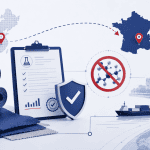
- New Sales Ban from Jan 2026: Maine’s expanded PFAS law (LD1537, Ch. 630, Apr 2024) outlaws any intentionally added PFAS in a wide range of products sold in Maine as of Jan 1, 2026. Covered goods include cleaning and cosmetic products, cookware, dental floss, juvenile items, menstrual products, textile articles (apparel, bedding, etc.), ski wax and upholstered furniture – basically all ordinary fabrics and treated textiles except certain outdoor gear.
- No PFAS “Safe” Threshold: The law bans PFAS outright (any intentional use is prohibited), so compliant fabrics must be truly PFAS-free (beyond trace levels from carry‑over). Brands cannot rely on a 100 ppm cut-off like in CA – even 1 ppm of intentionally added PFAS violates Maine’s rule. (In practice, laboratories test to ppb sensitivity under EN 17681-1:2025 or similar methods.)
- Compliance vs. Reality: Many Chinese mills claim “C0 DWR” or “PFAS-free” fabric, but in Shengze/Suzhou clusters this often fails lab testing. Shared stenter lines cause fluorotelomer carry‑over (residual PFAS from prior C6 runs redeposit onto “C0” fabric). Standard cleanings rarely remove the contamination, so even non-fluorinated finishes will exceed any strict fluorine limit unless mills invest in dedicated PFAS-free lines and rigorous cleaning protocols.
- Bottom‑Line Risk: Brands sourcing from China face direct legal risk. Finished goods containing PFAS cannot be sold in Maine, period. Likewise, if you import garments made in SE Asia from Chinese greige, Maine still cares about the chemistry in the finished article – PFAS in the fabric trigger the ban regardless of where sewing occurred. There’s no “gotcha” safe haven outside China: if your product contains PFAS and enters Maine, it’s subject to prohibition.
- Proactive Solution: Attack the problem with data, not declarations. Insist on accredited third‑party PFAS reports, proper Certificates of Compliance, and mill‑direct quality control. We recommend screening all incoming fabrics via a two‑tier protocol (initial total fluorine burn‐down screen, then full LC‑MS/MS PFAS analysis). Require suppliers to furnish SDS/TDS for all repellents, OEKO-TEX (Annex 6) certificates, and a signed PFAS-free CoC (e.g. CA AB 1817 style). If a mill can’t produce clean labs and paperwork, assume the fabrics are noncompliant.
Regulation At a Glance
| Effective Date | Threshold/Limit | Affected Products | Exemptions |
|---|---|---|---|
| Jan 1, 2023 | Any intentionally added PFAS banned | Carpets and rugs; fabric treatments | Resale of used goods; currently-unavoidable uses (CUUs) if DEP approves. |
| Jan 1, 2026 | Any intentionally added PFAS banned | Cleaning products; cookware; cosmetics; dental floss; juvenile items; menstruation products; textile articles (apparel, bedding, accessories); ski wax; upholstered furniture | Outdoor apparel for severe wet conditions may contain PFAS only if labeled “Made with PFAS chemicals” (allowed until 2028); products in PFAS‑containing containers are also covered; plus CUU exemptions (DEP may allow unavoidable uses). |
Note: Maine’s law covers “textile articles” broadly (ordinary apparel, home textiles, etc.). Single-use hygiene products and military/PPE uniforms are not considered textile articles. Products with only trace PFAS from packaging or containers are explicitly included in the ban.
Table of Contents
Toggle
What Changed in the Last 2 Years
- July 2021: Original Maine PFAS bill (LD 1503/Chapter 477) passed, requiring PFAS disclosure and banning carpets, rugs and fabric treatments with intentionally added PFAS. (That ban took effect Jan 1, 2023.)
- Jan 2023: Sales ban enforced on PFAS‑treated carpets/rugs and textile coatings. Maine also began requiring PFAS notification by manufacturers.
- April 2024: Maine’s legislature approved LD 1537 (Chapter 630), signed Apr 16, 2024. This law expands the PFAS ban to include textile articles, personal care products, cookware, etc. – all effective Jan 1, 2026. It also eliminated the planned general notification (reporting) requirement and added current‑use exemptions.
- Mid‑2025: Maine DEP drafted rules (Chapter 90) to implement the 2026 bans and CUU process; industry groups (e.g. Complex Products Manufacturers Coalition) submitted comments in Sept. 2025 focusing on how to handle multi‑component products.
- Jan 1, 2026: Expanded ban takes effect. From this date, any covered product sold in Maine may not contain intentionally added PFAS. (Meanwhile, other states are also moving: e.g. New York’s PFAS apparel ban took effect Jan 1, 2025, and Minnesota’s “Amara’s Law” banned similar categories Jan 1, 2025.)
Why This Matters for Chinese Fabric Suppliers
In our 20+ years in the Greater China textile clusters (Suzhou, Shengze, etc.), we’ve seen suppliers react in a rush to claim “PFAS‑free” finishes – but without the on‑floor controls to back it up. Many mills are now marketing “C0 DWR” (fluorine‑free) fabrics, but testing often tells a different story. The root problem is cross‑contamination in shared dyehouses: commission dyers frequently run fluorinated DWR and “PFAS‑free” treatments on the same stenter lines. During C6 stenter curing (150–180 °C), volatile fluorotelomer alcohols are driven out of the fabric and coat the equipment. When the next C0 fabric run is processed, those residues recondense on the clean textile.
Standard cleaning protocols simply don’t remove the PFAS film from ductwork and jackets, so even a top‑quality fluorine‑free finish ends up with a few hundred ppm total fluorine (enough to fail Maine/CA tests). In practice, mills report that achieving true PFAS compliance costs more than ink on a label: the more thorough flushing and isolation needed means ~15–20% higher processing costs and 2–3 extra lead‑time days. Many dyehouses simply skip these steps unless audited.
The bottom line: There is often a big gap between a Chinese mill’s assertion that a fabric is “PFAS-free” and what analytical labs find. Western brands must assume “PFAS-free” claims are suspect unless proven. A fabric batch can be contaminated by upstream sizing agents, shared machinery or even the resin binder of an inflatable membrane – any source that the local mill isn’t catching. Sourcing teams should treat every Sino‑made functional fabric as high‑risk: run independent PFAS tests, audit stenter hygiene, and don’t accept internal QC data alone.
Direct Impact on Textile Sourcing
5a. Finished Fabrics from China (Export Risk): If your brand buys finished fabrics from Chinese mills, understand that Maine will ban your fabric-based goods at the border if the materials contain PFAS. (A “fabric treatment” violation is a $5,000/day fine per item.) Even one non‑compliant component renders the whole product illegal to sell in Maine. Western buyers must lock down a full compliance package upfront. Don’t rely on a mill’s word – insist on actual lab reports per the latest standards and require suppliers to provide PFAS‑free declarations that reference those tests.
5b. “Third‑Country” Production Trap: Some brands try to dodge Chinese export rules by cutting and sewing fabrics in Vietnam, Bangladesh or elsewhere. Beware – Maine’s law is triggered by the final product’s chemistry, not the factory address. A jacket made in Vietnam with Chinese‑woven fabric still contains any PFAS from that fabric. Maine and similar laws attach to the article when sold in the state, regardless of where stitching happened. In other words, outsourcing assembly does not exempt you: if a fabric component fails a PFAS screen, the finished garment is banned. This “third country illusion” is a common trap. Western buyers must therefore control PFAS starting at the yarn or greige stage, not just at the CMT factory.
Compliance Evidence Package You Should Request
To prove PFAS compliance, a brand needs hard data – a suite of documents that cannot be faked. Key elements include:
- Independent PFAS Test Reports: Certified lab analyses showing no PFAS detected. Prefer labs accredited under ISO/IEC 17025 using modern methods (e.g. CEN EN 17681-1:2025 with alkaline hydrolysis and LC‑MS/MS). Reject tests done by the mill’s own lab or using outdated methods (the 2025 standard exposes many “hidden” PFAS that 2022 tests missed).
- Certificates of Compliance (CoC): Written declarations (often one per shipment) that the material contains no intentionally added PFAS. For example, California AB 1817 requires suppliers to give a PFAS‑free CoC to U.S. distributors – a useful model. The CoC should reference the specific test method and lab, and be signed by a senior technical contact at the mill. (Note: A CoC isn’t proof by itself, but a retailer is generally safe if it relied on an honest CoC.)
- OEKO‑TEX STANDARD 100 Certificate: A valid Oeko-Tex certificate (especially Annex 6/7 version) means the product was screened for PFAS and passed those limits. Oeko-Tex bans PFAS in its criteria, but does not certify “PFAS-free” – it only means tests were run (results not published). Still, an Oeko-Tex label is a baseline check. Ensure it’s the latest version with full RSL (Annex 6) rather than the stripped‑down version (Annex 4).
- Chemical SDS/TDS for All Repellents: Require the supplier to submit Safety Data Sheets and Technical Data Sheets for every durable water/stain repellent used (C0 alternatives, siloxanes, silicones, etc.). These documents show whether the formula is explicitly non-fluorinated. If a DWR uses a polymer like a fluorotelomer-based polyurethane, it will be listed on the SDS. This also provides ingredient names/CAS #’s for cross-checking.
- Membrane/Coating Disclosure: If the fabric has a functional coating or membrane (like PU, PVC, ePTFE), get written confirmation of the chemistry. For example, ask “Is this PU membrane 100% free of any fluoropolymer additives?” and document the answer. Any PTFE/ePTFE component is suspect (see FAQs below), so even if face-fabric is C0, hidden membrane PFAS can kill compliance.
- Chain‑of‑Custody & Mill Audit Records: Finally, document supply chain control. Good practices include a mill audit report verifying no PFAS source (e.g. no PFAS sorting in warehouse, no shared padding for PFAS chemicals) and lab chain‑of‑custody sheets for each test. Brands increasingly demand “paper trails” from raw material receipt through finishing. If the fabric uses recycled polyester or PU, get a chain-of-custody certificate for the recycling process – a stray PFAS from recycled inputs can contaminate otherwise clean processes.
How FabricsTrades Is Preparing
We treat the PFAS challenge as an engineering problem, not PR. Over the past 2 years we’ve doubled down on in‑house control and R&D:
- Strict Vendor Pre-Qualification: We only work with mills that agree to our “PFAS-Free Protocol.” All candidate mills undergo a preliminary audit of equipment usage (e.g. no PFAS across from C0 finishing lines) and must demonstrate they can keep C0 and C6 processes physically separated. Suppliers failing to pass initial testing or circuit checks are cut off.
- Guaranteed Third‑Party Testing: Every incoming batch from China is submitted to an independent lab for PFAS analysis before shipment. We use a two-tier system: first a Total Fluorine screen by combustion-ion chromatography (EN 14582 or ASTM D7359) to flag any fluorine >50 ppm. If any fluorine is found, we immediately do full-spectrum targeted PFAS analysis (EN 17681-1:2025 LC-MS/MS) to identify specific substances. We refuse self-declarations. This technical double-check aligns with Maine’s expectation of proof, and it mirrors our approach for EU PFAS limits (total organic fluorine, TOF) and California’s standards.
- Alternative Chemistry R&D: Fabric trades is investing heavily in C0 DWR and coating technology. For stretch/softshell fabrics, we’ve adapted new dendritic polyurethane finishes and bio-based repellents that achieve spray‑ratings up to ISO 4920 Grade 4 (similar to legacy C6). We also trial waterborne PU and silicone coatings for heavy canvas (backpacks/tents) to avoid any fluoropolymer binders. For each material class we develop, we compile performance data to ensure our PFAS-free options truly meet durability specs. (We publish these best practices internally and share them with our mills – for example, we’ve taught certain mills how to calibrate stenter tension for hyperbranched PU DWR.)
- Continuous Monitoring: Beyond initial tests, we’ve implemented ongoing QC. Every container we accept must come with a lot-specific lab report and traceable COA. If any deviations arise (e.g. unexpected TF result or supplier complaint), we immediately quarantine the lot and audit the supplier’s batch records. To keep ahead of changing rules, our in‑house compliance team tracks global PFAS proposals. We’ve already pre‑adapted to Denmark’s 50 ppm TOF standard and are ready to tighten if Maine ever sets a numeric threshold (so far, Maine has none).
In short, FabricsTrades treats PFAS compliance as an engineering spec: we require proof at every step, maintain factory‑direct control of finishes, and continuously innovate on alternative materials. Our goal is zero surprises.
FAQ about Maine LD 1503 (Western Buyers’ Top Questions)
- Q: “My supplier sent a lab report claiming ‘No PFAS detected.’ Can I take that at face value?”
A: Only if the lab is accredited and uses state‑of‑the‑art methods. Many mills use quick internal tests or outdated standards. In practice, we’ve seen plenty of “all-clear” supplier reports that later failed independent analysis. The safest approach is to verify with your own third‑party lab (and make sure they test for the newest PFAS restrictions). Never rely solely on a vendor’s in-house certificate. - Q: “If the technical data sheet says ‘fluorine-free finish’, does that mean PFAS-free?”
A: Not necessarily. “Fluorine-free” usually means the applied DWR chemistry contains no fluoropolymers. But fabric can still pick up PFAS elsewhere (e.g. contaminated stenter, dust, or a labeled thread). Always confirm with analysis. In our experience, some fabrics labeled “fluorine-free” have tested above regulatory limits because of residual PFAS in the mill environment. So treat that claim with caution unless accompanied by a clean lab report. - Q: “What about the ‘made with PFAS’ label on some outdoor jackets? Does Maine allow that?”
A: Under LD1537, outdoor apparel for severe wet conditions (e.g. rain shells) can contain PFAS only if they bear a clear “Made with PFAS chemicals” label. However, the label exception only delays the ban – Maine will phase that out in 2030 (or earlier) and currently requires a precise warning format. For most apparel and all household textiles, no PFAS at all are permitted as of 2026. - Q: “I have an OEKO-TEX Standard 100 certificate for my fabric. Is that enough to prove compliance?”
A: An OEKO‑TEX 100 certificate is a good baseline: it means the product was tested against Oeko-Tex’s limits, which explicitly ban PFAS. However, Oeko-Tex test results aren’t published on the cert. In practice, OEKO certs do test for common PFAS, but the only way to know your actual PFAS levels is to see the lab report. Many buyers require both – an OEKO cert and a recent PFAS analysis report. Don’t assume Oeko alone satisfies Maine; get the details. - Q: “Which PFAS test method should our lab use right now?”
A: For textiles, the new gold standard is CEN EN 17681‑1:2025 (alkaline hydrolysis + LC‑MS/MS). This can break down side‑chain fluoropolymers (the old C6 finishes) and detect the released FTOHs and carboxylates. Many Chinese labs still use legacy methods (2022 version) that miss bound PFAS. If you see an EN 17681-2022 report, reject it. Also consider total-fluorine combustion screening (EN 14582/ASTM D7359) as a first pass: below 50 ppm generally implies compliance with Maine (and upcoming US rules). Always use accredited labs with these methods – and insist on method details in the report. - Q: “My fabric has an ePTFE membrane inside. Do I need to worry?”
A: Yes. Expanded PTFE is 100% fluorine, so any ePTFE membrane in a textile is effectively PFAS. Maine’s law applies to textile articles, which would include garments with ePTFE layers. In other words, a high-performance Gore-Tex jacket is noncompliant unless the manufacturer confirms the membrane itself is PFAS‑free (currently there is no PFAS-free ePTFE replacement). Many brands have stopped using ePTFE for consumer goods for exactly this reason. - Q: “What’s the most common sourcing mistake brands make right now?”
A: Relying on verbal guarantees instead of data. We see buyers who say “we asked our mill and they said it’s all good” – but without records, that’s a recipe for disaster. Maine (and other regulators) will treat sales into the state as presumptions of violation if a product fails later. The safe strategy is “trust but verify”: always tie claims back to lab results and documented controls. As one compliance guideline bluntly warns, “supplier declaration only” is no longer a serious strategy.
Last Updated April 2026 — Written by the FabricsTrades Technical Compliance Team – Experts in High-Performance Stretch Fabrics and Global Regulatory Standards.