TL;DR
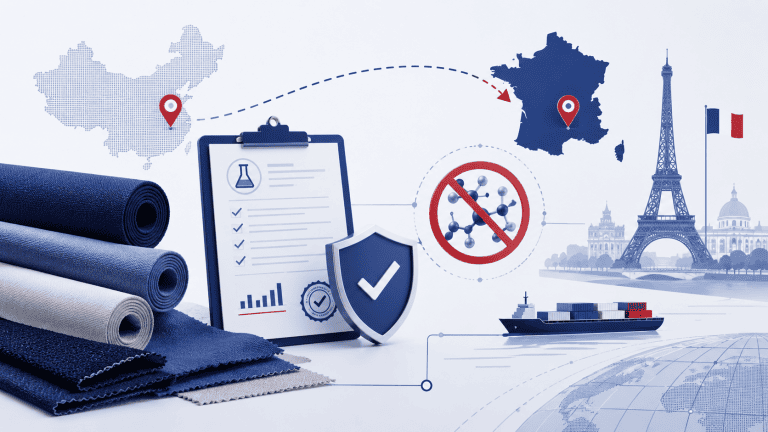
- France is not waiting for the EU. Law No. 2025-188 is already in force, and since 1 January 2026 France has banned PFAS-containing cosmetics, ski waxes, consumer clothing textiles, footwear, and waterproofing agents for those products. From 1 January 2030, the ban expands to all textile products, subject to narrow exemptions. [1]
- This is now a market-access issue, not a sustainability talking point. The French decree set residual thresholds at 25 ppb for any measured PFAS excluding polymers, 250 ppb for the sum of targeted PFAS excluding polymers, and 50 ppm for PFAS including polymers. That is low enough that lazy document packages and shared-line contamination can sink a shipment. [2]
- “Fluorine-free,” “C0,” “PFC-free,” and even an OEKO-TEX certificate are not the same thing as France-ready compliance. AFIRM and Inditex both warn that a product can be made without intentional PFAS use and still show detectable PFAS because of recycled inputs, fluoropolymer membranes, or cross-contamination in finishing. OEKO-TEX itself states it does not certify products as “PFAS-free.” [3]
- The real operational fix is boring and non-negotiable: locked chemical inventory, dedicated C0 finishing lines or aggressive decontamination, accredited third-party testing, and a chain-of-custody file that follows the article from yarn or greige through dyeing, finishing, lamination, and shipment. [4]
- Cutting in Vietnam does not wash out PFAS from Chinese inputs. France bans the import and placing on the market of covered PFAS-containing products, and the decree treats import as placing on the market. If Chinese shell, membrane, finish, or waterproofing chemistry is the source of the PFAS, the French risk still lands on the final article. [5]
Regulation at a glance
France’s framework matters because it combines a broad product ban with article-level residual thresholds and only limited exemptions. Western sourcing teams should treat it as a live compliance regime now, not as a future Brussels problem. [1]
Table of Contents
Toggle| Effective Date | Threshold or Limit | Affected Products | Exemptions |
| 1 January 2026 | Residual thresholds under the decree: 25 ppb for any measured PFAS excluding polymers; 250 ppb for the sum of targeted PFAS excluding polymers; 50 ppm for PFAS including polymers. If total fluorine exceeds 50 mg F/kg, authorities may require proof whether the fluorine comes from PFAS or non-PFAS substances. | Cosmetics, ski waxes, consumer clothing textiles, footwear, and waterproofing agents for consumer clothing textiles and footwear. | PPE under EU Regulation 2016/425; PPE and combat/protection equipment for armed forces, internal security, and civil security; re-waterproofing agents for those PPE; and clothing/footwear incorporating at least 20% post-consumer recycled material, where any residual PFAS must be limited proportionally to the recycled fraction. |
| 1 January 2026 through 31 December 2026 | Transitional stock clearance only. | Products in the 2026 scope that were manufactured before 1 January 2026. | They may still be placed on the market or exported for up to 12 months from 1 January 2026. |
| 1 January 2030 | Same residual-threshold structure applies. | All textile products containing PFAS, including categories beyond clothing and footwear. | Industrial technical textiles; essential-use products with no substitute; products contributing to national sovereignty; specified PPE and defense/civil-security equipment; certain medical sanitary textiles; and the same ≥20% post-consumer recycled clothing/footwear carve-out with proportional residual allowance. |
Source: French Law No. 2025-188, Decree No. 2025-1376, and the French Ministry of Economy explainer. [1]
What changed in the last 2 years
The short version: France moved from PFAS policy talk to an enforceable product-ban architecture faster than most sourcing teams expected. At the same time, the EU’s broader PFAS restriction is still moving through the REACH machinery, which is why French national law now matters so much for textiles. [6]
- January 2024: France published its national PFAS action plan, setting the policy direction toward reduction, monitoring, substitution, and stronger controls. [7]
- February 2025: France enacted Law No. 2025-188, creating the legal basis for phased bans on PFAS-containing products and writing the 2026 and 2030 textile dates into law. [8]
- August to September 2025: The government ran a public consultation on the implementing decree, making clear that it would define the residual concentration values and exemption list for the bans. [9]
- December 2025: Decree No. 2025-1376 was published, fixing the residual thresholds, spelling out exemptions, and granting only a 12-month sell-through for products made before 2026. [2]
- From January 2026: The French ban is operational, while the EU still has the broader all-PFAS restriction in proposal and committee stages under REACH. In parallel, the European Commission continues to frame consumer textiles and footwear as uses where alternatives exist. [10]
My blunt read: if your sourcing policy is still anchored to “we’ll fully move once the EU-wide rule lands,” you are already late for France. Paris has made PFAS a national import-and-market-access issue today. [11]
Why this matters for Chinese fabric suppliers
Shengze and greater Wujiang are not small specialist pockets. Official local figures describe Shengze as one of the world’s largest weaving bases, with more than 2,500 textile enterprises, over 7,000 trade companies, annual textile production capacity of 13 billion meters, and annual printing and dyeing capacity of 3.8 billion meters. That scale is the cluster’s advantage, but it also creates the exact traceability problem Western buyers keep underestimating: a single “supplier” may be coordinating spinning, weaving, dyeing, finishing, lamination, and shipment across multiple subcontractors. [12]
On the ground, the reaction is pragmatic rather than ideological. China-based trade events and suppliers are already leaning hard into PFAS-free and fluorine-free positioning: Intertextile Shanghai promoted PFAS-related compliance sessions in 2026, Microban China showcased PFAS-free finishing systems at Intertextile Shanghai in 2025, and suppliers tied to the Suzhou ecosystem are openly marketing fluorine-free waterproof solutions. That does not prove that the cluster is “solved.” It proves the export market has started pulling the cluster in that direction. [13]
The problem is the gap between saying compliant and testing compliant. AFIRM states that “no intentional use of PFAS” still allows residual PFAS to be detected from contaminated material streams, recycled content, or other contamination sources, while Inditex warns that facilities using PFAS chemistry for some clients create a high cross-contamination risk for supposedly PFAS-free orders. Both organizations go further and recommend dedicated PFAS-free production lines, or at minimum aggressive cleaning and segregation of padding and stenter equipment. [14]
That is the Suzhou/Shengze reality Western buyers need to absorb. A merchant can hand you a fresh TDS for a fluorine-free DWR, a GRS story, and an OEKO-TEX certificate. None of that proves the exact bulk lot on the exact stenter hit France’s residual thresholds. The only thing that proves it is article-relevant documentation plus testing. [15]
Direct impact on consumer apparel and footwear sourcing
The key legal point is simple: France is regulating products containing PFAS, and the law covers manufacture, import, export, and placing on the market. The decree also defines import as placing on the market. So the compliance question is not where your vendor sits. It is whether the article entering France falls in scope and exceeds the residual limits. [5]
For brands sourcing finished fabric from China
Here is the nuance many teams miss: the 2026 French ban is not yet a blanket ban on every textile roll. In 2026, the textile scope is focused on consumer clothing textiles, footwear, and their waterproofing agents. If you are purchasing finished shell fabric, lining, coated fabric, or laminated fabric from China for garments or footwear that will end up on the French market, the article-level risk is immediate. If you are importing B2B roll goods into France for industrial use, the legal picture is narrower in 2026, but the commercial risk is already real because your French customer will want France-ready fabric now and the 2030 ban will catch all textile products anyway. [16]
The highest-risk fabric briefs are the obvious ones: rainwear shells, softshells, stain-resistant schoolwear, coated fashion outerwear, membrane-backed activewear, and waterproof footwear uppers. If the performance brief still relies on legacy fluorinated DWR, fluoropolymer membranes, or ambiguous “waterproof / stain resistant” chemistry, you should assume a PFAS exposure until proven otherwise. AFIRM makes the same practical point: if a material claims water repellency, oil repellency, stain resistance, quick-dry, or breathable membrane performance, there is a high probability PFAS is somewhere in the construction unless the supplier can show otherwise. [17]
A second mistake is treating “fluorine-free” as a legal answer. It is a formulation clue, not a compliance result. Inditex explicitly notes that “PFC free” does not mean the chemical product or article is PFAS free, and AFIRM warns against using “free” claims loosely for exactly that reason. For French market access, you need the batch-level test result and document trail, not the sales pitch. [18]
For brands manufacturing in South East Asia using Chinese greige or yarn
This is the classic third-country compliance trap. Brands move garment assembly to Vietnam or Bangladesh and assume the French problem has become a Vietnam or Bangladesh problem. It has not. France bans the import and placing on the market of covered PFAS-containing products, and import is treated as placing on the market. So if the final article shipped into France contains PFAS above the French thresholds, the legal exposure remains, no matter where cutting, sewing, or final packing happened. [5]
In practice, the PFAS source may sit upstream in China even if final assembly is in SE Asia: pre-finished shell fabric, fluorinated membrane, coating system, seam component chemistry, or even residual contamination from recycled inputs moving through the chain. AFIRM and Inditex both stress that contamination can survive even where there was no intentional PFAS use in the final facility, which is exactly why country-of-origin changes do not give buyers a chemistry safe harbor. [19]
This is where document control usually collapses. The Chinese mill says the Vietnamese garment factory added the finish. The Vietnamese factory says the Chinese shell already carried the chemistry. The trader says the fabric was “C0.” France will not care about that blame triangle. Western brands should therefore require a single compliance file that starts with the Chinese greige or shell source and follows the product through dyeing, finishing, lamination, and export. If you are relying on recycled content claims anywhere in that route, keep the GRS or RCS chain-of-custody package separate from the PFAS evidence package, because they answer different questions. [20]
Compliance evidence package you should request
If I were writing the vendor manual for a France-facing fabric or garment program, I would require the following package before bulk approval. Anything less is a negotiation with luck. The legal and test-method backbone comes from the French law and decree, ISO/IEC 17025 laboratory competence requirements, current textile PFAS test standards, OEKO-TEX guidance, and Textile Exchange chain-of-custody rules. [21]
- A signed “no intentionally added PFAS” declaration covering finish, coating, membrane, lamination, foam, waterproofing agent, and any aftermarket care chemistry used on the article. The declaration should also state whether PTFE or any other fluoropolymer membrane is present. AFIRM and Inditex both treat membranes as a core PFAS risk area. [19]
- A full chemical disclosure pack for the wet finish: current SDS, TDS, commercial name, manufacturer, and confirmation that the approved chemistry is the same one used in bulk. This should include the DWR, coating, print paste, and any water- or stain-repellent auxiliary. Inditex explicitly recommends revising chemical products used for repellency and screening them for fluorine. [22]
- Third-party PFAS test reports from an ISO/IEC 17025-accredited laboratory, not just your supplier’s internal lab. ISO describes ISO/IEC 17025 as the competence standard for testing laboratories, and ILAC provides the global accreditation framework buyers use to verify recognized labs. [23]
- For textile components, a targeted PFAS report using EN 17681-1:2025 with the analyte list, reporting limits, sample description, batch identification, and sampling date. SGS notes that EN 17681-1:2025 replaced the 2022 version, and the standard is specifically designed for PFAS determination in textile materials using LC-MS/MS with alkaline extraction. [24]
- For leather components, a report using EN ISO 23702-1:2023. ISO states that this method is for detection and quantification of extractable non-volatile PFAS in leather and coated leather. For full footwear, ask the lab to document its component-by-component method choice, since the dedicated ISO footwear PFAS method is still under development. [25]
- A total fluorine screening report, ideally using EN 14582:2016 or ASTM D7359-23, because Inditex states that no single method currently covers all international PFAS regimes and recommends combining targeted PFAS analysis with total fluorine screening for textile materials. This matters because France’s decree also contains a proof trigger when total fluorine exceeds 50 mg F/kg. [26]
- A valid OEKO-TEX STANDARD 100 certificate showing whether it is under Annex 4 or Annex 6 and proving the exact article or component is in scope. Annex 6 is stricter than Annex 4, but OEKO-TEX itself says STANDARD 100 does not certify a product as “PFAS-free.” Use it as supporting evidence, not as a legal safe harbor. [27]
- If recycled content is claimed, request both the GRS scope certificate and the relevant transaction certificates. Textile Exchange says TCs verify that the concrete goods shipped conform to the standard and list shipment details matching invoices and shipping documents. That is valuable for traceability, but it does not replace PFAS testing. [20]
- A subcontractor and chain-of-custody map naming the spinner, weaver or knitter, dyer, finisher, laminator, printer, and garment plant, plus any outsourced waterproofing or membrane supplier. For recycled goods, use the same detail level you would expect from a Textile Exchange TC. For PFAS review, this map helps identify where shared-line contamination can occur. [28]
- Factory segregation evidence for C0 or PFAS-free programs: dedicated stenter and padding line where possible, cleaning SOPs, accessory segregation, stenter-exhaust maintenance logs, and retained-sample controls. AFIRM and Inditex both recommend dedicated lines or exhaustive cleaning where PFAS and non-PFAS production coexist. [29]
How FabricsTrades is preparing
Based on FabricsTrades’ published materials, the company presents itself as a Wujiang-based, GRS-certified manufacturer focused on stretch and sustainable fabrics, with its factory and office in Jiangsu and a stated product focus that includes 4-way stretch and recycled fabrics. In its compliance-facing articles, it also argues that PFAS control now has to be designed into the production architecture, not handled as an afterthought at shipment stage. [30]
The part of that positioning that makes operational sense is the emphasis on factory-direct control and segregated fluorine-free processing. FabricsTrades says it is pushing dedicated C0 stenter lines, batch-level screening, and stronger line separation to reduce shared-machine contamination. That matches the practical direction of AFIRM and Inditex, both of which recommend dedicated PFAS-free lines or thorough decontamination of padding and stenter systems if PFAS chemistry is used elsewhere in the facility. [31]
On the R&D side, the smarter argument is not “C0 performs exactly like legacy fluorochemicals in every application.” That is usually not true, especially where oil repellency is part of the spec. The smarter argument is that commercially viable fluorine-free systems now exist for many textile applications, and they need to be matched to realistic performance requirements. RUDOLF describes BIONIC-FINISH® ECO as a fluorine-free technology for rain and water-based stain protection with strong laundering resistance, and also notes that the newer EN 17681-1:2025 method is better at exposing polymer-derived PFAS and cross-contamination. That is the right development mindset for stretch fabrics: redesign the spec, the finish, and the verification together. [32]
For 4-way stretch specifically, the commercially sane route is usually C0 water repellency plus realistic end-use engineering. That may mean accepting that a commuter shell, yoga jacket, or light outdoor woven can be France-ready with high water repellency and clean documentation, while heavy oil-repellent or chemical-splash applications may need a different textile architecture, different market targeting, or an exempt technical route. France’s law leaves room for certain PPE, industrial technical textiles, and essential-use categories. Consumer fashion and activewear do not get that comfort blanket. [33]
FAQ about France PFAS Ban
Can I trust a supplier’s internal lab report for French PFAS compliance?
Not as your release decision. Internal labs are useful for routine physical QC, shade control, or process monitoring, but French PFAS sign-off should sit on accredited third-party testing. ISO/IEC 17025 is the benchmark for laboratory competence, and buyers can cross-check recognized accreditation frameworks through ILAC. [23]
Does “fluorine-free” always mean PFAS-free?
No. It usually describes the intended chemistry of the finish, not the verified analytical outcome of the article. AFIRM and Inditex both warn that products with no intentional PFAS use can still show PFAS due to contamination, recycled inputs, or fluoropolymer components. [19]
Does an OEKO-TEX Annex 6 certificate guarantee France compliance?
No. Annex 6 is stricter than Annex 4 and is useful, but OEKO-TEX says STANDARD 100 does not certify a product as “PFAS-free.” It is supporting evidence, not a substitute for France-specific PFAS testing and document control. [27]
If my garment is sewn in Vietnam using Chinese shell fabric, does France still care about the Chinese inputs?
Absolutely. France regulates import and placing on the market of covered PFAS-containing products, and the decree treats import as placing on the market. The country where sewing happened does not neutralize PFAS in upstream Chinese fabric, membrane, or finish chemistry. [5]
Are PTFE or other fluoropolymer membranes still a problem if targeted PFAS are low?
Yes. France’s decree includes a 50 ppm threshold for PFAS including polymers, and when total fluorine exceeds 50 mg F/kg authorities can ask for proof of the fluorine source. Inditex also flags PTFE and other fluoropolymer membranes as a detection risk in final articles. [34]
Can I use the recycled-content exemption as a blanket workaround?
No. The French decree’s recycled carve-out is narrow. It applies to clothing and footwear with at least 20% post-consumer recycled content, and the admissible residual PFAS must be limited proportionally to that recycled fraction. Separately, GRS or RCS transaction certificates only verify recycled-content chain of custody; they do not prove PFAS compliance. [35]
Are raw fabric rolls already banned in France in 2026?
Not across the board. The 2026 textile ban is aimed at consumer clothing textiles, footwear, and related waterproofing agents. The wider ban on all textile products starts in 2030. But any fabric intended for garments or footwear sold into France should be engineered and documented now as if that article-level check will happen, because your commercial customer will act before the regulator does. [16]
Last Updated: April 2026
Written by the FabricsTrades Technical Compliance Team – Experts in High-Performance Stretch Fabrics and Global Regulatory Standards.