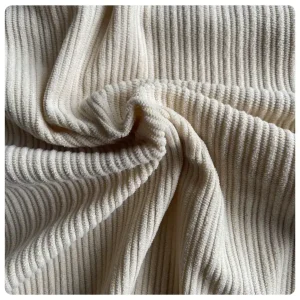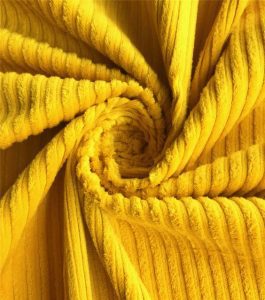
Tissu velours côtelé
- Fabriqué à partir de polyester, nylon et cotons recyclés
- Délai de livraison plus court
- Des prix intéressants
Custom Made Corduroy Fabric in Bulk at Wholesale Price from Manufacturers
Custom-Made Corduroy Fabric in Bulk at Wholesale Prices
Wholesale Corduroy Fabric
Corduroy is a durable woven pile fabric recognized by its raised, parallel ridges, known as wales. Traditional corduroy is usually made with cotton, while contemporary constructions can also use polyester-and-cotton blends, full polyester, wool, nylon, spandex, and recycled fibers.
The wale count, fiber composition, fabric weight, dyeing method, and finishing process determine the material’s appearance, hand feel, warmth, flexibility, and end use. Fine pinwale corduroy creates a refined surface suitable for shirts and tailored garments, while wide-wale and elephant cord constructions provide a heavier, more pronounced texture for outerwear, workwear, bags, and upholstery.
What Is Corduroy Fabric?
Corduroy is produced by weaving additional pile yarns into a base fabric and then cutting and brushing the pile to form its characteristic vertical cords. These raised wales create a soft, dimensional surface while increasing the fabric’s perceived weight and insulation.
The material developed from fustian, an Egyptian fabric dating to approximately 200 AD. Modern corduroy emerged in England during the 18th century and became widely used across British society. Although velvet later displaced it as a fashionable fabric, corduroy returned to prominence during World War I and experienced another major revival in the 1970s.
Today, corduroy remains relevant because it combines recognizable texture, durability, warmth, comfort, and broad design versatility.
Règlement sur les tissus 2024-2026 & Mise à jour de conformité
Corduroy is not automatically compliant or non-compliant based on its weave. Compliance depends on the complete article, including fiber claims, dyes, finishing agents, coatings, prints, trims, and documented supply-chain history.
Under the EU Ecodesign for Sustainable Products Regulation, textiles are being prioritized for product-level sustainability and traceability requirements. Brands sourcing corduroy for the EU should begin organizing verifiable data for composition, recycled-content claims, production stages, chemical information, and chain of custody. These records will support future Digital Product Passport requirements and help buyers substantiate environmental claims. See: https://fabricstrades.com/insight/espr-and-digital-product-passport-for-chinese-fabric-supply-chains/
The broader 2024-2026 compliance landscape also increases scrutiny of PFAS, restricted substances, traceability, and environmental and human-rights due diligence. Standard corduroy does not require a fluorinated finish, but coated, stain-resistant, oil-repellent, or water-resistant developments may create additional PFAS risk. Buyers should therefore define the destination market and end use before production and request testing that matches the finished fabric and applicable regulation. See: https://fabricstrades.com/insight/fabric-regulations-of-the-20242026-global-textile-compliance/
Compliance should be confirmed against the buyer’s specification and current destination-market requirements. A composition statement, “recycled” claim, or “fluorine-free” declaration alone does not replace batch-linked documentation and appropriate third-party testing.
Pourquoi nous choisir
Strategic Location in Suzhou’s Textile Hub
Located in Wujiang District, Suzhou, FabricsTrades operates at the center of one of the world’s most concentrated textile manufacturing hubs. Our proximity to specialized weaving, dyeing, brushing, printing, coating, and finishing factories gives buyers access to a broader range of corduroy constructions and production capabilities.Manufacturer and Strategic Sourcing Partner
We own a 4-way stretch fabric factory, but our capabilities are not limited to our own looms. We also work as a strategic sourcing partner, coordinating with specialized mills to identify or develop the corduroy fabric required for each project. If a fabric exists, we can help you find it. If it does not, we can help develop it.Custom Corduroy Development
We can coordinate corduroy development according to your required:- Composition des fibres
- Poids du tissu et largeur utile
- Wale count and pile height
- Color and dyeing method
- Hand feel and wash effect
- Stretch performance
- Surface and functional finishing
- End-use and compliance requirements
Diverse Material Sourcing
Our sourcing network supports corduroy made from recycled polyester, nylon and cottons, subject to the selected construction, order requirements, and availability.Faster Supply-Chain Coordination
Being close to a concentrated textile supply chain helps us coordinate sampling, greige fabric sourcing, dyeing, finishing, testing, and bulk production more efficiently—supporting shorter lead times.Prix de gros compétitifs
Our direct connection with manufacturers and specialized processing partners enables us to match each order with an appropriate production route, helping buyers obtain competitive wholesale prices without being restricted to a single mill’s equipment.Support technique axé sur les applications
We help buyers select suitable corduroy based on the finished product—not simply by appearance. Wale count, composition, weight, stretch, pile direction, abrasion performance, wash effect, and finishing can be evaluated for applications such as apparel, workwear, accessories, children’s wear, upholstery, and interior products.Approvisionnement soucieux de la conformité
For regulated markets, we can align development with the buyer’s specified testing, traceability, recycled-content documentation, and restricted-substance requirements. Compliance must be confirmed for the selected fabric, finish, production batch, destination market, and end use.

Corduroy Fabric Applications and Modern Use Cases
Fashion and Lifestyle Apparel
Corduroy remains a strong choice for trousers, overalls, skirts, dresses, shirts, overshirts, jackets, waistcoats, and coordinated suits. Pinwale constructions support cleaner tailoring and lightweight layering, while standard and wide-wale qualities create more visible texture for autumn and winter collections. Modern applications include cropped trucker jackets, chore coats, relaxed pleated trousers, utility overshirts, shackets, women’s co-ords, children’s dungarees, maternity garments, and gender-neutral capsule wardrobes.Vêtements de travail et vêtements utilitaires
The fabric’s durability and substantial hand make it suitable for carpenter trousers, workshop jackets, aprons, reinforced overshirts, heritage uniforms, hospitality garments, and fashion-led utility wear. Stretch corduroy can improve mobility in fitted work trousers and uniforms that require repeated bending or seated movement. For hard-wearing designs, developers should consider wale abrasion, seam slippage, pile flattening at pressure points, and directional cutting during garment engineering.Tailoring and Smart-Casual Collections
Fine-wale corduroy can be used for softly constructed blazers, suits, waistcoats, tailored trousers, A-line skirts, and business-casual separates. Its matte pile adds depth without the high sheen of velvet, making it suitable for textured professional wardrobes and premium cold-season collections.Children’s and Baby Clothing
Soft pinwale and standard corduroy can be developed into dungarees, pinafores, elastic-waist trousers, jackets, skirts, hats, and coordinated sets. Product development for children should prioritize a soft finish, secure trims, dimensional stability, colorfastness, and compliance testing appropriate to the destination market.Accessories and Footwear Components
Corduroy can provide a tactile face fabric for bucket hats, caps, tote bags, backpacks, pouches, laptop sleeves, cosmetic bags, footwear uppers, and decorative panels. Wide wales deliver a bold casual appearance, while pinwale corduroy supports smaller accessories and detailed pattern pieces.Upholstery and Interior Products
Corduroy is used for chairs, couch coverings, ottomans, headboards, bench seating, decorative cushions, floor cushions, curtains, and soft acoustic décor. Upholstery developments should be evaluated for abrasion resistance, seam performance, pile recovery, colorfastness to rubbing, and cleaning requirements.Contemporary Niche Applications
Corduroy can also be adapted for pet beds and carriers, stroller accessories, padded electronics cases, camera bags, notebook covers, retail display panels, seasonal packaging, camper-van cushions, boutique hotel accents, and limited-edition lifestyle collaborations.Types of Corduroy Fabric
Standard Corduroy
Standard corduroy typically has 11 wales per inch, although constructions ranging from 8 to 13 wales per inch are generally classified as standard. It provides a balanced texture suitable for trousers, jackets, overshirts, skirts, children’s clothing, and soft furnishings.Elephant Cord
Elephant cord features exceptionally large, thick ridges reminiscent of the folds in an elephant’s skin. It generally has between 1.5 and 6 wales per inch. Its bold surface works well for statement outerwear, heavy trousers, utility garments, structured bags, cushions, and upholstery.Pinwale Corduroy
Pinwale corduroy has very fine, closely spaced ridges and can contain up to 21 wales per inch. Its smoother, more refined appearance makes it appropriate for shirts, dresses, lightweight trousers, tailored separates, children’s wear, accessories, and detailed garment panels.Pigment-Dyed Corduroy
Pigment-dyed corduroy develops a mottled, lived-in appearance that becomes more distinct through washing. Designers frequently select it for vintage-inspired jackets, casual trousers, overshirts, workwear capsules, garment-dyed collections, and washed lifestyle products.Spandex Corduroy
Spandex corduroy combines cotton, polyester-blend or wool fibers with spandex to create a stretchable construction. It is particularly useful for fitted trousers, slim-cut jackets, skirts, children’s garments, mobility-focused uniforms, and contemporary workwear requiring improved freedom of movement.Bedford Cord
Bedford cord has a weave similar to corduroy but uses uncut pile yarns, producing less prominent ridges. Its firm structure and restrained texture make it suitable for uniforms, workwear, tailored garments, bags, furnishings, and other applications requiring a robust ribbed surface.Corduroy Fabric Properties
Distinctive Texture
Corduroy’s raised vertical cords run along the fabric length and may range from fine, narrow wales to broad, highly visible ridges. Wale selection influences visual scale, surface softness, drape, seam behavior, and the amount of texture visible in the finished product.Durabilité
The density and strength of the woven construction help corduroy withstand repeated wear. This makes it a practical choice for frequently worn clothing and home-furnishing applications exposed to regular handling.Chaleur
Corduroy is a relatively thick and heavy fabric. Its raised ridges trap warm air between the fibers, providing insulation and making the material especially suitable for cool-weather clothing and seasonal interiors.Confort
The raised pile creates a soft, plush surface. Corduroy also has a degree of natural give, while spandex constructions provide additional flexibility for close-fitting garments and products requiring greater mobility.Versatilité
Corduroy can be used across apparel, accessories, upholstery, drapery, and decorative products. Designers can adjust the wale count, fiber composition, color, wash, weight, and finish to create anything from refined pinwale shirts to rugged wide-wale jackets or tactile furnishing fabrics.How Corduroy Fabric Is
Manufactured
1. Fiber and Yarn Selection
Corduroy can be made from cotton, wool, synthetic fibers, or blended yarn systems. Raw-material selection is based on the required texture, strength, warmth, appearance, durability, and target price.2. Tissage
The yarns are interlaced on a specialized loom to create the fabric’s pile structure. Additional yarn floats are incorporated into the construction and subsequently developed into ridges. Closely spaced ridges produce narrow-wale corduroy, while wider spacing creates broad, more pronounced wales.3. Pile Cutting and Brushing
The pile floats are cut to open the cords. Brushing separates and raises the pile, helping create the soft, uniform surface associated with finished corduroy. Careful pile development is important because uneven cutting or brushing can cause irregular wales and visible shading.4. Teinture
Corduroy may be piece-dyed, pigment-dyed, garment-dyed, or left in its natural color, depending on the desired appearance. Because the pile can reflect light differently when viewed from opposite directions, shade evaluation and nap direction should be controlled during sampling and bulk production.5. Finition
Finishing may include brushing for softness, singeing to remove loose fibers, napping to create a plusher surface, pre-washing for a softer or more vintage character, and coating when additional water resistance is required. The exact manufacturing route varies according to the fiber composition and intended end product.Corduroy Design and Production Considerations
Corduroy has a visible nap direction. All garment panels should normally be cut in the same direction to prevent inconsistent shading in the finished product. Reversing one panel can make it appear lighter or darker even when it comes from the same dye lot. Wale count should be matched to product scale. Pinwale corduroy supports fine seams and small pattern pieces, whereas wide-wale constructions are better suited to larger panels where the texture can remain visually balanced. Pile compression should be considered when specifying trousers, seating surfaces, elbows, cuffs, collars, and other high-contact areas. Wash trials and wear testing can help evaluate pile flattening, shrinkage, twisting, shade change, and surface appearance before bulk approval.Corduroy Fabric Sourcing in Wujiang, Suzhou
FabricsTrades is located in the heart of Wujiang District, Suzhou, at the center of one of the world’s most concentrated textile manufacturing hubs. We own a 4-way stretch fabric factory and also operate as a strategic sourcing partner for buyers who need capabilities beyond a single mill. While many manufacturers are limited to their own looms, our proximity to thousands of specialized weaving, dyeing, printing, brushing, coating, and finishing factories expands the range of constructions we can source and develop. If a corduroy fabric exists, we can help find the appropriate supply route. If an existing quality does not meet the project brief, we can coordinate development around the required fiber composition, wale count, weight, color, hand feel, stretch, wash effect, and finishing process. For accurate sourcing, buyers should provide a physical swatch or clear technical brief covering the intended application, composition, target weight, usable width, wale count, color standard, performance requirements, testing protocol, order quantity, and destination market.Avantages
- Fabriqué à partir de polyester, nylon et cotons recyclés
- Délai de livraison plus court
- Des prix intéressants
Foire aux questions
What information should I provide when requesting a corduroy quotation?
Provide the desired composition, weight, usable width, wale count, color, stretch requirement, finish, end use, order quantity, testing standard, and delivery destination. A physical reference swatch is especially useful when pile height, softness, density, and wash appearance must be matched.What is the difference between pinwale and wide-wale corduroy?
Pinwale corduroy has many fine ridges per inch and offers a smoother, more refined appearance. Wide-wale corduroy has fewer, larger ridges that create a bolder texture and heavier visual character. Pinwale is commonly selected for shirts, dresses, tailored garments, and children’s wear, while wider wales work well for jackets, trousers, bags, cushions, and upholstery.Can FabricsTrades source recycled corduroy?
FabricsTrades supplies fabrics made from recycled polyester, nylon and cottons. The exact composition, construction, certification availability, minimum quantity, and production route should be confirmed for each inquiry. Where a recycled-content claim is required, buyers should specify the necessary chain-of-custody and transaction documentation before sampling.Is stretch corduroy suitable for fitted garments?
Spandex corduroy is designed to provide more flexibility than conventional non-stretch constructions. It can be used for fitted trousers, skirts, jackets, children’s clothing, and mobility-focused uniforms. Stretch performance should be verified through the agreed construction and testing requirements because recovery and dimensional stability depend on the fiber blend and fabric structure.Can corduroy be developed with water- or stain-resistant finishing?
Some corduroy fabrics may be coated or otherwise finished to improve water resistance. However, the treatment can affect the pile, color, hand feel, breathability, and regulatory profile. Buyers should specify the required performance level and destination market so the finish can be evaluated for both technical suitability and chemical compliance.What compliance documents should buyers request for corduroy?
Requirements vary by market and end use, but buyers may need a fiber-composition declaration, restricted-substance test reports, colorfastness and physical-performance results, recycled-content documentation where applicable, and batch-level production records. Products sold into the EU may also require increasingly detailed traceability data in preparation for ESPR and Digital Product Passport obligations.