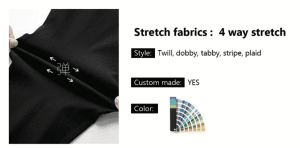
Tissu extensible dans 4 directions
- Fabriqué à partir de polyester, nylon et cotons recyclés
- Délai de livraison plus court
- Des prix intéressants
Tissu extensible 4 directions sur mesure en vrac au prix de gros auprès des fabricants
- En savoir plus
- En savoir plus
- En savoir plus
- En savoir plus
-
En savoir plus
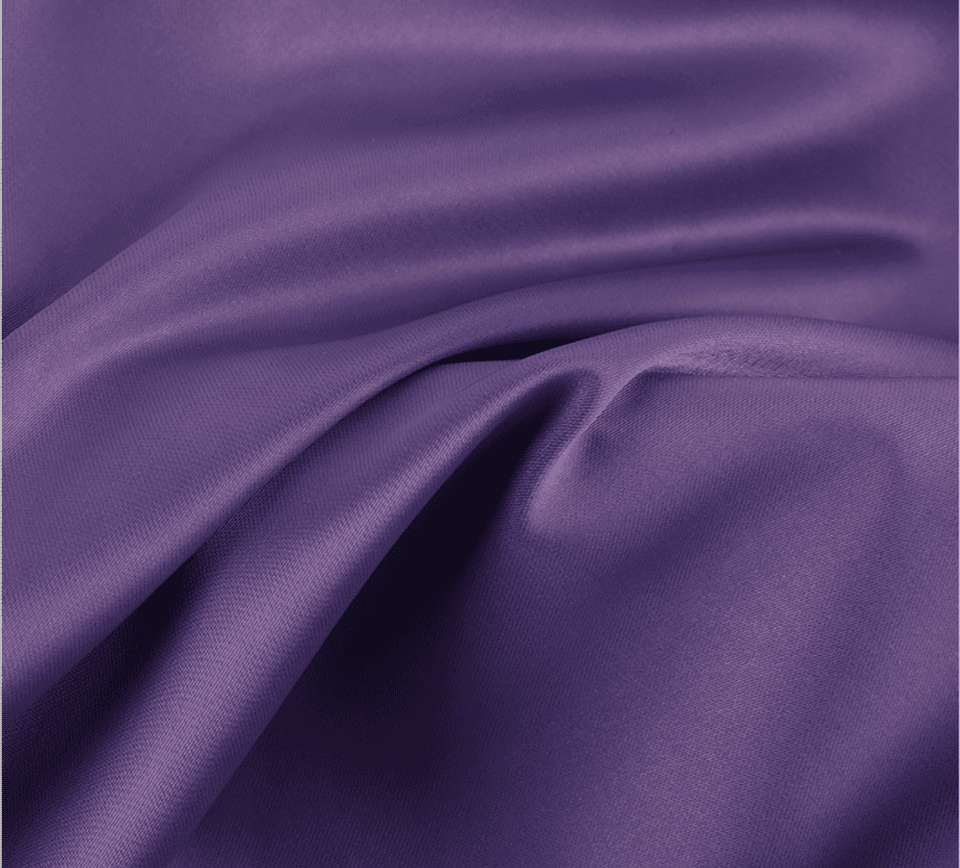
Tissu de haute qualité 102GSM 75D, extensible dans 4 directions, teint uni, 88 polyester, 12 spandex
- En savoir plus
- En savoir plus
- En savoir plus
- En savoir plus
- En savoir plus
- En savoir plus
- En savoir plus
- En savoir plus
- En savoir plus
- En savoir plus
- En savoir plus
- En savoir plus
- En savoir plus
- En savoir plus
- En savoir plus
- En savoir plus
- En savoir plus
- En savoir plus
- En savoir plus
- En savoir plus
- En savoir plus
- En savoir plus
- En savoir plus
- En savoir plus
- En savoir plus
Custom 4-Way Stretch Fabric Manufacturer and Strategic Sourcing Partner in China
Woven Fabrics | Recycled Nylon and Polyester | Custom Development
Develop performance-driven 4-way stretch fabrics for activewear, outdoor apparel, fashion, uniforms, linings, and technical applications.
FabricsTrades is a Global Recycled Standard (GRS)-certified fabric manufacturer founded in 2013 in Shengze, Wujiang District, Suzhou—one of the world’s most concentrated textile manufacturing hubs.
What Is 4-Way Stretch Fabric?
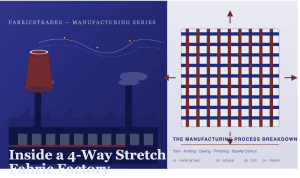
Four-way stretch fabric extends both horizontally and vertically—commonly described as left to right and up and down. This multidirectional movement gives garments greater mobility than rigid fabrics or constructions engineered to stretch primarily in one direction.
Four-way stretch can be achieved through elastomeric fibers such as spandex, through yarn and fabric engineering, or through a combination of fiber content and construction. The actual extension, recovery, compression, and dimensional stability depend on the individual fabric specification.
Règlement sur les tissus 2024-2026 & Mise à jour de conformité
Performance stretch fabrics may receive durable water-repellent, stain-resistant, membrane, coating, or lamination treatments. These treatments make PFAS control particularly relevant for outdoor apparel and other finished performance products.
Under the EU REACH PFHxA restriction, limits for specified general-public clothing, related accessories, and footwear begin applying on October 10, 2026. Buyers of EU-bound stretch textiles should evaluate every relevant homogeneous material, including the face fabric, coating, membrane, and laminated layer. Supplier declarations, finish SDS/TDS documentation, lot-specific testing, and contamination controls may be required; descriptions such as “C0,” “PFC-free,” or “fluorine-free” should not be treated as complete legal proof.
Read the FabricsTrades supply-chain update:
https://fabricstrades.com/insight/eu-reach-pfhxa-restriction-and-the-china-fabric-supply-chain/
California AB 1817 prohibits intentionally added PFAS in covered textile articles and establishes total-organic-fluorine thresholds that become more stringent in 2027. For California-bound activewear, fashion garments, uniforms, outdoor apparel, and other covered textile articles, performance finishes should be reviewed before bulk approval. A compliant program should connect the chemical formulation to the exact fabric quality, color, finish, and lot rather than relying on a general mill statement.
Read the FabricsTrades California update:
https://fabricstrades.com/insight/california-ab-1817-pfas-textile-ban-and-the-china-fabric-supply-chain/
Compliance cannot be inferred from fiber composition, recycled content, or certification alone. Requirements vary by destination, product category, finish, and effective date. Buyers should establish the applicable test protocol and acceptance limits before production.
Why Choose Us as Your 4-Way Stretch Fabric Supplier?
Factory-Direct Manufacturing
We specialize in woven 4-way stretch fabrics for activewear, outdoor apparel, fashion, uniforms, and technical applications. Direct production control helps us manage composition, weight, width, stretch, recovery, color, and finishing requirements.Approvisionnement stratégique à Suzhou
Located in Wujiang District, Suzhou—one of the world’s largest textile manufacturing hubs—we combine our own production capacity with access to specialized weaving, dyeing, printing, coating, and finishing partners. If a fabric already exists, we can source it. If it does not, we can help develop it.Développement de tissus personnalisés
Choose the fiber blend, spandex percentage, GSM, denier, construction, hand feel, color, print, and functional finish. We support sampling, lab dips, strike-offs, and specification-based development for new collections.Recycled Fabric Options
GRS-certified recycled polyester and recycled nylon programs are available for selected qualities. Certification scope and transaction documentation can be confirmed for each order.Assistance qualité et conformité
Fabric performance can be evaluated against agreed requirements for stretch, recovery, dimensional stability, colorfastness, abrasion, pilling, and other relevant properties. For regulated markets, we can coordinate the required documentation and third-party testing.Flexible Supply Solutions
We support both in-stock fabrics and custom production. In-stock products generally require 2–7 days, while custom manufacturing typically takes approximately 4–6 weeks.
Applications et cas d'utilisation modernes
Performance Activewear
- Yoga leggings with multidirectional mobility through deep flexion
- Training tights and compression garments
- Running shorts with stretch panels or integrated liners
- Sports bras and fitted training tops
- Dancewear, gymnastics apparel, and performance costumes
- Cycling garments designed around aggressive riding positions
- Climbing trousers requiring articulated knees and gusset mobility
- Racket-sport skirts, shorts, and dresses
- Golf trousers and lightweight stretch overshirts
- Adaptive sportswear that must accommodate assisted dressing and seated movement
Outdoor and Travel Apparel
- Soft-shell hiking trousers
- Packable stretch windbreakers
- Lightweight water-repellent shells
- Alpine and ski mid-layers
- Fishing shirts and quick-movement utility garments
- Travel trousers engineered for comfort during prolonged sitting
- Convertible garments and wrinkle-resistant commuter apparel
- Stretch reinforcements for knees, seats, elbows, and shoulder zones
Fashion and Intimate Apparel
- Body-contouring dresses and fitted blouses
- Stretch satin eveningwear
- Cheongsam and occasionwear requiring mobility without losing silhouette
- Lingerie, slips, camisoles, and sleepwear
- Pajamas and premium loungewear
- Lightweight stretch linings for fitted garments
- Printed stretch satin for statement dresses and fashion separates
- Maternity and size-inclusive garments requiring controlled accommodation
Workwear and Uniforms
- Hospitality uniforms requiring frequent bending and reaching
- Healthcare apparel and stretch scrub panels
- Corporate commuter trousers
- Service uniforms with improved shoulder and seat mobility
- Warehouse and light-industrial garments
- Tactical-inspired utility clothing where the approved specification requires freedom of movement
Medical and Adaptive Garments
- Mobility-support garments
- Orthopedic and rehabilitation apparel
- Adaptive clothing with simplified closures
- Fitted support products where controlled stretch is required
Home, Seating, and Specialty Uses
- Form-fitting cushion covers
- Upholstery applications requiring flexible recovery
- Stretch slipcovers
- Automotive seating inserts
- Protective equipment covers
- Exhibition, staging, and contour-fitting display textiles
Featured 4-Way Stretch and Stretch Fabric Products
Our current product range includes:- 92% polyester, 8% spandex 4-way stretch moss crepe chiffon fabric for women’s dresses
- 90% polyester, 10% spandex 4-way stretch fabric for autumn women’s clothing
- Imitation silk stretch satin lining fabric for pajamas
- 50D × 75D, 96% polyester, 4% spandex stretch satin fabric for lingerie
- 102 GSM, 75D, 88% polyester, 12% spandex plain-dyed 4-way stretch fabric
- 400T woven nylon fabric, 36 g, for bright 20D lightweight down-jacket linings
- 100D waterproof polyester-spandex 4-way stretch fabric
- Digital-print 100% polyester woven stretch satin fabric
- Thickened imitation acetate stretch satin for cheongsam, homewear, baseball apparel, and shirts
- 100D, 92% polyester, 3% spandex woven 4-way stretch fabric for women’s blouses and dresses
- Shiny satin-feel stretch fabric for women’s party dresses
- 92% polyester, 8% spandex printed woven stretch satin for dresses
- 180 GSM, 75D double-layer, 90% polyester, 10% spandex plain-dyed 4-way stretch fabric
- High-quality polyester stretch satin fabric
- 50D × 75D imitation silk stretch satin for evening-dress linings, pajamas, and loungewear
- Cationic two-tone polyester 4-way stretch fabric for summer shirts, lightweight suits, sportswear, and outdoor apparel
A Factory-Direct Supplier with Wider Sourcing Capacity
FabricsTrades owns a 4-way stretch fabric factory and also operates as a strategic sourcing partner. Located in the heart of Wujiang District, Suzhou, we sit at the center of one of the world’s most concentrated textile hubs. While a conventional manufacturer may be limited to its own looms, our proximity to thousands of specialized weaving, knitting, dyeing, printing, coating, lamination, and finishing facilities gives buyers access to a much broader development network. If a fabric exists, we can help locate and qualify it. If it does not, we can help develop it around the required fiber composition, construction, weight, stretch ratio, recovery, hand feel, color, print, and end-use performance.Custom 4-Way Stretch Fabric Manufacturing
Our wholesale and custom-developed fabric programs cover polyester, nylon, cotton, recycled inputs, plain-dyed qualities, and printed constructions. Development options may include:- Custom fiber composition and spandex percentage
- Target GSM, denier, density, and construction
- Two-way or four-way mechanical and elastane stretch
- Plain dyeing, cationic effects, and digital printing
- Satin, crepe, chiffon, double-layer, and lightweight shell constructions
- Water-repellent or waterproof performance based on the approved specification
- Recycled polyester or recycled nylon programs with applicable chain-of-custody documentation
- Color matching, lab dips, strike-offs, hand-loom samples, and bulk approval controls
Sustainable Polyester Fabrics
Recycled polyester can be produced using recovered plastic inputs and textile waste, helping divert suitable materials from landfill and reducing demand for virgin feedstock. We source and manufacture polyester stretch fabrics for fashion, activewear, outdoor apparel, linings, and technical garments. Recycled content should be verified against the documentation applicable to the specific order. A recycled-content certificate or transaction document does not, by itself, establish chemical or PFAS compliance.Sustainable Nylon Fabrics
Our nylon range includes lightweight woven qualities, stretch constructions, and recycled options suitable for shells, linings, packable garments, and performance apparel. The environmental profile of a nylon fabric depends on its raw-material source, durability, processing route, finish chemistry, and end-of-life pathway. Buyers should therefore evaluate the complete specification rather than relying on a broad “sustainable” label.Custom Lycra and Spandex Fabric Programs
Spandex can be blended with polyester, nylon, cotton, and other fibers to engineer stretch and recovery for a specific garment. We help buyers develop fabrics around practical requirements such as:- Extension in warp and weft directions
- Recovery after repeated movement
- Stabilité dimensionnelle
- Garment compression level
- Surface appearance and opacity
- Moisture-management requirements
- Abrasion, snagging, pilling, and colorfastness targets
- Compatibility with printing, coating, bonding, or lamination
Why Source 4-Way Stretch Fabric from FabricsTrades?
Manufacturing and Development Access
Our factory supports core stretch-fabric production, while our location in the Wujiang textile cluster provides access to specialized upstream and downstream partners. This makes it possible to manage both repeat production and more complex sourcing briefs.Established Textile Experience
Founded in 2013, FabricsTrades has developed experience serving domestic and international fabric buyers from Shengze, Suzhou.Contrôle de qualité
Fiber composition, construction, weight, width, color, stretch, recovery, hand feel, and applicable performance characteristics can be checked against the buyer-approved specification. Testing scope should be agreed before bulk production.Certification Support
FabricsTrades identifies GOTS, GRS, and STeP by OEKO-TEX among the certification frameworks associated with its sustainable fabric programs. Buyers should request the current certificate, verify its validity and scope, and confirm that the ordered product and processing site are covered.Lead Times
For in-stock products, the stated lead time is 2–7 days. Products that are not in stock generally require approximately 4–6 weeks to manufacture. Shipping typically takes 1–2 weeks, depending on the destination country and selected freight method.Core Properties and Advantages
Multidirectional Flexibility
Four-way stretch fabric moves with the wearer across multiple planes. This is particularly valuable at knees, elbows, shoulders, hips, and gusseted areas where a garment must accommodate repeated articulation.Increased Range of Motion
Because the material stretches vertically and horizontally, it supports movements such as lunging, squatting, climbing, reaching, twisting, and bending.Improved Fit
The fabric can conform more closely to the body, helping designers create streamlined silhouettes and reduce excess material in active or fitted garments.Confort
A stretch construction can reduce movement restriction and pressure at garment stress points. Comfort also depends on weight, surface texture, breathability, seam design, and garment fit.Shape Retention
Well-engineered 4-way stretch fabrics are designed to return toward their original dimensions after extension, reducing sagging and bagging during wear.Resistance to Wear and Tear
Appropriate synthetic-fiber constructions can provide strong resistance to routine wear. Actual durability varies with yarn type, fabric structure, thickness, finishing, garment design, and care.Stretch Recovery
Recovery describes how effectively a fabric returns after stretching. It should be evaluated against the intended garment and tested after repeated extension and laundering when the application is demanding.Solidité des couleurs
Stretch fabrics may be dyed or treated to maintain color through use and washing. Required fastness grades should be stated in the purchase specification and verified using the agreed test method.How 4-Way Stretch Fabric Is Manufactured
The source material, yarn system, construction, and finishing sequence determine the final performance.- Material selection: Polyester, nylon, spandex, cotton, and other fibers can be combined in different ratios to produce the required stretch and recovery.
- Knitting: Some 4-way stretch fabrics are produced on circular knitting machines, which form fabric continuously in a tubular structure.
- Weft knitting: Flat or other weft-knitted constructions can be engineered for different extension, recovery, weight, and surface characteristics.
- Woven stretch construction: Woven 4-way stretch fabrics can incorporate elastane yarns or engineered stretch yarn systems in both fabric directions. This produces a more structured hand than many knitted alternatives.
- Spandex integration: Spandex provides elastic extension and recovery and is blended or covered with other fibers according to the target performance.
- Teinture et finition : The fabric may undergo washing, dyeing, printing, heat setting, water-repellent treatment, coating, or other finishing. Each process can affect stretch, recovery, hand feel, shade, width, and dimensional stability.
Design and Sourcing Considerations
A successful fabric specification should define more than composition alone. Buyers should consider:- Construction tricotée ou tissée
- Warp and weft extension
- Recovery after repeated cycling
- Largeur finie et largeur utile
- GSM and thickness
- Opacity under extension
- Pilling, snagging, and abrasion resistance
- Glissement des coutures ou résistance des coutures
- Stabilité dimensionnelle après lavage
- Moisture management and drying rate
- Colorfastness to washing, perspiration, rubbing, and light
- Print distortion during stretch
- Heat-setting and ironing limitations
- Required chemical-restriction and market-access tests
Entretien et maintenance
Always follow the care label for the specific fabric or finished garment. General guidance for many synthetic 4-way stretch fabrics includes:- Wash in cold water using a delicate or gentle cycle.
- Utilisez un détergent doux.
- Avoid bleach and fabric softener unless the approved care instructions permit them.
- Air-dry flat or hang dry where appropriate.
- If tumble drying is allowed, use a low-temperature setting.
- Use low heat when ironing.
- Keep the fabric away from rough surfaces that may cause snagging.
- Store the material in a cool, dry place.