
T400 & Tissus T800

- Fabriqué à partir de polyester, nylon et cotons recyclés
- Délai de livraison plus court
- Des prix intéressants

T400 sur mesure & Tissus T800 en vrac au prix de gros des fabricants

Polyester T400-T800 (fibre élastique sans spandex)
Les tissus en polyester T400 et T800 sont tissus élastiques en 100% polyester. Il est imperméable, coupe-vent, extensible, respirant et résistant à l'eau. Avec son design intemporel, son motif ondulé distinct et son tissu naturellement doux, lisse et confortable, il est idéal pour une tenue décontractée.
T400 & T800 Stretch Fabrics
- Fabriqué à partir de polyester, nylon et cotons recyclés
- Délai de livraison plus court
- Des prix intéressants
Custom-Made T400 & T800 Fabrics in Bulk at Wholesale Prices
FabricsTrades supplies T400 and T800 stretch fabrics for apparel, lining, activewear and performance-textile development. These fabrics use elastic polyester-fiber structures to provide low-to-moderate mechanical stretch without relying exclusively on conventional spandex.
Depending on the required appearance and end use, T400 and T800 constructions can be produced using 100% polyester or blended with cotton or staple fibers for a more natural surface and hand feel. Available performance options may include water resistance, wind resistance, breathability, quick drying and moisture management, subject to the selected construction and finishing specification.
Located in the heart of Wujiang District, Suzhou, FabricsTrades operates within one of the world’s most concentrated textile manufacturing hubs. We are not limited to the capabilities of a single production line. In addition to operating our own 4-way stretch fabric factory, we work as a strategic sourcing partner with access to thousands of specialized weaving, dyeing, coating and finishing facilities. If a fabric exists, we can help you find it. If it does not, we can help you develop it.
[Image: 400T woven nylon fabric 36g bright down jacket 20D light down jacket lining]
400T Woven Nylon Fabric, 36g, Bright Finish, 20D Lightweight Down-Jacket Lining
The current product range includes a tightly woven 400T nylon fabric developed for lightweight down-jacket lining and related garment applications.
Product specifications
- Supply type: Spot goods
- Poids : 36g
- Finish: Bright
- Construction : lumière 20D
- Primary application: Down-jacket lining
- Colors: According to customer requirements; any color is available
- Samples: Free A4 reference sample
- Standard delivery: Normally 15–25 days after the down payment is received and the lab dip is confirmed; the exact lead time depends on the order
- Payment terms: T/T, L/C at sight or other terms negotiated in advance
Its tightly woven construction offers a strong barrier against wind and water while maintaining the low weight required for insulated garments. The bright finish adds a clean, fashion-oriented surface to down jackets, lightweight coats and technical outerwear. Its strength-to-weight balance also supports garment durability without introducing excessive bulk.
What Are T400 and T800 Stretch Fabrics?
T400 and T800 are elastic-fiber fabric categories commonly associated with polyester-based stretch systems. Their stretch effect is created through polymers that respond differently to heat during manufacturing, producing a three-dimensional crimp and mechanical recovery within the yarn.
This structure can provide comfortable movement and shape retention without the same fabric behavior as a conventional polyester-spandex blend. Performance depends on yarn selection, fabric construction, heat setting, dyeing and finishing, so buyers should evaluate each article against the intended garment rather than relying on the fiber name alone.
The category’s currently listed 400T product is a lightweight woven nylon lining fabric. “400T” in this product name refers to the fabric’s high-density woven construction and should not be confused with carbon-fiber grades used in aerospace or composite engineering.
Avantages des tissus T400 et T800
- Bon étirement et récupération
- Durable après plusieurs lavages
- Bonne gestion de l'humidité
- Respirant
- Confortable
- Séchage rapide
- Très résistant aux produits chimiques tels que le chlore
Actual performance should be confirmed on the selected fabric construction and finish. Stretch percentage, recovery, air permeability, moisture-management behavior, colorfastness and chemical resistance can vary by article and production lot.
Applications and Modern Use Cases
T400 and T800 fabrics are suited to products that require low-to-moderate stretch, dimensional stability and freedom of movement.
Customization, Sampling and Bulk Sourcing
Color can be developed according to customer requirements, with any color available. Lab dips normally require 3–5 days, while approval samples for plain colors normally require 7–10 days.
OEM service is available according to project requirements, including customized branding. Production capacity exceeds 3 million meters per month, supported by advanced equipment and coordinated production teams. Mass-production timing is generally 3–20 days, while the listed 400T nylon article states a normal delivery window of 15–25 days after down payment and lab-dip confirmation. Final timing depends on construction, finishing, color approval, quantity and production scheduling.
For first-time clients, the typical large-order payment arrangement is 30% down payment and 70% before shipment by T/T. L/C may be considered for repeat clients, and other payment terms can be negotiated.
Pricing is determined by quantity, quality and required functional finishes. Larger order quantities may qualify for more favorable unit pricing.
Quality and Development Considerations
Before bulk production, buyers should define measurable requirements for the finished fabric, including:
- Composition des fibres
- Finished width and weight
- Stretch percentage and recovery
- Stabilité dimensionnelle
- Solidité des couleurs
- Air permeability and breathability
- Moisture-management or quick-dry performance
- Water resistance or repellency
- Résistance au vent
- Surface appearance and hand feel
- Durabilité au lavage
- Exigences relatives aux substances restreintes
- Packaging, roll length and inspection standard
A lab dip, approval sample or production sample should be reviewed before bulk release. For performance programs, test reports should identify the tested fabric, color, finish, lot and test method so the results can be linked to the shipment.
Règlement sur les tissus 2024-2026 & Mise à jour de conformité
T400/T800 apparel fabrics and the listed 400T nylon lining may fall within current or developing textile rules when they are used in products sold in regulated markets. Compliance is not established by the fiber name alone. It depends on the finished fabric’s chemical inputs, coatings, water-repellent treatments, composition claims, traceability and intended market.
For EU-bound apparel, the Ecodesign for Sustainable Products Regulation entered into force in July 2024 and creates the framework for product-specific ecodesign requirements and Digital Product Passports. Textile and apparel suppliers should begin organizing product-level composition, production-stage, recycled-content and substances-of-concern data so buyers can build traceable compliance records. See the detailed FabricsTrades update: ESPR & Digital Product Passport for Chinese Fabric Supply Chains.
Performance fabrics with water-resistant, stain-resistant, coated or laminated finishes require particular PFAS attention. The EU PFHxA restriction begins applying to clothing, related accessories and footwear for the general public on October 10, 2026, with other general-public textile applications following later. Buyers should specify the required chemical standard before sampling and request shipment-linked evidence for the finished article where relevant. A “PFC-free” or “fluorine-free” marketing statement should not be treated as a substitute for method-appropriate testing and supply-chain documentation. See: Guide mondial de conformité des textiles 2024-2026.
FabricsTrades can coordinate sourcing and development around a buyer’s stated compliance requirements. Final legal conformity must be confirmed for the specific fabric, finish, production lot, finished product and destination market.
Strategic Sourcing in Suzhou’s Textile Hub
Located in Wujiang District, Suzhou, FabricsTrades combines our own 4-way stretch fabric manufacturing capabilities with access to specialized weaving, dyeing, coating and finishing facilities. If the fabric you need already exists, we can help source it. If it does not, we can support custom development.Flexible Customization
- Custom colors based on buyer requirements
- OEM and branding support
- Free A4 reference samples
- Trempages en laboratoire normalement effectués en 3 à 5 jours
- Échantillons d'approbation de couleur unie normalement complétés en 7 à 10 jours
Reliable Production and Delivery
- Production capacity of more than 3 million meters per month
- Spot goods available for the listed 400T nylon fabric
- Normal delivery for the listed fabric: 15–25 days after down payment and lab-dip confirmation
- Lead times confirmed according to color, quantity, finishing and order requirements
Competitive Wholesale Sourcing
Pricing is based on fabric quality, functional requirements and order quantity. Larger orders may qualify for more favorable unit pricing.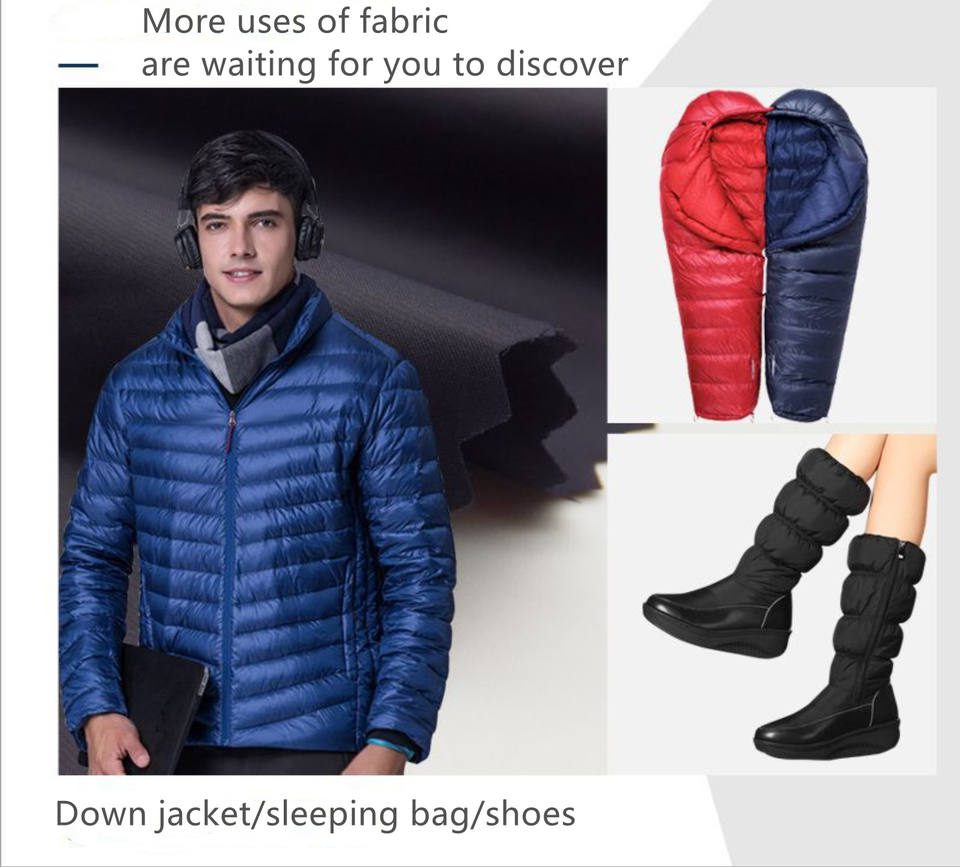
Uses for the Listed 400T Woven Nylon Fabric
The 36g, 20D 400T nylon article is specifically positioned for down-jacket lining. Its lightweight, tightly woven construction also makes it relevant to:- Down and synthetic-insulation jacket linings
- Packable puffer jackets
- Lightweight gilets and insulated vests
- Hood, sleeve and pocket-bag linings
- Reversible lightweight outerwear
- Quilted fashion garments
- Sleeping-bag lining development
- Insulated accessories where a lightweight woven barrier is required
- Costume and fashion applications requiring a bright surface
- Sun-protective clothing components, subject to verified UPF performance
Activewear and Athleisure
Suitable applications include jumpsuits, swimwear, jogger pants, running shorts, sweatshirts, leggings, lightweight jackets, tights and sweatpants. In product development, these fabrics can be considered for:- Woven training pants with articulated knees
- Lightweight warm-up jackets and track tops
- Golf and tennis apparel requiring controlled stretch
- Commuter trousers designed for cycling and extended sitting
- Travel garments that need recovery after packing
- Uniform-inspired athleisure with a cleaner woven appearance
- Hybrid garments combining woven stretch panels with knitted body sections
- Lightweight overshirts and technical lifestyle jackets
- Children’s performance clothing requiring comfort and durability
Denim and Casual Apparel
Polyester elastic-fiber constructions can support stretch denim, casual trousers and fitted garments where recovery is important. Potential applications include slim-fit jeans, work-leisure trousers, stretch chinos, skirts, fitted dresses and structured casual jackets. The fabric specification should be matched to the required wash process, garment shape and recovery target. Denim laundering, enzyme treatments and heat exposure can materially affect the finished performance.Vêtements de plein air et de performance
Where an appropriate water-resistant or wind-resistant finish is specified, these fabrics may be used for:- Packable windbreakers
- Lightweight hiking trousers
- Urban rain shells
- Cycling commuter jackets
- Travel vests
- Fishing and utility garments
- Stretch soft-shell panels
- Lightweight uniforms for mobile workforces
Socks, Bags and Accessories
The category is also suitable for socks and bags. Depending on construction, possible developments include stretch sock components, flexible bag panels, travel organizers, soft accessories and lightweight technical pouches.