Table des matières
BasculerViscose is a regenerated cellulosic fiber made by dissolving purified cellulose—usually derived from wood pulp—and reforming it as filaments or staple fiber. In everyday textile use, “viscose” often refers both to the manufacturing process and to the rayon fiber produced by that process. It combines a plant-derived feedstock with industrial chemical processing, so describing it simply as either a natural fiber or a conventional synthetic fiber is incomplete.
For apparel and home textiles, viscose is best known for a soft hand, fluid drape, good moisture absorbency, breathability, and strong dye uptake. Its main cautions are reduced strength when wet, dimensional instability in some constructions, wrinkling, and the environmental and occupational controls required in conventional viscose production.
Viscose Fabric at a Glance
| Attribut | Descriptif pratique |
| Famille de fibres | Regenerated cellulosic; commonly labeled rayon or viscose depending on market and applicable labeling rules |
| Typical feedstock | Dissolving-grade cellulose, usually from wood pulp |
| Main et drapé | Soft, smooth, and generally fluid |
| Comportement à l'humidité | Absorbent and usually comfortable in warm conditions; performance depends on construction and finish |
| Extensible | Low inherent elastic recovery; stretch normally comes from knit construction or elastane blending |
| Wet strength | Lower than dry strength for conventional viscose; careful laundering may be necessary |
| Utilisations courantes | Dresses, blouses, shirts, trousers, linings, scarves, sleepwear, upholstery blends, curtains, and selected nonwoven or industrial applications |
| Soins | Follow the finished-product label; cold or cool gentle washing and reduced agitation are common recommendations |
Thread count, weight, pilling, heat retention, and stretch are fabric-construction variables rather than fixed properties of the fiber. They should be confirmed against the actual woven or knitted specification.
What Is the Difference Between Viscose and Rayon?
Rayon is the broad generic family of regenerated cellulose fibers in U.S. terminology. Viscose is the dominant traditional process used to make rayon and is also the common fiber name in many other markets. The terms are therefore related, but they are not always interchangeable in technical specifications or legal labels.
Lyocell is also a regenerated cellulosic fiber, but it is made by a different direct-solvent process. In the United States, the Federal Trade Commission recognizes lyocell as a subclass of rayon with its own generic name. Modal is a defined high-wet-modulus rayon type rather than merely a marketing synonym for any soft viscose fabric. Buyers should use the fiber name shown in the supplier’s composition documents and confirm the label required in the destination market.
How Is Viscose Made?
A conventional viscose line converts cellulose into a soluble intermediate and then regenerates it into solid cellulose fiber. Exact chemistry and recovery systems vary by producer, but the core sequence is:
Prepare dissolving pulp. Wood is processed into high-purity cellulose suitable for fiber production. The original article cited at least 90% cellulose purity; buyers should treat actual pulp specifications as supplier-specific.
Steep in alkali. Cellulose sheets are treated with sodium hydroxide to form alkali cellulose.
Press and shred. Excess alkali is removed, and the material is shredded into “white crumb” to increase surface area.
Age and xanthate. Controlled aging adjusts the cellulose chain length. Carbon disulfide reacts with alkali cellulose to form cellulose xanthate, historically called “yellow crumb.”
Dissolve and ripen. The xanthate is dissolved in dilute sodium hydroxide to form the viscous spinning solution that gives the process its name.
Filter and deaerate. Solid particles and air bubbles are removed so the solution can pass consistently through spinnerets.
Wet-spin and regenerate. The solution is extruded through spinneret holes into an acidic coagulation bath, where cellulose is regenerated as filaments.
Wash, draw, finish, and convert. Filaments are washed to remove residues, stretched to develop properties, finished, and either wound as filament yarn or cut into staple fiber for spinning.
Carbon disulfide is a recognized occupational hazard used in conventional viscose manufacture. Modern sourcing should therefore examine chemical recovery, air emissions, wastewater treatment, worker-exposure controls, and third-party documentation rather than assuming that all viscose production has the same impact.
Key Properties: Benefits and Limitations
Avantages
Soft hand and fluid drape, useful for dresses, blouses, linings, scarves, and sleepwear.
Good moisture absorbency and generally comfortable next-to-skin wear in warm conditions.
Strong affinity for many dyes, enabling rich color and print definition.
Blend compatibility with cotton, linen, wool, polyester, nylon, and elastane to tune cost, handle, strength, recovery, and care.
Limites
Conventional viscose loses substantial strength when wet, so aggressive washing or handling can cause distortion or damage.
Some fabrics shrink, grow, skew, or wrinkle unless construction, finishing, and care are well controlled.
The fiber itself has limited elastic recovery; “stretch viscose” usually relies on knitting, mechanical construction, or elastane.
Pilling and abrasion performance vary with yarn quality, staple length, twist, fabric construction, blending, and finishing.
Environmental performance depends heavily on forestry practices, chemical recovery, energy source, water management, and mill controls.
Where Is Viscose Used?
Viscose can be engineered into lightweight woven fabrics, jersey and rib knits, crepes, twills, satins, linings, and blended constructions. Common applications include dresses, shirts, blouses, trousers, skirts, scarves, shawls, lingerie, sleepwear, towels, table linens, curtains, upholstery blends, wipes, and selected technical products.
It began as an “artificial silk” concept, but current use is broader. Viscose can imitate some of silk’s luster and drape and some of cotton’s softness and absorbency, yet it is not a performance-equivalent substitute for either fiber. The correct choice depends on fabric construction, end-use testing, care requirements, target price, and desired appearance.
For sourcing adjacent regenerated-cellulosic options, FabricsTrades’ catégorie de tissu de rayonne provides a relevant product path. Buyers should confirm fiber percentage, fabric weight, width, construction, finish, colorfastness, shrinkage, and minimum order requirements for the specific item rather than assuming category-level properties.
Where Is Viscose Produced and What Determines Cost?
Viscose fiber production is capital- and process-intensive and is generally carried out in large industrial facilities. Major manufacturing capacity is located in Asia, including China, India, and Indonesia, alongside producers in other regions. A current supplier decision should be based on verified mill-level capability and documentation, not broad claims about a country’s labor cost or regulatory enforcement.
Viscose is often positioned between commodity cotton and silk in commercial use, but there is no universal price relationship. Fiber price, pulp source, producer technology, certification or traceability program, yarn format, fabric construction, dyeing and finishing, testing, order size, currency, freight, and market conditions all affect the delivered price. Compare quotations on an equivalent specification and Incoterm.
[Image placeholder: Blouse in woven viscose fabric with a printed pattern]
Types of Rayon and Related Cellulosic Fibers
| Fiber or process | How to understand it |
| Viscose rayon | The conventional xanthate-route regenerated cellulose fiber described in this guide. |
| Modal | A high-wet-modulus rayon type designed for improved wet strength and dimensional behavior; performance still depends on the finished fabric. |
| Lyocell | Regenerated cellulose made by a direct-solvent process, commonly using N-methylmorpholine N-oxide. It is distinct from conventional viscose. |
| Cuprammonium rayon / cupro | Regenerated cellulose made using a copper-ammonia solvent system; still commercially available in specialty applications, contrary to the original article’s claim that manufacture ceased. |
| Acetate | A chemically modified cellulose derivative with different properties and labeling; it should not be presented as ordinary rayon. |
| Nitrocellulose “artificial silk” | An early, highly flammable historical route that is not a normal modern apparel-fiber option. |
For a focused comparison of another regenerated cellulosic, see FabricsTrades’ guide to modal fabric.
Environmental and Worker-Health Considerations
Viscose starts with renewable cellulose, but that fact alone does not establish sustainability. The relevant questions are where the pulp came from, whether forest-risk sourcing is controlled, how efficiently chemicals are recovered, how wastewater and sulfur emissions are managed, what energy powers the facility, and whether occupational exposure is controlled.
Feedstock: request fiber-producer and pulp-origin information, relevant chain-of-custody documentation where specified, and policies addressing ancient, endangered, or high-conservation-value forests.
Chemical management: ask for current evidence covering carbon disulfide recovery, sulfur emissions, wastewater treatment, and restricted substances relevant to the finished textile.
Claims: do not equate “plant-based,” “bio-based,” “biodegradable,” “certified pulp,” or “recycled feedstock” with a complete product-level sustainability conclusion.
Comparison: evaluate viscose, modal, lyocell, cotton, and synthetic alternatives against the actual product requirements and verified supply-chain data, not a single generic fiber ranking.
A certification may address a defined part of the chain or a specific claim; it does not automatically verify every environmental or social attribute. Organic claims are particularly sensitive because regenerated cellulose is chemically processed and scheme rules differ. Confirm the exact scope, certificate holder, product coverage, transaction documents, and permitted claim wording.
How to Care for Viscose Fabric
Always follow the finished garment or textile care label. A common conservative approach is cold or cool gentle washing with mild detergent, low mechanical action, no wringing, and air drying after reshaping. Iron on the reverse at a low-to-medium setting if the label permits. Structured garments, unstable constructions, special prints, pleats, or finishes may require professional cleaning.
Before bulk approval, buyers should test dimensional change, appearance after laundering, seam behavior, colorfastness, and strength using methods appropriate to the product and destination market. The guide d'inspection de la qualité des tissus provides a broader procurement framework.
Buyer’s Viscose Sourcing Checklist
Confirm whether the composition should be declared as viscose, rayon, modal, lyocell, or a blend in the destination market.
Lock the fabric construction, yarn count, weight, usable width, color, finish, and approved hand standard.
Specify shrinkage, spirality or skew, wet strength, pilling, abrasion, colorfastness, seam performance, and appearance-after-care requirements appropriate to the end use.
Request traceability and substantiation for wood-source, recycled-content, branded-fiber, or sustainability claims before marketing approval.
Communicate restricted-substance, labeling, testing, packaging, and documentation requirements before sampling and quotation.
Approve a representative pre-production sample and define lot inspection, shade control, defect tolerance, and corrective-action procedures.
Mise à jour actuelle de la réglementation et du marché
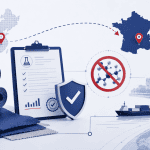
As of August 6, 2026, the EU Ecodesign for Sustainable Products Regulation (Regulation (EU) 2024/1781) is a framework law. It enables product-specific ecodesign and information requirements, including Digital Product Passports, through later delegated acts. Textiles—particularly garments—are prioritized in the EU’s 2025–2030 working plan, with an indicative 2027 timeline for adoption of a textile delegated act. This does not mean every viscose fabric or garment already requires a Digital Product Passport today; applicability will depend on the final product scope, delegated act, dates, and supply-chain role.
Buyers placing viscose-containing products on the EU market should start organizing reliable product data now: fiber composition, supplier and facility identifiers, material origin where required, substances-of-concern information, durability and care evidence, and support for environmental claims. FabricsTrades’ overview of Implications de l’ESPR et du Digital Product Passport pour les chaînes d’approvisionnement de tissus chinoises is useful related reading, but buyers should verify the final delegated rules and their own legal responsibilities before placing products on the market.
In the United States, textile fiber labels must use recognized generic names and meet the applicable Textile Fiber Products Identification Act rules. Because viscose, modal, and lyocell terminology can differ across markets, composition declarations, test reports, purchase orders, labels, and marketing copy should be aligned before production.
Foire aux questions
Is viscose a natural or synthetic fabric?
Viscose is best described as a regenerated cellulosic or man-made cellulosic fiber. Its feedstock is plant-derived cellulose, but the cellulose is dissolved and regenerated through an industrial chemical process.
Is viscose the same as rayon?
Viscose is the most common traditional process and a widely used name for the rayon produced by that process. “Rayon” is broader, and legal naming conventions vary by market.
Does viscose stretch?
The fiber has limited elastic recovery. Noticeable stretch usually comes from a knit construction, mechanical design, or a blend with elastane or another stretch fiber.
Does viscose shrink?
It can. Shrinkage depends on yarn, construction, finishing, and laundering. Confirm dimensional-change limits on the actual fabric and finished product.
Is viscose breathable?
Viscose is absorbent and many lightweight viscose fabrics feel breathable, but air permeability is determined by the full fabric construction and finish, not by fiber name alone.
Is viscose sustainable?
Not automatically. Performance varies with pulp sourcing, forestry risk, chemical recovery, emissions, wastewater, energy, worker protection, durability, and end-of-life assumptions. Claims should be specific and supported.
Is viscose cheaper than cotton or silk?
It is usually far less expensive than silk in comparable mass-market products, but there is no fixed price advantage over cotton. Compare current quotations for equivalent specifications.
What should buyers test before ordering viscose fabric?
Common checks include composition, weight and width, dimensional change, skew or spirality, wet and dry strength, pilling, abrasion, colorfastness, seam performance, and appearance after the intended care cycle.
Conclusion
Viscose is a versatile regenerated cellulosic fiber that can deliver softness, drape, absorbency, and vivid color across apparel and home-textile applications. Its suitability cannot be judged from the fiber name alone. Construction, finishing, wet performance, care, chemical management, traceability, labeling, and destination-market requirements all matter.
For a sourcing project, send the intended application, target composition, fabric weight and width, color or print, performance requirements, testing protocol, order volume, and destination market before sampling. FabricsTrades can use that specification to support sourcing, development, customization, sampling, and documentation discussions; final performance and compliance should be confirmed for the approved product and production batch.