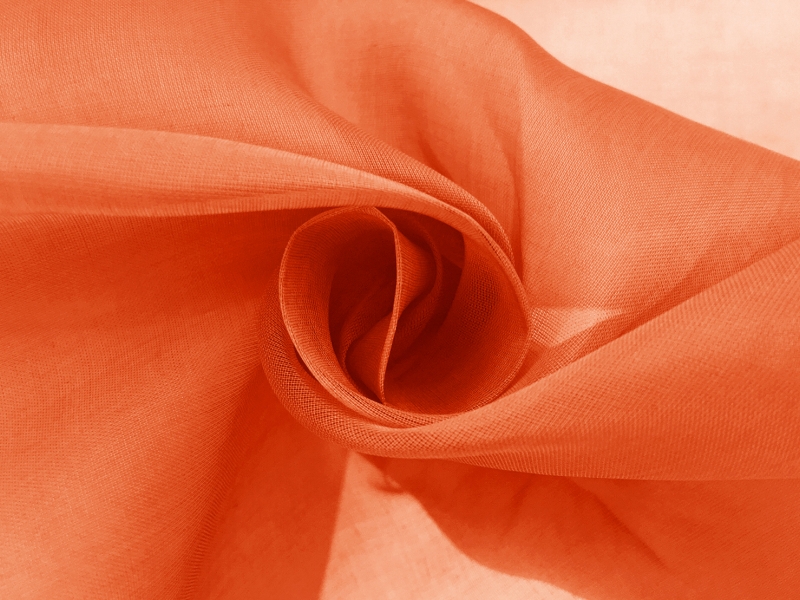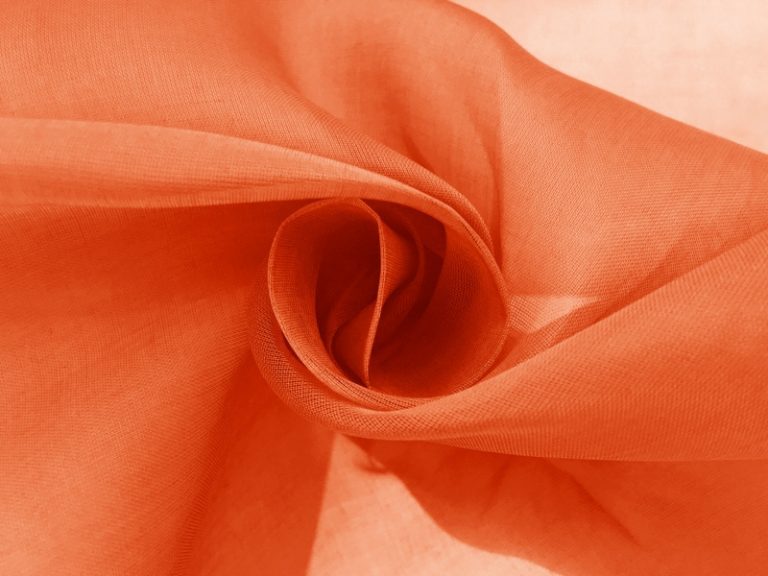
Organdy, also spelled organdie, is a lightweight, sheer, crisp fabric traditionally made from fine cotton yarns in a plain weave. Its transparent appearance and firm, springy hand make it useful for structured dresses, bridal and ceremonial clothing, trims, underlining, curtains, and decorative applications.
Organdy is not the same as organza. Traditional organdy is cotton, while organza is usually made with silk, polyester, or nylon filament yarns. Commercial naming is not always consistent, however, so buyers should verify the declared fiber composition and finish rather than relying on the fabric name alone.
Key Takeaways
- Organdy is generally defined as a fine, sheer, crisp, plain-woven cotton fabric.
- Its stiffness comes primarily from finishing, not simply from a very tight weave.
- Traditional durable organdy finishing may use controlled acid treatment, while starch, resin, and other finishes can produce different levels of crispness and wash durability.
- Organdy has low stretch, low heat retention, and good air passage relative to heavier cotton fabrics, but its exact performance depends on yarn, density, weight, and finish.
- “Stiff,” “semi-stiff,” and “soft” organdy are commercial descriptions rather than universal technical grades.
- Buyers should confirm composition, weight, width, finish durability, shrinkage, colorfastness, tear strength, seam performance, and restricted-substance requirements before bulk production.

What Is Organdy Fabric?
The Getty Research Institute’s Art & Architecture Thesaurus describes organdy as a sheer, lightweight, crisp, semitransparent cotton fabric made in plain weave from fine combed yarns.
A typical organdy specification has the following characteristics:
- Common names: Organdy or organdie
- Traditional composition: Cotton
- Construction: Fine plain weave
- Appearance: Sheer to semitransparent, with a clean surface
- Hand: Crisp, dry, and springy
- Stretch and recovery: Low unless the construction has been modified
- Heat retention: Low
- Breathability: Generally good for a woven fabric of its weight, although density and finish influence airflow
- Wrinkling: Usually noticeable because of the cotton composition and firm finish
- Pilling tendency: Often relatively low, but yarn quality and abrasion conditions still matter
- Common uses: Dresses, bridalwear, ceremonial clothing, collars, cuffs, sleeves, trims, underlining, aprons, curtains, and decorative textiles
Thread count is not standardized for all organdy. A range such as “100-300” should not be treated as a universal specification. Professional buyers should instead request measurable construction data, such as ends and picks per unit, yarn count, weight, width, and an approved reference sample.
Organdy, Organdie, and “Swiss Organdy”
“Organdie” is a common alternative spelling. Although the term “Swiss organdy” is used commercially, it should not automatically be interpreted as a verified country-of-origin statement. Buyers should confirm where the cotton was grown, where the fabric was woven and finished, and what the seller means by “Swiss” in the particular offer.
The precise geographic origin of organdy is not well documented. Merriam-Webster records the term’s first known English use in 1757, but its etymology remains uncertain. This does not support presenting Switzerland as the confirmed place where the fabric was invented.
Historically, crisp sheer cotton fabrics appeared in children’s formalwear, First Communion dresses, bridalwear, evening dresses, blouses, aprons, collars, and cuffs. Organdy was especially visible in full-skirted fashion during the nineteenth and mid-twentieth centuries. Contemporary use is more specialized, but the fabric remains relevant when designers need volume and transparency without relying on a synthetic filament fabric.
How Is Organdy Fabric Made?

The exact route varies among mills and finish suppliers, but cotton organdy commonly passes through the following stages.
1. Cotton Fiber and Yarn Preparation
Cotton is ginned, cleaned, carded or combed, drawn, and spun into yarn. Fine, even yarns help produce a smooth, transparent fabric with fewer distracting thick places or neps.
Yarn count, twist, hairiness, uniformity, and cotton quality all affect the finished fabric. Higher-quality organdy generally requires better yarn preparation, but no single yarn count or twist level defines every product.
For projects evaluating premium extra-long-staple cotton, FabricsTrades’ guide to Pima cotton properties and sourcing provides additional fiber context. Pima or SUPIMA® content should never be assumed from the organdy name; it requires separate composition and origin documentation.
2. Plain-Weave Construction
The prepared yarns are woven in a plain weave, with each weft yarn passing alternately over and under the warp. Fabric transparency depends on the yarn diameter, weave sett, weight, and finishing process.
The earlier article suggested that tightly twisting the yarn automatically creates more space between warp and weft. That explanation is too simple. Yarn twist can influence diameter, firmness, hairiness, and strength, but the final openness is also controlled by loom settings, yarn count, and fabric density.
3. Preparation Before Finishing
The grey fabric may be desized, scoured, washed, and otherwise prepared before its appearance and hand are developed. Preparation must remove impurities consistently without causing excessive strength loss or uneven absorbency.
4. Crisp or Parchment-Like Finishing
Traditional durable organdy effects can be created through a tightly controlled parchmentizing treatment. Japan’s Ministry of Economy, Trade and Industry describes organdie finishing as a process that produces a thin, transparent, rigid hand and notes that concentrated sulfuric acid may be used on cotton.
This is an industrial chemical process requiring precise control of acid concentration, exposure time, temperature, prior preparation, washing, and neutralization. More treatment does not simply equal better or stiffer fabric: excessive or uneven treatment can damage cellulose and reduce strength.
Other products may use starch, resin, heat-assisted, or proprietary crisp finishes. These alternatives can differ considerably in:
- Initial stiffness
- Wash durability
- Formaldehyde or restricted-substance considerations
- Yellowing risk
- Tear strength
- Sewing behavior
- Hand after laundering
Buyers should ask the supplier to identify the finish type and state whether the effect is temporary, semi-durable, or intended to withstand a defined care cycle.
5. Bleaching, Dyeing, Printing, and Decoration
Organdy may be supplied white, piece-dyed, yarn-dyed, printed, embroidered, flocked, or otherwise decorated. The sequence of finishing and coloration affects shade, transparency, strength, and stiffness.
The completed fabric should be inspected for width, weight, shade consistency, bow and skew, holes, slubs, finish streaks, contamination, crease marks, and uneven transparency before packing.
Properties of Organdy Fabric
Advantages
- Crisp structure: Organdy can support full skirts, puffed sleeves, collars, cuffs, bows, and layered shapes.
- Sheer appearance: It adds transparency and visual depth without the sheen associated with many filament fabrics.
- Light weight: The fabric can create volume without the bulk of a heavier woven material.
- Air passage: Fine, lightweight constructions usually allow more air movement than dense cotton fabrics.
- Layering ability: Multiple layers can increase opacity while preserving a light silhouette.
- Decorative versatility: Organdy accepts embroidery, printing, appliqué, pleating, and dimensional manipulation when the construction and finish are suitable.
- Low inherent stretch: The stable plain weave can help maintain structured shapes.
Limitations
- Wrinkling: Cotton organdy creases readily, particularly when crushed, folded, or exposed to moisture.
- Limited stretch and recovery: It is generally unsuitable for close-fitting stretch garments unless combined with another construction.
- Possible fragility: Fine yarns and an aggressive durable finish can reduce tear or flex resistance.
- Fraying and seam concerns: Lightweight woven edges may fray, and seam slippage or puckering can occur if the sewing specification is unsuitable.
- Transparency: Many applications require layering, lining, or strategic placement.
- Finish variation: Two fabrics sold as organdy may feel and perform differently after washing.
- Sewing sensitivity: Needle size, thread tension, stitch density, seam type, and pressing temperature require trial approval.
Types of Organdy
Stiff Organdy
Stiff organdy has a pronounced, rigid hand. It is suited to sculptural garments, ceremonial clothing, trims, decorations, and applications where shape retention matters more than softness.
Semi-Stiff Organdy
Semi-stiff products balance structure with somewhat easier handling and drape. They may be selected for dresses, sleeves, overlays, and occasionwear.
Soft Organdy
Soft organdy retains more body than lawn or batiste but has a less rigid hand than traditional stiff organdy. It can be more comfortable for blouses, dresses, or applications involving greater movement.
These three descriptions are not standardized grades. An approved hand-feel sample or measurable bending-stiffness requirement is more reliable than the words alone.
Printed, Embroidered, or Dotted Organdy
Surface decoration can change weight, stiffness, transparency, laundering, and sewing performance. Embroidery density can also create differential shrinkage or distortion, so decorated materials should be evaluated as finished articles rather than assumed to perform like the base fabric.
Organdy vs. Organza, Lawn, Batiste, and Voile
| Fabric | Typical fiber | Structure and hand | Main distinction | Common applications |
|---|---|---|---|---|
| Organdy | Cotton | Sheer plain weave with a crisp, dry hand | Cotton character with pronounced stiffness | Structured dresses, trims, underlining, curtains |
| Organza | Silk, polyester, or nylon | Sheer, crisp filament fabric, often with more sheen | Filament composition and smoother, sometimes shinier appearance | Bridal overlays, eveningwear, decoration |
| Lawn | Usually cotton | Fine plain weave with a smoother, softer hand | Less rigid and generally more comfortable against the skin | Shirts, blouses, dresses, summer clothing |
| Batiste | Cotton or blends | Very fine, lightweight, and soft | Softer and less structured than organdy | Babywear, lingerie, blouses, handkerchiefs |
| Voile | Cotton, polyester, or blends | Lightweight and sheer with softer drape | More fluid and less rigid | Curtains, blouses, dresses, warm-weather clothing |
Buyers who need a filament-fiber alternative can compare organza fabric options. The destination page covers a different fabric category and should not be used as evidence that organza and organdy are interchangeable.
How Is Organdy Fabric Used?
Common applications include:
- Bridal gowns, veils, overskirts, and structural details
- First Communion, flower-girl, and other ceremonial dresses
- Eveningwear and formal dresses
- Blouses and statement sleeves
- Collars, cuffs, bows, ruffles, and trims
- Children’s occasionwear
- Aprons and historical-costume reproductions
- Underlining or internal structural layers
- Lightweight curtains and decorative window treatments
- Craft, display, and event decoration
Organdy can be used as an underlining to add shape to a softer fashion fabric. It is not a substitute for every interfacing: the desired opacity, stiffness, wash durability, seam construction, and compatibility with the outer fabric must be evaluated.
Where Is Organdy Produced, and What Does It Cost?
Organdy can be woven and finished in textile-producing regions with access to fine cotton yarns and suitable wet-processing resources. Public trade data usually classifies fabric by fiber, construction, weight, or customs code rather than by the retail name “organdy.” As a result, there is no sufficiently reliable organdy-specific dataset supporting the earlier claims that one country is the world’s largest producer or that China and India manufacture the vast majority of all organdy.
Price depends on the actual specification, including:
- Cotton type and yarn quality
- Fabric weight, width, and density
- Finish chemistry and wash durability
- White, dyed, printed, or embroidered treatment
- Color and shade requirements
- Certification and traceability scope
- Testing requirements
- Order quantity and production route
- Inspection, packaging, and documentation
- Freight, duties, and destination market
Organdy is therefore not universally more expensive than other cotton fabrics, nor is it always cheaper than silk organza. Quotations should be compared against equivalent specifications and commercial terms.

Organdy Sourcing and Quality-Control Checklist
Before requesting samples or quotations, buyers should define the end use and communicate the following requirements.
Composition and Construction
- Declared fiber composition and permitted tolerance
- Cotton type or origin claim, if relevant
- Yarn count and construction
- Ends and picks per unit
- Finished weight and tolerance
- Usable width and tolerance
- White, dyed, printed, or embroidered specification
The FabricsTrades cotton fabric category can serve as a starting point for discussing cotton constructions. Organdy availability, finish capability, minimum order quantity, and lead time should be confirmed for the individual project.
Finish and Hand
- Finish type
- Target stiffness or approved hand-feel standard
- Temporary, semi-durable, or durable effect
- Stiffness retention after the required care cycle
- Acceptable yellowing, odor, or surface variation
- Restrictions on resin, formaldehyde, optical brighteners, or other chemicals
Performance Testing
Depending on the application, testing may include:
- Dimensional change after laundering or cleaning
- Colorfastness to washing, rubbing, perspiration, light, or water
- Tear and tensile strength
- Seam slippage or seam strength
- Fabric stiffness
- Air permeability
- Pilling or surface abrasion
- Appearance after care
- Restricted-substance testing
FabricsTrades’ fabric quality inspection guide provides additional procurement checkpoints. Test methods, acceptance limits, laboratory requirements, and responsibility for costs should be agreed before sampling or production.
Garment and Sewing Trials
A production-representative sample should be cut, sewn, pressed, and laundered using the intended factory process. Check for puckering, needle damage, fraying, seam visibility, distortion, finish loss, shrinkage, and changes in transparency.
How Should Organdy Be Cared For?
There is no universal washing instruction for all organdy. Care depends on the fiber declaration, finish, dye, embroidery, trims, and garment construction.
Practical precautions include:
- Follow the supplier’s or finished-product care instructions.
- Test a swatch before approving machine washing, hand washing, or dry cleaning.
- Use gentle handling to reduce crushing, seam damage, and distortion.
- Avoid wringing or aggressive agitation unless testing confirms suitability.
- Confirm whether the crisp effect survives the intended cleaning process.
- Press a test area first, using temperature and moisture settings compatible with the finish and decoration.
- Store finished garments with enough space to avoid permanent creasing.
“Machine wash cold,” “hand wash,” and “dry clean” should not be presented as interchangeable recommendations without product-specific testing.
Environmental and Certification Considerations
Cotton is a plant-derived fiber, but that alone does not make every organdy sustainable. Environmental performance depends on cotton cultivation, irrigation, agricultural inputs, energy use, water and chemical management during preparation and finishing, product durability, transport, care, and end-of-life conditions.
The earlier claim that organdy has negligible environmental impact because it represents a small market share is not a useful product-level assessment. Buyers should evaluate the actual supply chain and avoid broad sustainability claims without supporting evidence.
Relevant voluntary programs may include:
- GOTS: The Global Organic Textile Standard covers processing and chain-of-custody requirements for certified organic fibers. Its “organic” label grade requires at least 95% certified organic fibers, while its “made with organic materials” grade covers products with at least 70%.
- OEKO-TEX® STANDARD 100: STANDARD 100 is a harmful-substance testing certification for textile articles. It is not an organic certification.
- USDA organic: USDA organic status applies to agricultural production and eligible labeling claims. It should not be described as automatic certification of a finished textile merely because cotton was grown in the United States.
- SUPIMA®: SUPIMA® is a trademark and authentication program for American-grown Pima cotton. Supima’s AQRe™ program controls authorized trademark use and traceability; it is not a general environmental certification.
Certification must be confirmed for the actual supplier, processing stage, product scope, transaction, and validity period. A logo on a website is not enough to establish that a particular production lot is certified.
Current Regulatory and Market Update
As of August 11, 2026, fiber labeling, chemical documentation, and emerging product-data requirements are more commercially relevant to organdy buyers than any regulation specific to the name “organdy.”
Fiber-Composition Labeling
For products made available in the European Union, Regulation (EU) No 1007/2011 governs textile fiber names and related composition labeling. “Organdy” describes a fabric, not a recognized fiber name, so labels must identify the actual fiber composition, such as cotton or polyester, as applicable.
In the United States, the Federal Trade Commission’s Textile Fiber Rule requires covered textile products to disclose constituent fibers by generic name and percentage, the responsible manufacturer or marketer, and country of processing or manufacture. Most apparel also requires appropriate care instructions.
These requirements make the organdy-organza distinction commercially important. A fabric marketed as “synthetic organdy” must still be labeled according to its real fiber content.
EU ESPR and Digital Product Passport
Regulation (EU) 2024/1781 established the EU’s Ecodesign for Sustainable Products Regulation framework and Digital Product Passport system. Textile apparel is included among the priority product groups in the 2025-2030 working plan. The European Commission currently indicates planned adoption of a textile-specific delegated act in the fourth quarter of 2027.
A Digital Product Passport is therefore not yet a universal requirement for every organdy fabric or garment. Binding product information, scope, transition periods, and compliance dates will depend on the future delegated act.
Buyers preparing EU apparel programs can review FabricsTrades’ overview of ESPR and Digital Product Passport implications for Chinese fabric supply chains. The internal resource provides supply-chain context and should not be treated as legal advice or proof that a product complies.
Chemical and Product Documentation
Traditional or modern crisp finishing does not exempt organdy from destination-market chemical restrictions or buyer restricted-substance lists. Requirements may differ by product category, age group, finish, country, and date of sale.
Organdy does not inherently require a PFAS treatment. If water-, oil-, or stain-repellent performance is requested, the finish chemistry and applicable restrictions should be reviewed separately.
Before bulk production, buyers should consider requesting:
- Fiber-composition records
- Country-of-origin and processing information
- Finish and chemical declarations
- Applicable restricted-substance test reports
- Certification scope and transaction documentation
- Lot or batch traceability
- Care-label support
- Destination-market packaging and labeling information
The responsible importer or brand should verify current legal, retailer, and product-specific requirements before approving production.
Frequently Asked Questions
Is organdy the same as organza?
No. Traditional organdy is a crisp cotton plain weave, while organza is normally made from silk, polyester, or nylon filament yarns. Both can be sheer and structured, but their fiber content, sheen, hand, care, and sewing behavior differ.
Is all organdy made from cotton?
Cotton defines traditional organdy, but commercial sellers sometimes use “organdy” for polyester, nylon, or blended fabrics with a similar appearance. Always confirm the fiber declaration rather than relying on the trade name.
Is organdy naturally stiff?
Not entirely. Its fine plain weave contributes to the structure, but much of the characteristic crispness is produced by finishing. The type and durability of that finish should be included in the specification.
Does organdy remain stiff after washing?
It depends on the finish. A temporary starch finish may soften substantially, while a durable parchmentized or resin-based effect may retain more stiffness. Wash testing is necessary before making a durability claim.
Is organdy breathable?
Lightweight cotton organdy generally permits useful air movement and retains little heat, but breathability varies with weight, density, layering, finish, coating, and garment design.
Does organdy shrink?
Cotton organdy can shrink, especially when the material or finished garment has not been stabilized for the intended care process. Buyers should approve dimensional-change tolerances using the specified laundering or cleaning method.
Can organdy be used as a lining?
Organdy can be used as a structural underlining or internal support layer. Its transparency, stiffness, fraying, compatibility with the outer fabric, and care requirements should be evaluated before production.
Can organdy be certified organic or tested for harmful substances?
Yes, an eligible organdy product and supply chain may obtain certifications such as GOTS or OEKO-TEX® STANDARD 100. Certification is not automatic and must be verified for the actual product, supplier, scope, and production lot.
Choosing Organdy for a Sourcing Project
Organdy is most suitable when a design needs a crisp, sheer cotton structure rather than the shine and filament character of organza. Successful sourcing depends on defining the required stiffness, transparency, weight, finish durability, care method, sewing performance, and destination-market documentation.
FabricsTrades is based in Wujiang District, Suzhou, and can help buyers evaluate fabric constructions, sourcing options, colors, finishes, samples, testing coordination, and documentation requests. Organdy availability and any specialized finishing capability should be confirmed against the final specification before quotation or bulk production.