Canvas is a strong woven fabric, usually made with a plain-weave construction and relatively robust yarns. Traditional canvas was produced from hemp, flax, or cotton; modern versions may also use polyester, nylon, recycled fibers, or blends.
The term describes a fabric family rather than one fixed specification. Weight, density, yarn size, fiber composition, coating, and finishing can vary significantly. Consequently, a cotton artist canvas, polyester luggage canvas, workwear duck, and PVC-coated tarpaulin may behave very differently even though all are sold as canvas.
For buyers, the correct question is not simply “Is this canvas?” It is “Which canvas construction, fiber, finish, and test requirements match the final product?”
Key Takeaways
- Canvas is generally a firm, durable woven fabric, commonly made in a plain weave.
- Cotton is widely used, but linen, hemp, polyester, nylon, recycled fibers, and blends are also available.
- Duck canvas is a more tightly woven subtype; it is not a different fiber.
- Uncoated canvas is not automatically waterproof. Water resistance depends on construction and finishing.
- Breathability, stretch, shrinkage, moisture behavior, and durability vary by fiber, density, coating, and end use.
- Buyers should specify composition, weight, width, construction, color, finish, performance tests, care conditions, and destination market before sampling.
- PFAS requirements are increasingly relevant when canvas uses water-, oil-, or stain-repellent finishes.
Canvas Fabric at a Glance
| Attribute | Practical description |
|---|---|
| Basic construction | Usually plain woven, with warp and weft yarns alternating over and under each other |
| Common fibers | Cotton, linen/flax, hemp, polyester, nylon, recycled fibers, and blends |
| Related term | Duck canvas, a tighter and generally more compact canvas construction |
| Typical handle | Firm, structured, and sometimes coarse; lighter or finished versions can feel softer |
| Stretch | Usually limited unless the construction includes stretch yarns or elastomeric fibers |
| Breathability | Variable; coatings and laminations can reduce it substantially |
| Water performance | Uncoated canvas may resist brief light moisture, but waterproof performance normally requires an appropriate coating, lamination, or finish |
| Common finishes | Dyeing, printing, priming, waxing, coating, lamination, water repellency, flame retardancy, UV stabilization, or mildew-control treatment |
| Main applications | Bags, workwear, footwear, tents, covers, awnings, upholstery, artist materials, printed products, and industrial textiles |
| Buyer specifications | Fiber content, weight, width, yarn and weave details, color, finish, testing, care, end use, and destination market |
What Is Canvas Fabric?

Canvas is a firm woven fabric valued for its stable surface, structural body, and ability to withstand demanding use. Most conventional canvas uses a plain weave: each weft yarn passes alternately over and under successive warp yarns.
Although canvas is often described as “heavy-duty,” it is available in many weights. A lightweight canvas for sneakers or printed accessories should not be expected to perform like a dense workwear duck, marine cover, or industrial coated fabric.
Canvas is also not defined by a single fiber. Common options include:
- Cotton canvas: Absorbent, dyeable, printable, and available in a wide range of weights and constructions.
- Linen canvas: Dimensionally firm and traditionally valued as a painting support.
- Hemp canvas: Associated with the historical development of canvas and selected for a firm, wear-resistant structure.
- Polyester canvas: Often chosen for dimensional stability, practical care, printing, and compatibility with functional finishes.
- Nylon canvas: Used where toughness and abrasion performance are important, subject to the selected construction.
- Blended or recycled canvas: Developed to balance cost, appearance, strength, care, recycled content, or other project requirements.
“Duck” is sometimes used as if it were a synonym for all canvas. More accurately, duck is a closely woven type of canvas. Terms such as tarp cloth, tenting, awning cloth, and sailcloth describe applications or related textile categories rather than universal synonyms.
Canvas Construction and Technical Properties
Canvas performance cannot be determined from its name alone. Buyers should evaluate the following variables.
Yarn Size and Fabric Density
Canvas commonly uses relatively substantial yarns, producing a firm surface and visible woven structure. Yarn size, the number of warp and weft yarns, and the balance between the two directions influence weight, opacity, strength, flexibility, and surface texture.
There is no universal “canvas thread count.” Consumer-style thread-count figures such as those used for bedding are usually inadequate for industrial sourcing. A technical specification should instead identify the relevant yarn count, ends and picks per unit, finished weight, width, and construction.
Plain Weave Versus Twill
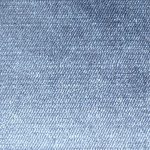
Most canvas is plain woven. Denim, by comparison, normally uses a twill construction that creates visible diagonal ribs. This structural difference affects appearance, drape, abrasion behavior, and the way the fabric forms around a finished product.
Weight and Thickness
Heavier canvas is not automatically better. Additional weight may improve structure or durability, but it can also increase shipping cost, sewing difficulty, stiffness, and wearer discomfort. Product developers should choose weight according to seam load, abrasion exposure, required drape, reinforcement design, and care conditions.
Breathability and Moisture Behavior
Breathability varies substantially. An open or uncoated natural-fiber canvas can allow air exchange, while a dense PVC-coated or laminated construction may have very low air permeability.
Cotton canvas can absorb moisture, but absorption is not the same as engineered moisture wicking. Canvas should not be described as a high-wicking fabric unless the finished construction has been tested for that performance.
Stretch and Recovery
Conventional canvas has limited mechanical stretch because of its woven construction. Cotton may provide slightly more give than linen or hemp, but meaningful stretch and recovery generally require a specialized weave, textured yarn, or elastomeric component.
Water Resistance
A dense weave can slow the passage of light moisture, but untreated canvas is not inherently waterproof. Waterproof or defined water-resistant performance may require:
- Wax or other compatible impregnation;
- Polyurethane or PVC coating;
- Lamination;
- Water-repellent finishing;
- Seam sealing in the finished product;
- A combination of fabric and product-construction controls.
The applicable test method and minimum result should be stated when performance is commercially important.
A Brief History of Canvas
Canvas has longstanding links to hemp, flax, sailcloth, shelters, and painting. The English word can be traced through Anglo-French and Vulgar Latin to a term meaning “hempen,” according to the Merriam-Webster history of the word canvas.
Woven textile supports became increasingly important to European painters because they were lighter and more portable than large wooden panels. The National Gallery’s canvas glossary describes historic painting canvas as strong unbleached hemp or flax cloth fixed over a wooden framework and normally primed before painting.
Canvas was particularly well suited to maritime and commercial centers where sailcloth and other heavy woven materials were already available. It subsequently became established in painting, shelters, covers, work clothing, luggage, footwear, furnishings, and industrial products.
How Is Canvas Fabric Made?
The production route depends on the selected fiber and end use, but the process normally includes four broad stages.
1. Fiber and Yarn Preparation
Cotton, linen, hemp, polyester, nylon, or another specified fiber is prepared and spun into yarn. Canvas usually prioritizes strength, consistency, and structural performance over an exceptionally soft handle.
Natural-fiber yarn preparation may involve opening, cleaning, carding, drawing, spinning, and winding. Synthetic yarn production follows a different route, beginning with polymer processing and filament or staple-fiber formation.
Fiber identity and yarn specification should be confirmed because they affect dyeing, printing, shrinkage, abrasion behavior, moisture response, and care.
2. Weaving
Warp yarns are prepared and placed under controlled tension on the loom. Weft yarns are then inserted across the width.
In a basic plain weave, each weft passes over one warp yarn and under the next. Duck constructions generally use a tighter, more compact arrangement. Loom settings, yarn tension, density, and defect control influence fabric appearance and finished performance.
[Image: Sunbrella-style canvas fabric showing a compact woven surface]
3. Dyeing, Printing, and Functional Finishing
Greige fabric may be cleaned, prepared, dyed, printed, heat set, washed, softened, coated, laminated, or otherwise finished. The route depends on the fiber and application.
Industrial, outdoor, or furnishing canvas may receive treatments for water resistance, waterproofing, stain release, flame retardancy, UV exposure, mildew control, or coating adhesion. These properties are not inherent in every canvas fabric and should be confirmed through the relevant finished-fabric tests.
4. Artist Canvas Preparation
Canvas intended for painting may be sized, primed, and supplied as a roll, panel, or fabric stretched over a wooden frame. Ground or primer selection depends on the painting medium and product specification.
Bleaching and traditional animal-glue gesso are not universal requirements. Contemporary artist canvas may use different preparation systems, including acrylic primers. The finished support must provide suitable tension, surface character, and compatibility with the intended paint.

Main Types of Canvas Fabric
Canvas can be classified by construction, fiber, or finish. These classifications may overlap.
Plain Canvas
Plain canvas has a conventional plain-woven construction and may use relatively coarse yarns. It is available in many weights and can be developed for covers, craft products, bags, utility textiles, furnishings, and industrial applications.
Duck Canvas
Duck canvas is woven more tightly than many ordinary canvas constructions. Its compact surface can be useful for workwear, bags, covers, upholstery, footwear, and products exposed to repeated wear.
“Duck” does not establish a guaranteed strength or weight. Buyers still need a complete specification and applicable test requirements.
Cotton Canvas
Cotton canvas is widely used for bags, aprons, workwear, casual footwear, upholstery, printing, and artist materials. It absorbs dyes and finishes readily, but untreated cotton can shrink, retain moisture, or mildew under unsuitable conditions.
Linen Canvas
Linen canvas is firm and dimensionally stable, making it a traditional option for painting supports and selected premium products. Price, yarn availability, surface consistency, and processing requirements should be assessed during development.
Hemp Canvas
Hemp canvas reflects the fabric’s historical fiber origins. Its characteristics depend on fiber quality, yarn preparation, blending, weaving, and finishing. Availability and regulatory treatment of industrial hemp vary among jurisdictions, so fiber documentation may be important.
Polyester and Nylon Canvas
Synthetic canvas can offer consistent yarn quality, dimensional stability, rapid drying, and compatibility with printing or functional coatings. Performance varies by polymer, yarn type, fabric density, heat setting, and finish.
Buyers evaluating synthetic or blended constructions can review FabricsTrades’ canvas fabric sourcing and development options for application examples and specification considerations.
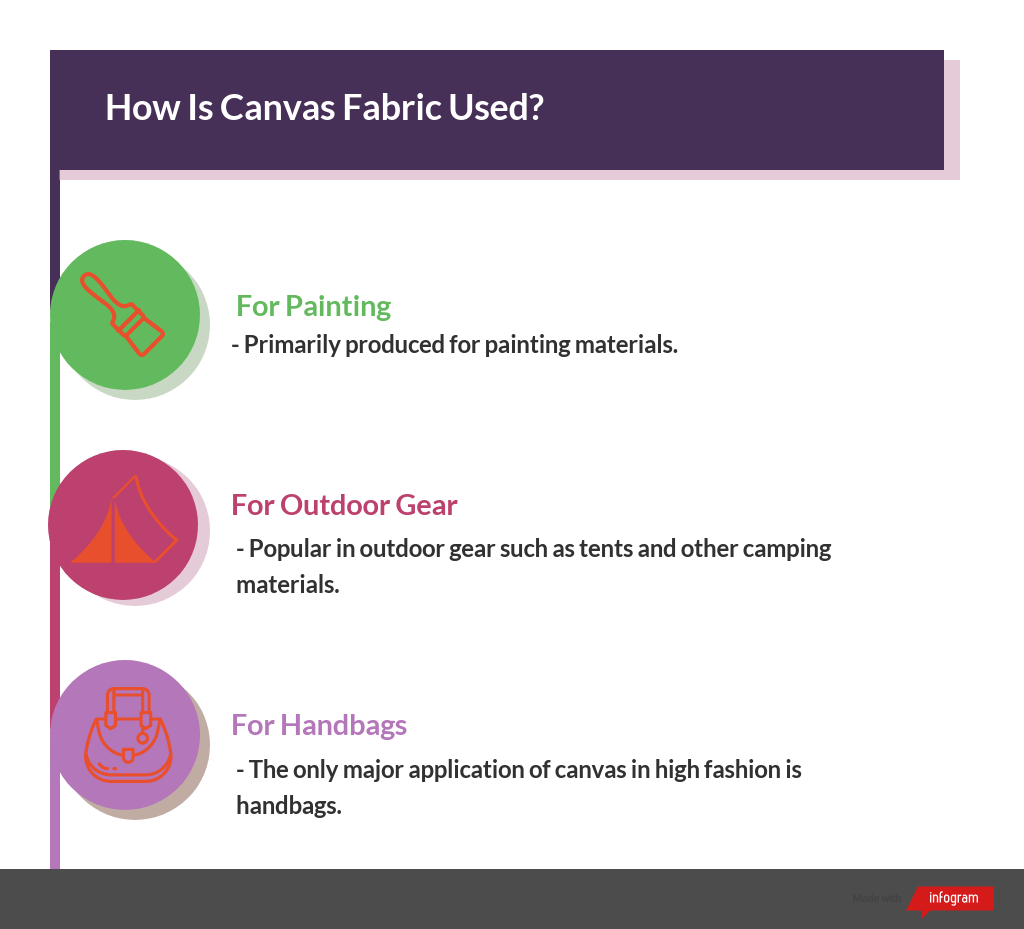
How Is Canvas Fabric Used?
Canvas serves consumer, commercial, artistic, outdoor, and industrial markets.
Bags and Accessories
Canvas is used for totes, handbags, backpacks, tool bags, luggage, organizers, straps, and reinforced panels. Relevant tests may include tensile and tear strength, seam slippage, abrasion resistance, colorfastness, coating adhesion, and load testing of the finished product.
Workwear and Utility Clothing
Firm cotton or blended duck may be selected for chore coats, work trousers, aprons, pockets, and reinforcement panels. Developers must balance durability with garment weight, mobility, breathability, washing, and wearer comfort.
Footwear
Canvas is common in sneaker uppers, espadrilles, casual shoes, and accessory components. Footwear programs may require flex, abrasion, bonding, dimensional-stability, color-migration, and process-temperature evaluations.
Tents, Covers, Tarpaulins, and Awnings
Outdoor canvas may be used for tents, equipment covers, furniture covers, shade products, awnings, and tarpaulins. The specification may need to address rain exposure, hydrostatic pressure, UV resistance, mildew, flame performance, seam construction, and dimensional change.
Uncoated cotton canvas and coated synthetic canvas are not interchangeable. The correct selection depends on climate, expected service life, storage, maintenance, weight, and market requirements.
Upholstery and Home Furnishings
Canvas can be developed for cushion covers, casual upholstery, storage products, blinds, curtains, table textiles, and decorative printed products. Abrasion, pilling, seam performance, rubbing fastness, lightfastness, cleanability, and dimensional stability may be relevant.
Painting, Printing, and Display Products
Canvas remains an important painting support and is also used for photographic prints, signage, branded merchandise, retail displays, wall décor, and craft products.
Print results depend on fiber composition, surface texture, pretreatment, ink chemistry, coating, curing, color gamut, and the required rub, light, or wash fastness.
Industrial Applications
Heavy canvas may be used for machinery covers, reusable transport packaging, workshop dividers, dust covers, protective curtains, tool organizers, and material-handling products. Industrial specifications should be based on the actual hazards and service conditions rather than the fabric name alone.
Where Is Canvas Fabric Produced?
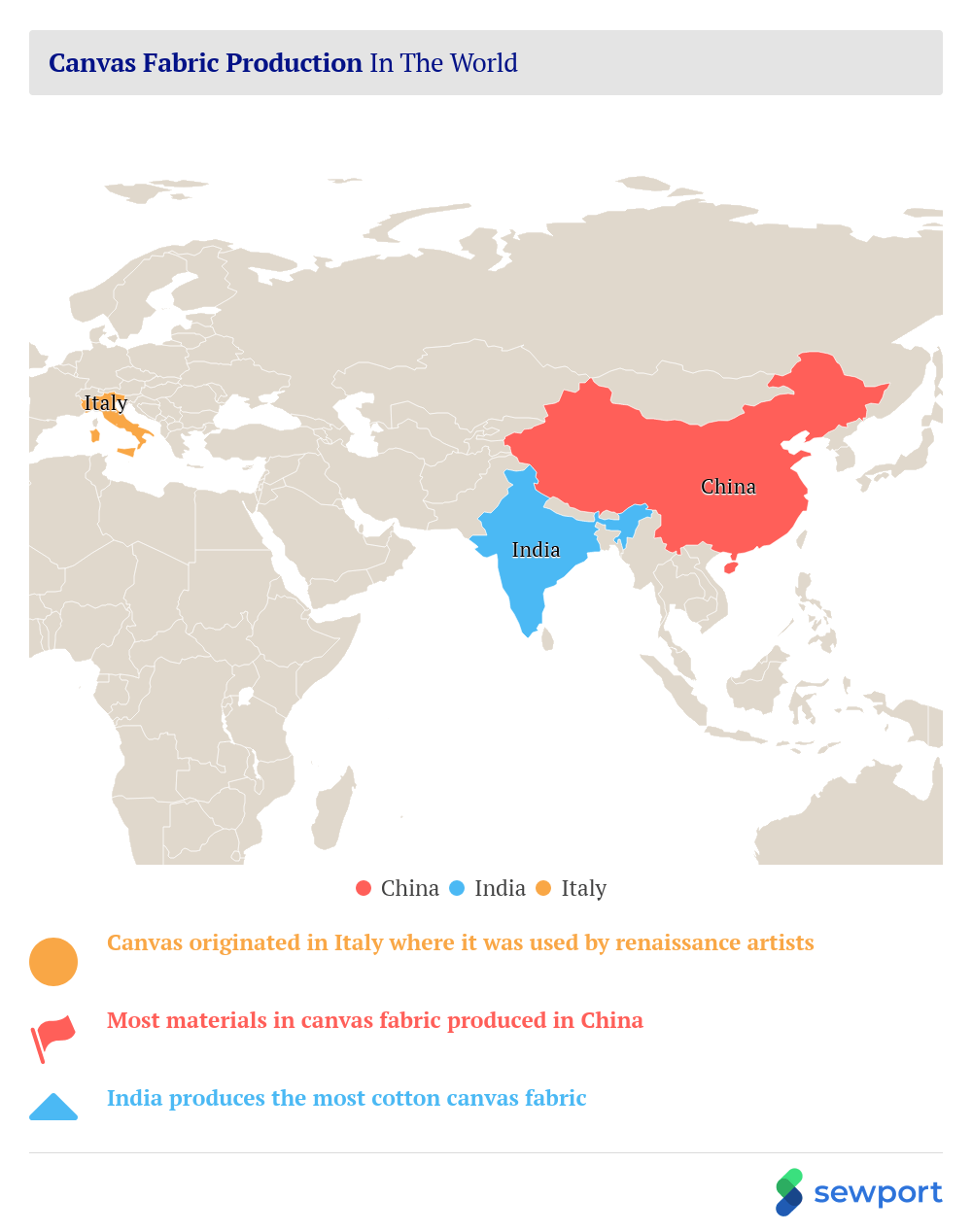
Canvas has a global supply chain. Fiber cultivation or polymer production, spinning, weaving, dyeing, printing, coating, sewing, and final assembly may occur in different countries.
It is therefore misleading to assign all canvas to one country of origin or to assume that the country supplying the raw fiber also produces the finished fabric.
China remains an important integrated textile-manufacturing and finishing location, while other countries also produce cotton, linen, hemp, synthetic yarns, woven fabrics, and finished canvas products. The best sourcing location depends on:
- Required fiber and construction;
- Mill and finishing capabilities;
- Order volume;
- Lead time;
- Testing and documentation;
- Coating or printing requirements;
- Labor and conversion costs;
- Shipping route and destination market;
- Country-of-origin and customs rules.
FabricsTrades is based in Wujiang District, Suzhou, within a major textile-manufacturing cluster. Depending on the project, the company can help evaluate canvas constructions, fibers, weights, widths, colors, printing, coatings, sampling, testing requests, and supporting documentation. Availability must be confirmed against the final specification.
What Determines the Cost of Canvas Fabric?
Canvas prices vary too widely for a single market-wide figure. Major cost drivers include:
- Fiber type and origin;
- Virgin, recycled, organic, or specialty material requirements;
- Yarn size and quality;
- Finished fabric weight and density;
- Width and usable yield;
- Dyeing or printing method;
- Coating, lamination, or specialty finishing;
- Color quantity and approval requirements;
- Testing and documentation;
- Minimum order quantity;
- Packaging, freight, duty, and commercial terms.
A heavier fabric can cost more per linear meter while offering different cutting yield or product performance. Buyers should compare quotations using the same composition, finished weight, width, finish, usable quality standard, testing scope, and trade terms.
Environmental and Certification Considerations
Canvas should not be described as environmentally neutral simply because it contains natural fibers. Cotton, linen, and hemp cultivation can involve land, water, fertilizers, pesticides, energy, and processing chemicals. Synthetic fibers depend on polymer and energy inputs, while coatings and laminations may make material separation or recycling more difficult.
The European Environment Agency’s assessment of textiles and the environment emphasizes that impacts occur across fiber production, textile manufacturing, distribution, use, and end of life. Material durability, long service life, repairability, chemical selection, waste reduction, and credible sourcing documentation all matter.
There is no single certification that proves “canvas fabric” as a category is sustainable or compliant. Depending on the product and claim, buyers may encounter organic-fiber, recycled-content, chemical-safety, or chain-of-custody certification programs. A certificate should be checked for:
- Issuing body and current validity;
- Certified organization and production site;
- Product and process scope;
- Applicable standard version;
- Fiber or recycled-content claim;
- Transaction or shipment documentation where required;
- Connection to the actual order and production lot.
A generic logo, supplier statement, or expired scope certificate is not sufficient evidence for every product claim.
Current Regulatory and Market Update

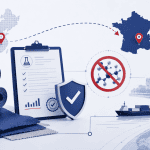
Water-, oil-, and stain-resistant canvas deserves particular attention because fluorinated finishing chemistry may introduce PFAS-related requirements. The applicable rule depends on the chemical, concentration, product category, destination market, and date the finished article is placed on the market.
European Union: Binding PFHxA Restriction
Commission Regulation (EU) 2024/2462 added a PFHxA restriction to Annex XVII of EU REACH.
From October 10, 2026, specified concentration limits apply to PFHxA, its salts, and PFHxA-related substances in textiles used in clothing and related accessories for the general public, as well as footwear for the general public. From October 10, 2027, the restriction extends to other textiles for the general public, subject to the regulation’s scope and exemptions.
This is relevant to canvas used in jackets, footwear, handbags, and other treated consumer products. Buyers can review a supply-chain-focused explanation of the EU REACH PFHxA restriction, but the official regulation and the exact finished-product scope should control the compliance assessment.
European Union: Broader PFAS Proposal
The proposed universal PFAS restriction under EU REACH is broader than the adopted PFHxA restriction. As of August 11, 2026, it remains a restriction proposal rather than a blanket PFAS ban already applying to every canvas product. The European Chemicals Agency’s PFAS information should be monitored for further decisions.
FabricsTrades also provides an overview of the proposed EU universal PFAS restriction and textile supply chains. Buyers should distinguish this proposal from PFAS restrictions that are already adopted and entering application.
California: PFAS in Textile Articles
California Health and Safety Code Section 108971 has prohibited, from January 1, 2025, the manufacture, distribution, sale, or offer for sale in California of covered new textile articles containing regulated PFAS, subject to definitions and exclusions. The law also requires manufacturer certificates of compliance. Outdoor apparel for severe wet conditions has a delayed prohibition and specified disclosure rules.
Canvas products can fall within the law’s broad textile-article categories, including apparel, accessories, handbags, backpacks, furnishings, and upholstery. Some products and components are excluded, so buyers should review the current California statutory text rather than assuming that every canvas application has identical treatment.
Practical Buyer Actions
Before sampling treated canvas, communicate:
- Destination country or state;
- Finished product category and intended user;
- Fiber composition and coating or finish;
- Whether water, oil, or stain repellency is required;
- Restricted-substance specification;
- Required test method, laboratory, and limits;
- Chemical declarations and certificate requirements;
- Lot and batch traceability;
- Production and market-placement dates;
- Any retailer-specific requirements.
“PFC-free,” “C0,” “fluorine-free,” or similar marketing language should not be treated as a substitute for a clear chemical specification, supporting declarations, and appropriate testing.
Documentation needs vary by product, treatment, production batch, destination market, and date of sale. Buyers should verify current legal and retailer requirements before bulk production.
Canvas Quality-Control and Sourcing Checklist

A complete canvas specification should cover more than composition and color.
Material and Construction
- Fiber content and permitted tolerance;
- Virgin, recycled, organic, or blended status where relevant;
- Yarn type and count;
- Weave and construction;
- Finished weight and tolerance;
- Finished width and usable width;
- Color, print, surface texture, and hand feel;
- Coating, lamination, or other finish;
- Face and back identification.
Performance
Depending on the end use, confirm:
- Tensile and tear strength;
- Abrasion resistance;
- Seam slippage or seam strength;
- Pilling;
- Dimensional change;
- Colorfastness to washing, water, rubbing, perspiration, or light;
- Water repellency or hydrostatic pressure;
- Coating adhesion;
- Flex or fold durability;
- Print adhesion and fastness;
- UV, mildew, or flame-performance requirements.
Not every test applies to every canvas. The test plan should reflect the finished product and target market.
Sampling and Bulk Control
Approve a physical reference, lab dip, strike-off, or pre-production sample before bulk manufacturing. Record measurable tolerances instead of relying only on descriptions such as “heavy,” “soft,” “waterproof,” or “durable.”
Bulk inspection should confirm roll identification, shade continuity, width, weight, appearance, defects, coating condition, packing, and lot documentation. FabricsTrades’ guide to fabric quality inspection procedures provides additional procurement context.
How to Care for Canvas
Care instructions must match the fiber, dye, print, coating, construction, and finished product.
General precautions include:
- Remove loose dirt before wet cleaning;
- Spot-clean with a compatible mild detergent when permitted;
- Avoid bleach unless the care specification expressly allows it;
- Do not assume that coated or printed canvas is machine washable;
- Dry the product completely before storage;
- Store away from prolonged moisture, contamination, and direct sunlight;
- Avoid high heat that could shrink natural fibers or damage coatings and adhesives;
- Follow the finished product’s care label instead of applying one universal canvas-washing temperature.
Painting canvas, footwear, luggage, tents, upholstery, and coated industrial products require different care methods.
Frequently Asked Questions
Is canvas fabric waterproof?
No. Uncoated canvas is not automatically waterproof. A dense weave may slow light moisture, but reliable waterproof performance normally requires an appropriate coating, lamination, impregnation, finish, and—where relevant—sealed seams.
What is the difference between canvas and duck canvas?
Duck is a tightly woven type of canvas. It generally has a more compact surface than ordinary plain canvas, but its actual weight, strength, and performance still depend on the yarn, density, fiber, and finish.
What is the difference between canvas and denim?
Canvas is normally plain woven, while denim normally uses a twill weave with visible diagonal ribs. Both can be durable, but they differ in structure, appearance, drape, and processing behavior.
Is cotton or polyester canvas better?
Neither is universally better. Cotton offers a natural-fiber handle, absorbency, and good print or dye compatibility. Polyester may provide faster drying, dimensional stability, and compatibility with certain coatings. The correct choice depends on use, care, appearance, performance, price, and destination-market requirements.
Does canvas fabric stretch?
Conventional canvas has limited stretch. Cotton may provide modest give, but substantial stretch and recovery usually require a specialized construction or elastomeric fiber.
Is canvas fabric sustainable?
Canvas is not automatically sustainable. Environmental performance depends on fiber production, manufacturing, chemistry, durability, transport, use, and end-of-life management. Organic or recycled claims should be supported with documentation applicable to the actual order.
Can canvas be machine washed?
Some uncoated cotton canvas can be machine washed, but printed, coated, laminated, structured, or assembled products may require spot cleaning or another method. Always follow the approved care specification for the finished product.
Where can buyers source custom canvas fabric?
Canvas is available through mills and sourcing partners in multiple textile-producing regions. Buyers should provide the intended application, fiber, weight, width, quantity, color, finish, testing, documentation, and destination market. FabricsTrades can help evaluate sourcing and development routes, subject to the final specification and availability.
Selecting the Right Canvas for Your Product
Canvas is a versatile woven-fabric family rather than a single standardized material. Its performance depends on the interaction of fiber, yarn, weave, density, weight, finish, sewing construction, and end-use conditions.
Before requesting a quotation, prepare a specification that identifies the intended product, reference sample, composition, weight, width, color, finish, quantity, testing, care, and destination market. FabricsTrades can assist with evaluating suitable canvas options, samples, custom development, testing coordination, and documentation requests according to project requirements.