Corduroy is a woven cut-pile fabric distinguished by parallel raised ribs called wales. It is commonly made from cotton, but cotton-polyester blends, stretch blends, wool, rayon, and other fibers can also be used.
The fabric’s performance depends on more than its name. Fiber composition, wale count, fabric weight, pile density, backing construction, dyeing method, and finish all influence its appearance, durability, warmth, stretch, care requirements, and price.
For brands, garment factories, importers, and product developers, the most important sourcing questions are therefore not simply “Is this corduroy?” but “What type of corduroy is it, how was it tested, and is it suitable for the intended product?”
Key Takeaways
- Corduroy is a cut-pile woven fabric, not a specific fiber.
- Its ribs are called wales; a lower wale count means wider ribs, while a higher count means finer ribs.
- Cotton is common, but blends can improve stretch, dimensional stability, cost, or ease of care.
- Corduroy is often warm and durable, but these properties vary with construction and composition.
- Nap direction, shade consistency, pile crushing, shrinkage, and colorfastness require particular attention during sampling and production.
- Care instructions and compliance documents should be based on the finished fabric and garment, not on generic assumptions about corduroy.
Corduroy Fabric at a Glance
| Attribute | Typical description |
|---|---|
| Fabric name | Corduroy |
| Also known as | Cord, pinwale, wide-wale corduroy; sometimes Manchester cloth in certain markets |
| Construction | Woven ground fabric with cut filling-pile yarns forming lengthwise ribs |
| Common fibers | Cotton, cotton-polyester blends, stretch blends, wool, rayon, or synthetic fibers |
| Typical wale range | Approximately 1.5 to 21 wales per inch, depending on supplier terminology and construction |
| Breathability | Usually moderate, but strongly dependent on fiber, weight, density, and finish |
| Heat retention | Often moderate to high in heavier constructions |
| Stretch | Normally limited unless elastane or another stretch construction is used |
| Pilling or surface change | Depends on fiber, yarn quality, pile construction, abrasion, and finishing |
| Common uses | Trousers, jackets, overshirts, dresses, childrenswear, uniforms, accessories, cushions, and upholstery |
| Care | Must be confirmed for the exact fiber blend, dye, finish, and finished product |

What Is Corduroy Fabric?
Corduroy is a woven fabric with evenly spaced, raised pile ribs running along its length. These ribs create its recognizable striped texture and give the surface a soft, dimensional appearance.
Unlike “cotton” or “polyester,” corduroy does not describe the fiber content. A fabric can be 100% cotton corduroy, cotton-polyester corduroy, stretch cotton corduroy, wool corduroy, or another blend. Buyers should therefore specify both the construction and the complete fiber composition.
Many classic corduroys use a plain- or twill-woven ground with additional filling yarns that float over groups of warp yarns. Those floats are cut and brushed to form the pile. The resulting ribs normally run in the warp direction.
What Does Wale Count Mean?
A wale is one raised rib. Wale count usually describes the number of ribs in one inch of fabric.
- A low wale count produces broad, prominent ribs.
- A high wale count produces narrow, closely spaced ribs.
- An intermediate count produces the familiar appearance of standard corduroy.
For example, elephant cord may have only a few ribs per inch, while fine pinwale corduroy may have approximately 16–21. These categories are commercial conventions rather than universal technical standards, so buyers should approve a physical swatch instead of relying on a product name alone.
Wale count also does not fully describe quality. Pile height, pile density, yarn fineness, ground construction, fabric weight, brushing, and shearing can make two fabrics with the same nominal wale count look and perform differently.
A Brief History of Corduroy
Ribbed fabrics related to corduroy are often traced to earlier fustian constructions. Modern corduroy is commonly associated with British textile production during the 18th century, although its development cannot be reduced to a single factory or invention date.
The popular claim that “corduroy” comes directly from the French phrase corde du roi, or “cloth of the king,” is not supported by clear historical evidence. Other proposed origins include older English trade terminology and the surname Corderoy.
Corduroy became widely used for practical clothing, workwear, school uniforms, and furnishings. Its reputation shifted repeatedly: it was treated at different times as durable workwear, an inexpensive alternative to velvet, and a fashionable material associated with 20th-century and 1970s styles.
Today, corduroy continues to appear in seasonal apparel, childrenswear, work-inspired fashion, accessories, and home furnishings.
How Is Corduroy Fabric Made?

The exact production route varies with fiber, machinery, dyeing method, and the required surface. A typical woven corduroy process includes the following stages.
1. Fiber and Yarn Preparation
The manufacturer selects yarns according to the intended hand feel, strength, pile appearance, cost, and end use. Cotton remains common, while polyester may be blended with cotton to modify dimensional stability, drying behavior, or price. Elastane may be introduced for stretch.
Fiber preparation occurs before weaving. Cotton must be cleaned, carded or combed as required, and spun; manufactured fibers are produced and spun or supplied as filament yarns according to the specification.
Buyers considering natural-fiber constructions can review available cotton fabric options, while programs requiring added mobility may need to compare suitable stretch fabric constructions.
2. Weaving the Ground and Pile Structure
A ground fabric is woven to hold the construction together. Additional filling-pile yarns form floats across selected warp yarns. Their arrangement determines the number, width, and spacing of the future ribs.
Corduroy can use different ground weaves and pile arrangements. Consequently, the supplier should confirm the construction instead of describing every corduroy as an identical plain weave.
3. Stabilizing and Cutting the Pile
The floating pile yarns are cut with specialized equipment. Precise cutting is essential: missed cuts, uneven cutting depth, or damage to the ground fabric can cause visible lines, thin ribs, exposed backing, or weak areas.
Some production routes use temporary stabilization or adhesive to help control the structure during cutting. This is not necessarily part of every corduroy process, and any temporary processing aid should be removed or controlled as required.
4. Brushing, Singeing, and Shearing
After cutting, the pile is brushed so that the fibers open and stand more evenly. Singeing or shearing may be used to remove loose fibers and improve surface uniformity.
This stage strongly affects the hand feel and visual consistency. Excessive processing can weaken or flatten the pile, while insufficient brushing may leave the ribs irregular.
5. Dyeing, Washing, and Finishing
Corduroy may be yarn-dyed, piece-dyed, garment-dyed, or pigment-dyed, depending on the intended appearance. Pigment dyeing can create a washed or uneven effect that becomes more pronounced with laundering, but it is a design option rather than a feature of all corduroy.
Possible finishing stages include softening, pre-shrinking, washing, coating, stain resistance, water resistance, or mechanical finishing. Each finish can affect shade, hand feel, pile definition, care, chemical documentation, and regulatory scope.
Key Properties of Corduroy
Distinctive Texture
The wales give corduroy a recognizable three-dimensional surface. Fine-wale fabric can appear relatively smooth and refined, while wide-wale constructions look more casual and pronounced.
Corduroy also has a directional nap. Light reflects differently depending on the direction of the pile, so panels cut in opposite directions may appear to be different shades even when they come from the same dye lot.
Warmth
The raised pile can trap air and make medium- or heavyweight corduroy suitable for cooler-weather garments. Warmth nevertheless depends on fabric weight, density, fiber, lining, and garment construction. Lightweight pinwale corduroy should not be assumed to provide the same insulation as a heavy wide-wale quality.
Durability
A well-constructed corduroy can withstand regular apparel or furnishing use, but durability is not universal. The pile may flatten, polish, abrade, shed, or develop pressure marks. Seams and high-contact areas such as knees, elbows, pockets, and seat panels require particular attention.
Breathability and Moisture Behavior
Cotton-rich corduroy generally permits more moisture exchange than a dense synthetic construction, but breathability varies considerably. Dense ground fabrics, heavy pile, coatings, and laminations can reduce air permeability.
Generic claims such as “breathable” or “moisture-wicking” should be supported by the actual construction and, when commercially important, relevant testing.
Stretch and Recovery
Traditional woven corduroy usually has limited stretch. Stretch corduroy incorporates elastane or uses another engineered construction to improve mobility.
Stretch percentage alone is insufficient for product development. Recovery after extension, growth during wear, widthwise shrinkage, elastane durability, and seam behavior should also be evaluated.
Drape and Bulk
Fine-wale or lightweight corduroy may work for shirts, dresses, and childrenswear. Heavy wide-wale constructions are usually bulkier and more suitable for trousers, jackets, outer layers, cushions, or upholstery.
Advantages and Limitations
Advantages
- Recognizable ribbed appearance
- Soft, tactile pile surface
- Multiple wale widths and weights
- Suitable for apparel and furnishings
- Often provides useful warmth
- Available in cotton, blends, stretch constructions, and different finishes
- Can support casual, workwear-inspired, vintage, or premium design directions
Limitations
- Directional nap complicates marker planning and cutting
- Pile can crush or polish in high-contact areas
- Surface defects are highly visible
- Shade may appear different when panels are cut in opposite directions
- Some constructions shrink, shed lint, or attract surface debris
- Heavy corduroy can add bulk at seams
- Pigment-dyed qualities may change noticeably during washing
- Care and pressing must avoid permanently flattening the pile
Main Types of Corduroy
Standard Corduroy
Standard corduroy is often described as having approximately 8–13 wales per inch, with about 11 wales being a common reference point. Supplier definitions vary.
Elephant Cord
Elephant cord has very broad, heavy ribs, sometimes around 1.5–6 wales per inch. It creates a bold surface and is commonly considered for jackets, trousers, accessories, and furnishings where the pronounced texture is desirable.
[Image: Soft butter-colored corduroy fabric]
Pinwale Corduroy
Pinwale has fine, closely spaced ribs. Some qualities reach approximately 16–21 wales per inch. It is generally lighter in appearance and can be more suitable for shirts, dresses, childrenswear, and detailed garments.
Wide-Wale Corduroy
Wide-wale is a broader commercial category that may overlap with elephant cord. Because terminology differs among suppliers, the approved wale count and reference swatch should control the order.
Stretch Corduroy
Stretch corduroy usually combines cotton or another principal fiber with elastane. Buyers should specify fiber percentages, required stretch and recovery, shrinkage, and the direction in which stretch is needed.
Pigment-Dyed or Garment-Washed Corduroy
Pigment-dyed and garment-washed qualities are designed to develop a faded, uneven, or vintage appearance. Color transfer, wash-down consistency, seam effects, and lot-to-lot variation should be reviewed during development.
Bedford Cord
Bedford cord is a related ribbed woven fabric, but its raised structure is normally produced without the same cut pile as corduroy. It should not automatically be treated as an interchangeable corduroy specification.
How Is Corduroy Used?

Common apparel applications include:
- Trousers and jeans-style bottoms
- Jackets and overshirts
- Dungarees and overalls
- Skirts and dresses
- Childrenswear
- Uniform-inspired garments
- Hats, bags, and accessories
Home and interior applications include:
- Cushion covers
- Decorative pillows
- Chair and sofa upholstery
- Curtains and other decorative components
Upholstery corduroy should be evaluated against the actual end-use requirements. Apparel-grade fabric should not be assumed to provide suitable abrasion resistance, seam performance, flammability characteristics, colorfastness, or cleaning behavior for furniture.
Where Is Corduroy Produced?
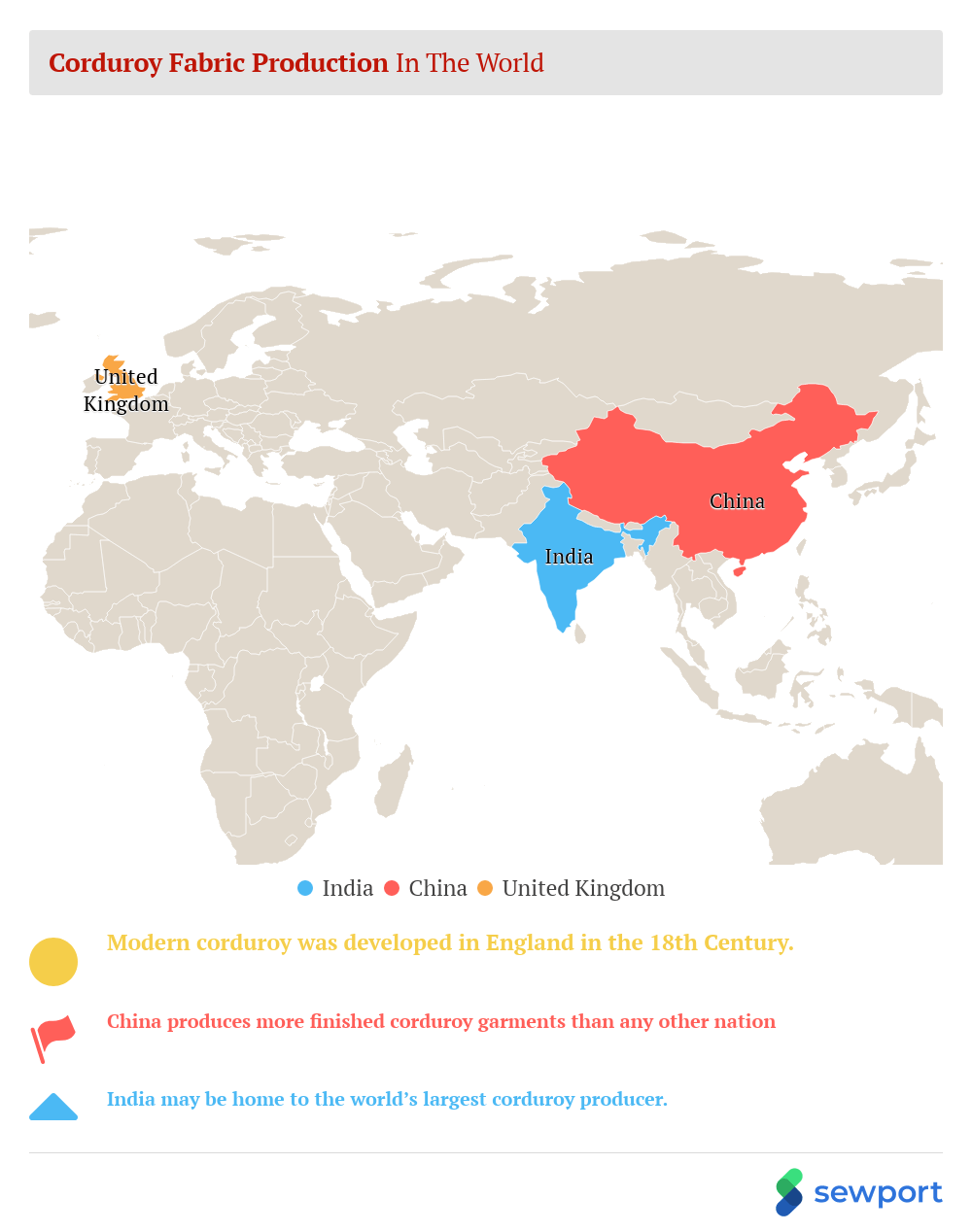
Corduroy is manufactured in several established textile-producing regions, including China, India, Pakistan, Türkiye, and parts of Europe. Production may involve separate spinning, weaving, pile-cutting, dyeing, finishing, and garment-making facilities.
The original claim that one country definitively produces the most corduroy could not be supported with a current, corduroy-specific authoritative dataset. General national textile output is not sufficient evidence of corduroy production volume.
For buyers, supplier capability is more important than a broad country ranking. Confirm whether the proposed mill or converter controls the critical pile-cutting and finishing stages, how defects are inspected, and whether repeat orders can match the approved wale, pile, shade, and hand feel.
What Affects Corduroy Fabric Cost?
Corduroy often costs more than a comparable flat woven fabric because it requires additional pile yarn, specialized weaving, accurate pile cutting, brushing, and finishing. There is no reliable universal premium.
Important cost variables include:
- Fiber and yarn quality
- Fabric weight and usable width
- Wale count and pile density
- Cotton, polyester, wool, or elastane content
- Dyeing and washing route
- Finishes or coatings
- Color quantity and minimum order requirements
- Inspection and testing requirements
- Packaging and documentation
- Order volume, season, and production capacity
Quotations should therefore be compared against an aligned specification rather than price per metre alone.
Care and Garment-Processing Considerations
There is no single safe washing temperature for every corduroy. Care depends on fiber content, dye, finish, interlining, trims, garment construction, and dimensional-stability results.
Useful precautions may include:
- Test the finished fabric or garment before confirming care instructions.
- Keep the nap direction consistent during cutting.
- Turn washable garments inside out to reduce pile abrasion.
- Avoid overcrowding during washing and drying.
- Use only an approved drying temperature.
- Press from the reverse side or use controlled steaming to avoid crushing the ribs.
- Brush the dry pile gently when appropriate.
- Evaluate pigment-dyed qualities for continued shade change and color transfer.
For the United States, the FTC Care Labeling Rule requires covered manufacturers and importers to provide regular care instructions and possess a reasonable basis for those instructions. Generic care advice should not replace product-specific evidence.
Corduroy Quality-Control Checklist
Before bulk production, buyers should define and approve:
- Complete fiber composition
- Wale count per inch and measurement method
- Fabric weight and tolerance
- Usable width
- Pile height, density, and uniformity
- Ground construction
- Hand feel and approved reference swatch
- Nap direction
- Color standard and shade tolerance
- Stretch and recovery, when applicable
- Dimensional stability
- Colorfastness to washing and rubbing
- Pile retention and shedding
- Abrasion or surface-change performance
- Seam strength or seam slippage
- Bow, skew, and rib alignment
- Visible defect limits
- Finish and chemical requirements
- Roll length, packaging, and inspection method
Common defects include missed or uneven pile cuts, tramlines, crushed ribs, exposed ground fabric, shading, barre, bowing, contamination, holes, oil marks, and inconsistent brushing.
A structured inspection plan should cover incoming material, pilot production, bulk rolls, and pre-shipment evaluation. FabricsTrades’ fabric quality inspection procedures provide additional context for building a procurement checklist.
Environmental Considerations
Corduroy is not inherently sustainable or unsustainable. Its environmental profile depends on fiber production, dyeing, finishing, durability, care, transport, and end-of-life conditions.
- Conventional cotton production can involve substantial land, water, fertilizer, and pesticide inputs, with results varying by region and farming method.
- Polyester is fossil-derived unless recycled feedstock is used, and synthetic fabrics can release microfibres during use and washing.
- Wool is renewable and biodegradable under suitable conditions but has animal-welfare, land-use, and greenhouse-gas considerations.
- Blended constructions may provide performance benefits but can be more difficult to recycle.
- Longer usable life can improve material efficiency, but durability alone does not validate a broad environmental claim.
For recycled-content programs, buyers can review appropriate recycled fabric sourcing options and request evidence that supports the claimed fiber, percentage, supply-chain scope, and production batch. A certificate held by one company does not automatically certify every product it sells.
Current Regulatory and Market Update
Fiber Labeling and Care Information
Corduroy is a construction name, so labels still need to identify the actual fibers.
In the European Union, Regulation (EU) No 1007/2011 governs textile fiber names and related composition labeling. Multi-fiber products generally must identify constituent fibers and percentages by weight in descending order, subject to the regulation’s detailed provisions and exceptions.
In the United States, the FTC Textile Fiber Rule requires covered textile products to disclose the generic fiber names and percentages, the manufacturer or marketer identity, and the country where the product was processed or manufactured.
Buyers should communicate destination countries before labeling, packaging, and production approval because language, product-scope, care-label, and other requirements vary.
PFAS and Performance Finishes
Untreated corduroy does not need PFAS to achieve its ribbed construction. Regulatory relevance arises when stain-resistant, water-resistant, oil-repellent, or other performance finishes are specified.
California AB 1817 prohibits, from January 1, 2025, the manufacture, distribution, sale, or offer for sale of new textile articles containing regulated PFAS, subject to specified scope and exceptions. Outdoor apparel for severe wet conditions has a later January 1, 2028 date, with disclosure provisions applying from 2025. The official AB 1817 text also addresses manufacturer certificates of compliance.
Programs supplying California should review AB 1817 and its implications for textile supply chains and confirm the current legal scope for the finished article. A generic “PFAS-free” statement should not replace supplier declarations, formulation information, testing where required, or destination-specific legal review.
EU Traceability and Digital Product Passports
Under the EU Ecodesign for Sustainable Products Regulation framework, textile apparel is a priority group in the 2025–2030 working plan. The European Commission states that textile-specific Digital Product Passport requirements will be defined through a future delegated act; its current indicative timeline points to planned adoption in the fourth quarter of 2027 and notes that the timeline may change.
Therefore, a Digital Product Passport is not yet a universal requirement for every corduroy fabric or garment as of August 11, 2026. Nevertheless, buyers targeting the EU can prepare by organizing fiber-composition data, supplier identities, product references, care information, finish declarations, and traceability records. The European Commission’s textile-apparel DPP page provides the current official status, while FabricsTrades’ guide to ESPR and Digital Product Passports for Chinese fabric supply chains offers related sourcing context.
Legal, retailer, testing, and documentation requirements should be reconfirmed for the destination market, finished product, production date, and specified finish before bulk production.

How to Source Corduroy Fabric
A practical sourcing process is:
- Define the end use, target market, design, season, and expected care method.
- Specify fiber content, wale count, weight, width, stretch, pile, color, and finish.
- Obtain swatches or hanger samples for visual and hand-feel comparison.
- Request a development sample or lab dip where appropriate.
- Approve the nap direction and cutting requirements.
- Agree on tests, tolerances, inspection criteria, and required documents.
- Compare bulk production with the signed reference sample.
- Confirm packaging, roll identification, shade grouping, and shipment records.
FabricsTrades is based in Wujiang District, Suzhou, and operates its own four-way stretch fabric factory. For corduroy projects, the company can help evaluate sourcing routes, alternative fibers, weights, widths, colors, stretch options, finishes, samples, and documentation requests through relevant textile resources. Availability and support should be confirmed against the final specification.
Frequently Asked Questions
Is corduroy always made from cotton?
No. Cotton is common, but corduroy can also be made from cotton-polyester blends, stretch blends containing elastane, wool, rayon, or other manufactured fibers.
What does the wale number of corduroy mean?
The wale number usually indicates how many raised ribs occur in one inch. Lower numbers mean wider ribs, while higher numbers mean finer, more closely spaced ribs.
Is corduroy a warm fabric?
Corduroy is often warm because its raised pile can trap air, especially in heavy constructions. Lightweight pinwale fabric, however, may provide much less insulation than heavy wide-wale corduroy.
Does corduroy stretch?
Traditional woven corduroy has limited stretch. Stretch corduroy generally contains elastane or uses another construction designed to provide extension and recovery.
What is the difference between corduroy and velvet?
Both have pile surfaces, but corduroy has distinct lengthwise ribs. Velvet normally presents a more uniform pile surface without corduroy’s regular wale structure.
Why do corduroy garment panels sometimes look like different colors?
Corduroy has a directional nap that reflects light differently when reversed. Garment panels should normally be cut in a consistent direction, and shade should be evaluated under controlled lighting.
Is corduroy sustainable?
Corduroy is not automatically sustainable. Its impact depends on fiber source, farming or polymer production, dyeing, finishing, durability, care, supply-chain practices, and end-of-life options.
Can apparel corduroy be used for upholstery?
Only after verifying that it meets the required upholstery performance. Abrasion, seam behavior, colorfastness, cleaning, flammability, and other specifications may differ substantially from apparel requirements.
Conclusion
Corduroy is a versatile cut-pile fabric whose appearance and performance are controlled by wale count, fiber composition, weight, pile quality, dyeing, and finishing. Fine pinwale, heavy wide-wale, stretch, cotton-rich, blended, and pigment-dyed qualities serve different applications and should not be treated as interchangeable.
Before placing a bulk order, approve a physical standard and confirm nap direction, shade, shrinkage, colorfastness, pile durability, care instructions, chemical requirements, and destination-market documentation. FabricsTrades can help evaluate corduroy sourcing and development options according to the required construction and end use.