Lace is a decorative openwork textile in which patterned solid areas are combined with deliberate spaces or holes. It can be made directly from interlooped, twisted, braided, or knitted yarns, or produced by embroidering a design onto a temporary or permanent ground.
Lace is not one standardized fiber or construction. It may be made from cotton, linen, silk, polyester, polyamide, viscose, elastane blends, metallic yarns, or combinations of these materials. Its performance therefore depends on the fiber, construction, pattern density, finishing, and intended application.
Key Takeaways
- Lace is defined mainly by its patterned openwork construction, not by one fiber.
- Handmade needle and bobbin lace coexist with industrial Raschel, Leavers, embroidered, and dissolved-ground constructions.
- Breathability, stretch, drape, durability, and care requirements vary substantially between lace styles.
- Tulle and mesh can serve as lace grounds, but plain tulle or mesh is not automatically lace.
- Buyers should specify usable width, repeat, edge design, stretch, fiber content, color, finish, and test requirements before bulk production.
- Fiber labeling and chemical restrictions depend on the destination market and final product.
- For EU consumer apparel, an adopted PFHxA restriction begins applying on October 10, 2026, subject to its stated scope, thresholds, and exemptions.

What Is Lace Fabric?
Lace is an openwork fabric or trim built around a decorative pattern. Floral motifs are common, but lace can also use geometric, abstract, figurative, or all-over designs.
Some lace is created as an independent textile, including traditional needle and bobbin lace. Other products commonly sold as lace are knitted on Raschel machines, woven on Leavers machines, or embroidered onto tulle or another net ground. Guipure and related products may be embroidered on a removable foundation so that the motifs remain connected after the ground is dissolved or otherwise removed.
This distinction matters commercially. Two materials sold under the same style name can behave very differently during cutting, sewing, dyeing, washing, and wear.
Typical Lace Fabric Characteristics
| Characteristic | Typical behavior | Important qualification |
|---|---|---|
| Fiber composition | Cotton, linen, silk, polyester, polyamide, viscose, elastane blends, metallic or blended yarns | “Lace” does not identify the fiber |
| Surface | Patterned, textured, sheer, semi-sheer, or relatively dense | Motif coverage and yarn size determine transparency |
| Breathability | Often good in open constructions | Linings, coatings, dense embroidery, and fiber choice can reduce airflow |
| Stretch | Low in rigid bobbin, Leavers, or embroidered lace; moderate to high in knitted stretch lace | Stretch direction and recovery must be measured on the selected article |
| Drape | Ranges from soft and fluid to crisp or structured | Fiber, yarn count, ground, cording, and finish affect drape |
| Moisture behavior | Highly variable | Fiber content and finish matter more than the word “lace” |
| Durability | Can be vulnerable to snagging and motif damage | Corded, dense, or heavier constructions may be more robust |
| Heat retention | Usually limited in open, unlined constructions | The complete garment system determines thermal performance |
| Care | Often gentle washing, low agitation, or professional cleaning | The supplier’s and finished-product care instructions take priority |
| Common uses | Bridalwear, lingerie, dresses, blouses, trims, accessories, curtains, table linens, and decorative home textiles | Construction should be matched to the end use |
Terms such as Chantilly, guipure, corded, eyelash, stretch, and embroidered tulle may describe different aspects of the product—its historical style, construction, edge, surface, or performance. Buyers should not rely on the trade name alone.
A Short History of Lace
Decorative openwork techniques existed in ancient and medieval textiles, but the precise birthplace of true lace remains disputed. Independent needle and bobbin lace became prominent in Europe during the fifteenth and sixteenth centuries, particularly in areas associated with Italy and Flanders.
From the seventeenth through eighteenth centuries, European centers in present-day Belgium, France, Italy, England, Spain, and other regions developed distinctive lace traditions. Fine lace was labor-intensive and often communicated wealth or status.
Mechanization during the nineteenth century changed the industry. Machines were developed to reproduce net grounds and complex lace-like structures at greater speed and lower cost. Handmade lace continued as a specialist craft, while industrial production expanded lace into broader bridal, fashion, lingerie, and home-textile markets.
Today, lace production is global. China and other Asian textile centers are significant sources of machine-made and embroidered lace, while European manufacturers and workshops continue to produce heritage, premium, and specialist constructions. A current, comprehensive official ranking of lace-producing countries was not identified, so buyers should evaluate individual suppliers rather than relying on national rankings.
How Is Lace Fabric Made?

Every lace-production route begins with yarn or thread selection. Fiber choice affects appearance, strength, dyeing, handle, stretch, care, price, and possible certification.
The manufacturer then develops the pattern, ground, motif repeat, width, edge, color, and required performance. Production follows one of several main routes.
Needle Lace
Needle lace is built with a needle and thread, traditionally over a temporary pattern or support. Guiding threads define the design, and small stitches create the motifs and connecting bars.
This method can produce exceptionally detailed work but is slow and labor-intensive. Genuine handmade needle lace should not be confused with machine embroidery designed to imitate its appearance.
Bobbin and Leavers Lace
Traditional bobbin lace is made by twisting and crossing multiple threads held on bobbins around pins placed on a pillow. The number of bobbins varies with the width and complexity of the pattern.
Leavers machines industrialized aspects of bobbin-lace construction and can create fine, stable, highly detailed lace. Leavers lace is often associated with premium lingerie and bridalwear, but the trade description should be supported by the supplier’s construction information.
Raschel Warp-Knitted Lace
Raschel machines produce lace-like patterned structures through warp knitting. This method is widely used for scalable apparel, lingerie, stretch lace, curtains, and decorative fabrics.
Raschel construction can accommodate fine or heavy yarns, elastic yarns, engineered patterns, and a wide range of weights. Unlike rigid traditional lace, Raschel stretch lace may offer significant widthwise or multidirectional extension, depending on its yarn arrangement.
Embroidered Lace on Tulle or Mesh
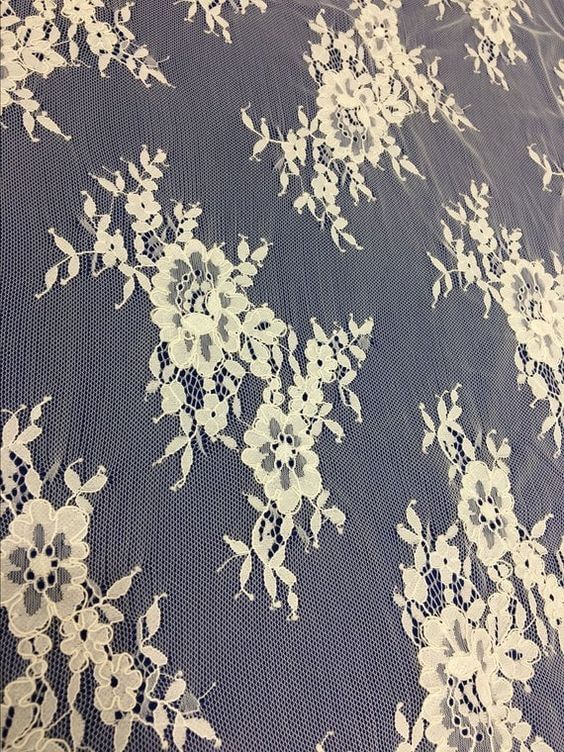
A motif can be embroidered onto tulle, net, organza, or another base fabric. The ground remains in the finished product, making this construction different from independent needle or bobbin lace.
[Image: Floral-leaf mesh embroidered lace for bridalwear]
Embroidery may include cording, sequins, beads, appliqué, or three-dimensional elements. Buyers should inspect attachment security, motif registration, reverse-side appearance, usable width, and the compatibility of the ground and embroidery yarns with dyeing and care processes.
Guipure and Dissolved-Ground Lace
Guipure-style lace consists of connected motifs without a visible net ground. One production route embroiders the design onto a temporary foundation that is removed after stitching.
The foundation may be water-soluble, heat-sensitive, or removed using another controlled process. The older term “chemical lace” is still used, but it does not identify one universal modern production method or environmental profile.
Dyeing, Finishing, and Inspection
Lace can be piece-dyed, yarn-dyed, printed, coated, softened, heat-set, washed, or embellished. The sequence depends on its fibers and construction.
Mixed-fiber lace can be difficult to shade consistently because the ground, motifs, cording, and elastic yarns may absorb dye differently. Final inspection should therefore cover shade, width, repeat, stretch, edge consistency, holes, broken yarns, stains, bowing, skew, and embellishment security.
Main Types of Lace Fabric
The following categories preserve common traditional and commercial lace terms, but the categories can overlap.
1. Crocheted Lace
Crocheted lace is produced with crochet techniques rather than classic needle- or bobbin-lace methods. Filet crochet, Irish crochet, and pineapple motifs are familiar examples.
2. Bobbin Lace
Bobbin lace is created by twisting and crossing threads around pins. Handmade forms range from relatively simple trims to extremely intricate patterns; machine-made relatives include Leavers constructions.
3. Knitted and Raschel Lace
Knitted lace uses loops to create patterned openings. It can be made by hand or machine. Industrial Raschel lace is especially important for lingerie, fashion, and elastic lace applications.
4. Cutwork
Cutwork begins with a base fabric. Selected areas are cut away and the remaining edges are secured with stitching or embroidery. Hand and automated production methods are both possible.
5. Needle Lace
Needle lace is built stitch by stitch with a needle and thread. It is valued for detail and craftsmanship but is generally unsuitable for high-volume, price-sensitive production.
6. Tape Lace
Tape lace arranges a pre-made tape or braid into a pattern and joins the sections with stitches or connecting bars. Handmade and machine-assisted variations exist.
7. Guipure or Dissolved-Ground Lace
Guipure has substantial connected motifs without an obvious net ground. Industrial versions are frequently embroidered on a removable foundation.
8. Sheer Lace
Sheer lace has a high proportion of open space. It may require a lining, strategically placed motifs, or garment engineering to provide coverage.
9. Dense or Fully Patterned Lace
Dense lace has greater motif coverage and less transparency. It can offer more visual weight and coverage but is not necessarily stronger than open lace.
10. Corded Lace
Corded lace uses thicker outline yarns to emphasize motifs. Cording creates relief and definition and may also change stiffness, weight, seam behavior, and care requirements.
11. Beaded or Sequined Lace
Beads, sequins, pearls, or other decorative components are attached to a lace construction or embroidered ground. Attachment strength and placement must be checked before cutting and bulk production.
[Image: Ivory embroidered daisy lace for bridalwear and curtains]
12. Limerick and Other Embroidered-Net Laces
Historical Limerick lace uses embroidery or tambour work on a machine-made net ground. The term illustrates why a product can be culturally recognized as lace even when its pattern is worked onto an existing foundation.
Other frequently encountered names include Chantilly lace, eyelash lace, Alençon-style lace, stretch lace, appliqué lace, and three-dimensional floral lace. Suppliers should define what these names mean for the specific article.
Lace vs. Tulle, Mesh, and Embroidery
These materials are related but not interchangeable.
| Material | Defining feature | Common buyer consideration |
| Lace | Decorative openwork pattern forming the fabric or applied to a ground | Motif, repeat, construction, edge, stretch, and usable width |
| Tulle | Fine open net, commonly hexagonal or diamond-shaped | Stiffness, hole size, width, color, and embroidery compatibility |
| Mesh | Broad category of open structures for fashion, lining, sport, filtration, and technical uses | Yarn, hole geometry, strength, stretch, and end-use performance |
| Embroidered tulle | Decorative stitching applied to an existing tulle ground | Ground stability, embroidery coverage, attachment, and dye compatibility |
For a broader explanation of net constructions, see the FabricsTrades guide to mesh fabric properties and production. Buyers sourcing a plain net ground or a base for embroidery can also review available tulle fabric options, subject to confirmation of the required specification and availability.
How Is Lace Used?
Apparel
Lace is used in:
- Bridal gowns and veils
- Lingerie and sleepwear
- Evening dresses and formalwear
- Blouses, skirts, sleeves, and overlays
- Gloves, hosiery, scarves, and fashion accessories
- Neckline, cuff, hem, and panel trims
- Appliqués and engineered garment details
A lace suitable for a rigid bridal bodice may be unsuitable for stretch lingerie. Garment developers should evaluate the complete fabric-and-lining system rather than choosing by appearance alone.
Home and Decorative Textiles
Common applications include:
- Curtains and decorative panels
- Tablecloths, runners, and doilies
- Cushion and bedding accents
- Lampshades
- Decorative covers and craft products
Home-textile lace may require different colorfastness, dimensional stability, flame-performance, or cleaning specifications from apparel lace. Requirements depend on the product and destination market.
Where Is Lace Produced?

Lace is manufactured in specialist clusters across Europe, China, and other Asian textile-producing countries. Production ranges from handcraft workshops to large Raschel and embroidery facilities.
Country of origin alone does not establish quality. Buyers should evaluate:
- Machine type and construction capability
- Pattern-development and sampling support
- Repeatability between sample and bulk
- Yarn and dye-lot control
- Embroidery and embellishment capability
- Inspection standards
- Documentation and traceability
- Minimum order quantity and lead time
- Ability to reproduce colors, edges, and engineered motifs
What Determines Lace Fabric Cost?
Lace pricing depends on more than the fiber.
Major cost drivers include:
- Handmade versus machine production
- Needle, bobbin, Leavers, Raschel, or embroidered construction
- Pattern complexity and stitch density
- Width and usable width
- Fiber and yarn quality
- Cording, beads, sequins, appliqués, or three-dimensional motifs
- Custom pattern or tooling requirements
- Dyeing and color-matching difficulty
- Order quantity
- Inspection standards and defect allowance
- Testing, certification, and documentation requirements
Handmade needle or bobbin lace is generally more expensive than high-volume machine lace. However, a heavily embroidered, beaded, or custom-engineered synthetic lace can cost more than a simpler natural-fiber lace. Quotations should therefore be based on an approved specification and sample.
Lace Fabric Sourcing and Quality Checklist
A lace specification should identify:
- Fiber composition and permitted tolerance
- Construction method
- Finished weight
- Total and usable width
- Pattern repeat and repeat direction
- Motif placement
- Scalloped, eyelash, straight, or cut edge
- Stretch direction, extension, and recovery
- Color standard and lighting conditions
- Ground and embroidery-yarn composition
- Finish and chemical requirements
- Required care performance
- End use and skin-contact category
- Packaging and rolling requirements
- Testing and destination-market documentation
During sample approval and bulk inspection, check:
- Pattern consistency: Confirm motif shape, repeat, registration, and edge continuity.
- Usable width: Exclude damaged edges or incomplete motifs when calculating consumption.
- Stretch and recovery: Measure each relevant direction and check permanent deformation.
- Shade: Compare the ground, embroidery, cord, and embellishments under agreed lighting.
- Defects: Look for broken yarns, unintended holes, missing stitches, stains, snags, distorted motifs, and loose components.
- Dimensional behavior: Test shrinkage, relaxation, and heat sensitivity using conditions relevant to production and care.
- Garment compatibility: Conduct cutting and sewing trials with the intended needle, thread, seam, lining, and reinforcement.
- Documentation: Confirm fiber declarations, finish information, test reports, certificates, and transaction documents required by the buyer.
For a broader procurement workflow, refer to FabricsTrades’ fabric quality inspection procedures.
Care and Processing Considerations

There is no universal care method for lace. Follow the approved care label for the finished product.
As a general development approach:
- Test laundering or professional cleaning before confirming the care label.
- Use low mechanical action for delicate or embellished lace.
- Protect the fabric from hooks, rough surfaces, and exposed fasteners.
- Avoid high heat unless the fiber, elastic, ground, and embellishments have been tested.
- Support heavy beaded lace during storage to reduce distortion.
- Store rolls and cut panels without crushing raised motifs or scalloped edges.
- Test pressing temperature and pressure on production fabric.
- Confirm whether embroidery thread, ground, cord, and trim react differently to heat or cleaning.
Environmental Considerations and Certification
Lace is not automatically sustainable or unsustainable. Its impact depends on raw materials, yarn processing, dyeing, finishing, production efficiency, durability, care, and end-of-life options.
Natural fibers are not impact-free, and synthetic lace should not be described as environmentally preferable solely because it contains recycled material. Open patterns may reduce material use by area, but intricate motifs, mixed fibers, coatings, and embellishments can complicate recycling.
When environmental or safety claims matter, buyers should verify the scope and validity of supporting documents:
- GOTS covers certified organic inputs and defined textile-processing requirements; it does not itself certify raw-fiber farming.
- The Global Recycled Standard verifies and tracks recycled raw materials through the supply chain and includes additional processing criteria.
- OEKO-TEX STANDARD 100 is a certification for textiles tested for harmful substances; it is not, by itself, proof that a textile is organic or broadly sustainable.
A supplier’s facility certificate does not automatically certify every lace article. Request the relevant scope certificate, product certificate, transaction certificate, test report, or declaration for the specific material and order.
Current Regulatory and Market Update
Fiber Labeling
For products placed on the EU market, the current EU Textile Labelling Regulation framework requires covered textile products to be labeled or marked with their fiber composition. The regulation generally covers products containing at least 80% textile fibers by weight and applies across industrial processing and commercial distribution. Component-specific treatment should be confirmed for the final product.
In the United States, the FTC Textile Fiber Rule requires covered textile products to disclose fiber content, the responsible manufacturer or marketer, and the country of processing or manufacture. Separate care-label requirements may apply to finished apparel. Certain trimmings and product categories are subject to exemptions, so a lace bolt, decorative trim, and finished garment should not automatically be treated as identical cases.
PFHxA and Treated Lace
Lace does not normally need a fluorinated finish. However, programs using water-, oil-, or stain-repellent treatments should confirm the finish chemistry and possible contamination.
The EU has adopted Regulation (EU) 2024/2462, which restricts PFHxA, its salts, and PFHxA-related substances in specified uses. From October 10, 2026, the restriction applies to clothing and related accessories for the general public at thresholds of 25 ppb for the sum of PFHxA and its salts and 1,000 ppb for the sum of PFHxA-related substances, measured in homogeneous material. Other consumer textiles enter scope from October 10, 2027, subject to the regulation’s exemptions and conditions.
FabricsTrades provides a supply-chain overview of the EU REACH PFHxA restriction for fabric buyers. That resource supports buyer planning but should not replace the official regulation or product-specific legal review.
A broader EU-wide PFAS restriction also remains under development. In March 2026, ECHA’s scientific committees supported restriction with targeted derogations, but the universal PFAS restriction was still a proposal as of August 11, 2026—not an enacted universal ban.
Buyers should communicate destination market, product category, fiber composition, finish chemistry, skin-contact level, labeling needs, restricted-substance list, testing protocol, and documentation requirements before sampling and quotation.
Frequently Asked Questions
Is lace a fiber or a fabric construction?
Lace is a fabric or trim construction, not a fiber. It can be made from cotton, linen, silk, polyester, polyamide, viscose, elastane blends, and other yarns.
Is all lace handmade?
No. Traditional needle and bobbin lace can be handmade, but most industrial lace is produced using Raschel, Leavers, embroidery, and other machinery.
What is the difference between lace and tulle?
Lace contains a decorative openwork pattern, while tulle is primarily a fine net ground. Tulle can be used alone or as the foundation for embroidered lace.
Does lace fabric stretch?
Some lace stretches and some does not. Rigid Leavers, bobbin, and embroidered laces may have little give, while Raschel lace made with elastic yarn can offer substantial stretch and recovery.
Which lace fiber is best?
The best fiber depends on the application. Cotton and viscose can provide a soft hand, polyester and polyamide can support strength and color consistency, silk can provide a premium appearance, and elastane blends are useful when stretch and recovery are required.
Can lace be machine washed?
Some lace can be machine washed under controlled conditions, while delicate, corded, or embellished products may require hand washing or professional cleaning. The finished-product care label should be based on testing.
Is lace environmentally friendly?
Lace is not inherently environmentally friendly. Environmental performance depends on fiber production, dyeing, finishing, durability, care, certification, and end-of-life considerations.
What should buyers test before bulk lace production?
Testing should reflect the end use and can include fiber composition, colorfastness, dimensional stability, stretch and recovery, snagging, seam performance, embellishment attachment, restricted substances, and care performance.
Sourcing Lace with FabricsTrades
The correct lace should be selected by construction and performance—not appearance alone. Buyers should approve the fiber, ground, motif, repeat, edge, stretch, color, finish, care method, testing, and documentation before bulk production.
FabricsTrades is based in Wujiang District, Suzhou, and operates its own four-way stretch fabric factory. Lace may require sourcing from specialist knitting, embroidery, dyeing, or finishing facilities rather than FabricsTrades’ own production line. As a sourcing and product-development partner, FabricsTrades can help evaluate suitable constructions, coordinate samples, compare specifications, and discuss testing or documentation requests. Availability and support should be confirmed for the final project.