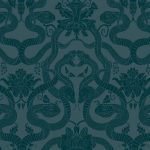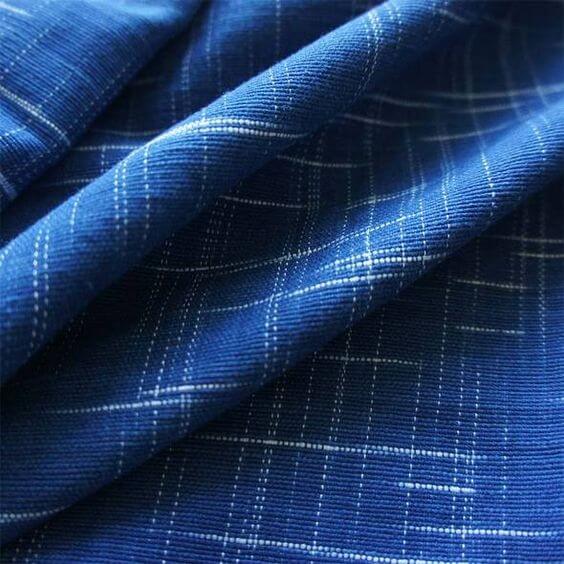
Ikat is a textile patterning technique in which selected sections of warp yarns, weft yarns, or both are bound to resist dye before the yarns are woven. The planned color sequence becomes a pattern on the loom. Small shifts between dyed yarns produce the soft, feathered motif edges associated with authentic ikat.
The term describes a process and the cloth made by that process; it does not identify a fiber. Ikat can be woven from cotton, silk, wool, rayon or viscose, polyester, and other dyeable yarns. Its breathability, stretch, durability, drape, care requirements, and price therefore depend on the fiber, yarn, weave, dyeing, finish, and level of craftsmanship.
Key Takeaways
- Authentic ikat is patterned by resist-dyeing yarn before weaving, unlike batik, tie-dye, and most printed “ikat-look” fabrics, which are patterned after a fabric already exists.
- Warp ikat patterns the lengthwise yarns; weft ikat patterns the crosswise yarns; double ikat patterns both systems and requires precise alignment during weaving.
- Ikat has no universal composition or performance specification. Buyers must define fiber content, construction, weight, width, colorfastness, shrinkage, pattern repeat, and finish for each order.
- A controlled blur at motif edges is characteristic of many ikats, but excessive misalignment, shade bars, broken ends, or inconsistent repeats may be defects if they exceed the approved standard.
- “Ikat” is also used commercially for printed designs. Purchase specifications should state whether the requirement is authentic yarn-resist ikat, another yarn-dyed construction, or an ikat-inspired print.
Ikat Fabric at a Glance
| Attribute | Practical description |
|---|---|
| Fabric name | Ikat |
| What the name identifies | A yarn-resist patterning technique and the textile made with it |
| Possible fibers | Cotton, silk, wool, rayon or viscose, polyester, blends, and other dyeable yarns |
| Common structures | Often plain weave; the structure may be warp-faced, weft-faced, or balanced to display the patterned yarn system |
| Visual signature | Motifs with soft or feathered edges caused by small yarn movements during dyeing and weaving |
| Breathability and absorbency | Determined mainly by fiber, yarn size, density, and finish; not by ikat patterning alone |
| Stretch | Not inherent; most traditional woven ikat has limited mechanical stretch unless the construction or fiber blend is designed to stretch |
| Durability and pilling | Depend on fiber strength, yarn quality, weave, surface, finishing, and end use |
| Care | Must be set from the actual composition, dye fastness, construction, and finish |
| Common uses | Dresses, shirts, jackets, scarves, shawls, bags, cushions, curtains, wall hangings, ceremonial cloths, and other apparel or interior products |

What Is Ikat Fabric?
The process that defines ikat is resist-dyeing at the yarn stage. A dyer arranges yarns in the order needed for the design, binds selected areas so they do not absorb dye, dyes the exposed areas, and repeats the sequence when additional colors are required. The yarns are then placed on a loom and woven while the pattern is carefully aligned.
The Seattle Art Museum’s explanation of ikat production describes the same essential sequence and distinguishes single warp, single weft, and double ikat. The slight movement of individual yarns gives many authentic ikats their characteristic soft-edged design.
Is ikat a fabric, a weave, or a print?
Ikat is most accurately described as a yarn-resist patterning method. It is not one fiber, one weave, or one performance category. A supplier may also use “ikat” to describe the finished woven textile. In commercial collections, however, “ikat print” usually means a printed imitation of the visual style rather than a yarn-resist ikat.
This distinction affects appearance, lead time, cost, minimum order quantity, repeat precision, reverse-side appearance, and acceptable variation. Buyers should put the intended process in the specification instead of relying on the word “ikat” alone.
Ikat through history and across regions
There is no reliable basis for assigning ikat to one country of origin. Related yarn-resist traditions developed in multiple regions. The English term comes from a Malay-Indonesian word associated with tying or binding, but the technique has important traditions in Indonesia, India, Japan, Central Asia, and other textile-producing regions. The Fashion History Timeline at the Fashion Institute of Technology documents the technique and its use across South and Central Asia and Indonesia.
Regional textiles should be identified with care because local names, fibers, motifs, techniques, and cultural meanings are not interchangeable. For example, patola is associated with a highly skilled Indian double-ikat tradition, while kasuri is a Japanese term used for related yarn-resist textiles. A generic industrial “ikat-look” print should not be presented as an artisan regional textile.
Ikat vs. tie-dye, batik, jacquard, and ikat-look printing
| Technique | When the pattern is created | How to distinguish it |
|---|---|---|
| Authentic ikat | Yarn is resist-dyed before weaving | Pattern is formed by colored yarns; characteristic soft edges and small alignment variation are common |
| Tie-dye | Finished fabric or garment is tied and dyed | Resist shapes are created directly on the cloth, not planned in the yarn system before weaving |
| Batik | Wax or another resist is applied to woven cloth before dyeing | Pattern sits on an existing fabric and may show wax-resist features rather than yarn-by-yarn alignment |
| Jacquard | Pattern is constructed by controlling yarn interlacing during weaving | Motif comes from weave structure; it does not require resist-dyed yarn |
| Ikat-look print | A motif is printed on finished fabric | Repeat is usually more uniform; the reverse may be much paler or unprinted, depending on the process and substrate |
How Is Ikat Fabric Made?
Traditional methods, tools, binding materials, dye classes, and loom types vary by region, but the production logic is consistent.

- Plan the motif and yarn sequence. The design is translated into positions along the warp, weft, or both. Pattern scale, repeat, color order, fabric width, and loom setup must be decided before dyeing.
- Arrange and group the yarns. Yarns are stretched on a frame or organized into bundles in the sequence required for the design.
- Bind the resist areas. Sections that must remain undyed are wrapped tightly. The accuracy of each tie affects the eventual motif.
- Dye the exposed sections. The bundles are dyed, rinsed, and dried. For multiple colors, ties may be removed, repositioned, or added before another dye bath.
- Remove the final bindings and organize the yarns. The dyer checks color placement and keeps the yarn order intact.
- Set up the loom. Warp ikat requires the patterned warp to be dressed and tensioned carefully. Weft ikat requires the weaver to control pattern placement as each pick is inserted.
- Weave and realign the pattern. The weaver makes small adjustments to keep the dyed areas aligned. Double ikat is especially demanding because both yarn systems must meet to create the intended motif.
- Finish and inspect the cloth. Washing, stabilization, calendaring, or other finishing may follow, depending on the fiber and specification. The final fabric should be checked against the approved sample for shade, repeat, dimensions, performance, and acceptable handcrafted variation.
Industrial production may use engineered yarn layouts, mechanized tying or section dyeing, computer-assisted pattern planning, or an entirely different print process that imitates ikat. Those options are commercially valid when disclosed accurately, but they should not be confused with one another in a purchase order.
Types of Ikat
Warp ikat
The lengthwise warp yarns are resist-dyed and the weft is normally solid. The pattern is visible in the warp before weaving begins. Warp ikat is widely used because the full patterned warp can be arranged and adjusted on the loom.
Weft ikat
The crosswise weft yarns are resist-dyed and inserted into a usually solid warp. The weaver must align the motif as the cloth grows, making control of each pick important.
[Image: Magnolia Fabrics Fender Quarry]
Double ikat
Both warp and weft are resist-dyed in planned patterns. The two systems must align during weaving, which increases technical difficulty, time, variation, and usually cost. “Double ikat” should describe this construction, not simply a reversible-looking cloth or a two-color design.
Regional and contemporary variations
Regional ikats differ in motif language, yarn, color, loom, width, finishing, and intended cultural use. Contemporary mills may reproduce an ikat aesthetic through yarn dyeing, engineered weaving, digital printing, rotary or screen printing, or jacquard construction. The commercial name does not by itself prove the production method.
What Properties Does Ikat Fabric Have?
Ikat’s only broadly consistent property is its yarn-planned visual character. Physical performance must be evaluated from the base material and construction.
Fiber composition
- Cotton ikat can offer a dry, natural hand and good comfort, but weight, softness, shrinkage, and colorfastness vary. Buyers exploring cotton-based developments can review cotton fabric options as a starting point; authentic ikat availability and specifications should be confirmed separately.
- Silk ikat can be lightweight, lustrous, and fluid or crisp depending on yarn and structure. It generally requires more careful handling and can carry higher material and labor costs.
- Wool ikat can provide warmth and resilience, but hand, felting risk, care, and moth protection depend on the wool and finish.
- Rayon or viscose ikat can provide softness and drape. Wet strength, shrinkage, seam performance, and care should be tested for the exact construction.
- Polyester ikat or ikat-look fabric can offer dimensional stability and easy-care potential, but dye method, hand, heat sensitivity, pilling, and static behavior still require confirmation.
- Blended or stretch constructions may combine properties, but stretch is not created by ikat itself.
Appearance and pattern variation
Soft motif edges can be an intended feature rather than a defect. The buyer and supplier should nevertheless agree on limits for pattern drift, repeat variation, shade difference, missing yarns, stains, bars, bow, skew, and other faults. A sealed approval sample or signed visual standard is more useful than a vague instruction such as “make it perfectly aligned.”
Hand, drape, breathability, and care
These properties follow fiber, yarn size and twist, fabric density, weave, weight, and finishing. A loosely woven cotton ikat and a dense polyester ikat-look upholstery fabric can behave completely differently. Care labels should be based on testing and the final product, not copied from a generic description of ikat.
Common Uses of Ikat

Apparel
Ikat appears in dresses, skirts, blouses, shirts, trousers, jackets, robes, eveningwear, and ceremonial garments. Garment developers should consider motif direction, placement, matching across seams, usable width, shade grouping, and cutting loss. Large repeats or irregular artisan widths can increase consumption.
Accessories
Scarves, shawls, head coverings, bags, belts, and footwear components may use authentic ikat or an ikat-inspired print. For structured accessories, confirm backing, lamination, abrasion resistance, seam strength, and color transfer.
Interiors and decoration
Ikat and ikat-style patterns are used for cushions, curtains, bedding, table linens, upholstery, rugs, wall hangings, and decorative panels. End-use testing may need to cover lightfastness, rubbing, seam slippage, abrasion, dimensional stability, flammability, or cleaning performance, depending on the product and destination market.
Where Is Ikat Produced?

Ikat is produced in artisan and industrial settings across multiple regions; there is no single meaningful “largest ikat producer” because the category includes different fibers, techniques, and end uses. Important traditional centers include parts of Indonesia and India, as well as Japanese and Central Asian yarn-resist traditions. Production also exists elsewhere in Southeast Asia, the Middle East, and the Americas.
For sourcing, the most relevant question is not which country leads a raw-fiber ranking. It is whether a supplier can make or source the required ikat type, fiber, width, repeat, volume, color standard, performance, documentation, and lead time. Fiber may be spun in one country, yarn dyed in another, woven elsewhere, and finished or converted in a fourth location.
What Determines Ikat Fabric Cost?
Quotations can vary widely because “ikat” covers artisan double ikat, commercial warp ikat, and inexpensive printed interpretations.
- Production method: Hand binding and weaving normally require more labor than mechanized production or printing.
- Ikat type: Double ikat is generally more demanding than single warp or weft ikat.
- Fiber and yarn: Silk, fine-count yarns, special fibers, blends, and traceable materials can change cost.
- Number of colors: More binding and dye cycles increase time and risk.
- Pattern complexity and alignment: Fine motifs and tight tolerances need more control.
- Fabric dimensions: Width, repeat, artisan loom limitations, roll length, and usable width affect yield.
- Order conditions: MOQ, design exclusivity, sampling, lab testing, certification evidence, packaging, and delivery terms should be priced explicitly.
A useful quotation should state the process, composition, construction, finished width, weight, color standard, repeat, finish, quantity, inspection standard, test scope, packing method, Incoterm, and validity period. Price comparisons are unreliable when suppliers are quoting different interpretations of “ikat.”
Sustainability and Certification Considerations
Ikat is not inherently sustainable or unsustainable. Its impact depends on fiber cultivation or production, dye chemistry, number of dye baths, water and energy use, wastewater management, weaving efficiency, finishing, product durability, care, and end-of-life route.
Natural fibers are not automatically low-impact, and synthetic fibers are not accurately assessed through a single degradation claim. Buyers should compare evidence for the actual supply chain rather than relying on broad statements about fiber classes. Useful questions include:
- What is the verified fiber composition and origin?
- Which dyes, auxiliaries, and finishes are used?
- How are restricted substances controlled?
- How are wastewater and off-quality yarn or fabric handled?
- Which colorfastness and durability tests apply to the end use?
- If organic, recycled, or other environmental claims are made, what certificate or transaction evidence supports the specific material and order?
There is no universal “ikat certification.” A certification or test report may apply to fiber content, organic or recycled claims, a processing site, chemical management, product safety, or another defined scope. Buyers should verify the issuing body, certificate holder, product scope, standard version, validity date, and chain-of-custody documents instead of treating a logo as proof of every claim.
Buyer Quality-Control Checklist
Before bulk production, define the following in the tech pack or purchase specification:
- Authentic yarn-resist ikat, yarn-dyed interpretation, jacquard, or printed ikat-look process
- Fiber composition and tolerance
- Yarn count or yarn specification, weave, finished weight, width, and usable width
- Pattern artwork, scale, direction, repeat, color standard, and motif-placement rules
- Approved limit sample for the intended feathered edge and acceptable alignment variation
- Shade-band and roll-to-roll tolerance
- Bow, skew, shrinkage, spirality where relevant, and dimensional-stability limits
- Colorfastness to washing, rubbing, perspiration, light, water, or other end-use exposure
- Strength, seam slippage, abrasion, pilling, or snagging requirements where relevant
- Finish and chemical restrictions for the destination market and retailer program
- Sampling stage, production inspection, final inspection, test reports, and corrective-action process
FabricsTrades’ guide to fabric quality inspection procedures provides a broader procurement framework. For ikat, inspection should preserve intentional craft variation while rejecting faults that fall outside the approved specification.
Current Regulatory and Market Update
Ikat is a technique rather than a legally recognized fiber name, so invoices, specifications, and consumer labels should identify the actual composition. For textile products marketed to EU consumers, the European Commission’s textile labeling guidance states that covered products must show fiber composition and use the permitted fiber names; language and presentation requirements depend on the Member State and sales context. B2B documentation may supplement or, in specified circumstances, replace the attached label, but buyers should confirm requirements for the finished product and destination.
Ikat patterning does not normally require a water-, oil-, or stain-repellent finish. If such a finish is added, however, PFAS restrictions can become relevant. California AB 1817 has applied to covered new textile articles containing regulated PFAS since January 1, 2025, with defined exclusions and a delayed date for outdoor apparel for severe wet conditions. The law sets a total-organic-fluorine threshold of 100 ppm from January 1, 2025 and 50 ppm from January 1, 2027, in addition to covering intentionally added PFAS with a functional or technical effect. Buyers can review FabricsTrades’ overview of California AB 1817 PFAS textile requirements alongside the official California bill text.
Requirements vary by jurisdiction, product category, treatment, date of sale, and buyer specification. Before sampling and quotation, communicate the target market, end use, fiber-label wording, finish chemistry, restricted-substance list, test methods, and documentation needed. An internal supplier statement or FabricsTrades article is not a substitute for product-specific legal review, testing, or retailer approval.
How to Source Ikat Fabric
Start with the intended visual and commercial outcome, then specify the process. An artisan yarn-resist textile and a digital ikat-look print may both suit a collection, but they involve different lead times, repeat control, scalable volumes, costs, and narratives.
Ask potential suppliers for:
- A process declaration and clear close-up images of both fabric faces
- A physical sample showing full repeat, selvage, and usable width
- Fiber-content and construction details
- MOQ, sampling route, color-approval method, lead time, and capacity for the required process
- Test reports and certificates that match the product, batch, claim, and destination-market scope
- Agreement on natural variation, defect limits, shade grouping, and replacement or corrective-action terms
FabricsTrades is based in Wujiang District, Suzhou and operates its own four-way stretch fabric factory while also working with specialized textile supply-chain resources. For an ikat or ikat-inspired project, FabricsTrades can help evaluate sourcing routes, base fibers, weights, widths, colors, finishes, samples, testing coordination, and documentation requests. Options depend on the final specification; buyers can begin with custom fabric development and confirm whether the required yarn-resist, woven interpretation, or printed process is available.
Frequently Asked Questions
What is ikat fabric?
Ikat is a textile made by resist-dyeing selected sections of yarn before weaving. The dyed warp, weft, or both create the pattern as the cloth is woven, often producing soft or feathered motif edges.
Is ikat always made from cotton?
No. Ikat can be made from cotton, silk, wool, rayon or viscose, polyester, blends, and other dyeable yarns. Performance and care depend on the actual fiber and construction.
How can you tell authentic ikat from an ikat print?
Inspect both sides and look closely at the yarns. In authentic ikat, colored yarns form the motif through the weave, and small alignment variation is common. In a print, color is applied to finished cloth and the reverse may be paler or unprinted. A sample and supplier process declaration provide stronger evidence than appearance alone.
What is the difference between warp, weft, and double ikat?
Warp ikat uses resist-dyed lengthwise yarns, weft ikat uses resist-dyed crosswise yarns, and double ikat uses planned resist-dyed patterns in both systems. Double ikat requires the two patterned yarn systems to align during weaving.
Is ikat fabric stretchy?
Ikat is not inherently stretchy. Stretch depends on fiber content and construction, such as elastane in a blend, stretch yarn, mechanical stretch from the weave, or a knitted base in an ikat-look product.
Why is some ikat expensive?
Cost rises with skilled handwork, fine yarn, multiple dye cycles, complex motifs, double-ikat alignment, narrow artisan widths, testing, traceability, and low production volume. Printed ikat-look fabric is usually a different and more scalable product.
How should ikat fabric be washed?
Follow care instructions based on the exact fiber, dyes, construction, finish, and finished product. Before setting a care label, test relevant colorfastness, shrinkage, and dimensional stability; a universal ikat wash temperature is not reliable.
Does ikat have a certification?
There is no universal certification for ikat as a technique. Certifications and test reports may cover a defined fiber claim, processing site, chemical requirement, product-safety parameter, or chain of custody, so their scope and validity must be checked.
Conclusion
Ikat is best understood as a pre-weaving yarn-resist technique, not a single material specification. Its value comes from planned color, skilled alignment, and a visual character that can range from precise geometry to expressive feathered edges. For successful sourcing, decide whether the project requires authentic ikat or an ikat-inspired alternative, then document fiber, construction, repeat, performance, variation, testing, and market requirements before bulk production.