TL;DR
- C6 is no longer the “safer replacement” lane for EU consumer textiles. Regulation (EU) 2024/2462 added Entry 79 to REACH Annex XVII, setting a 25 ppb limit for the sum of PFHxA and its salts and 1,000 ppb for the sum of PFHxA-related substances, measured in homogeneous material. For general-public clothing, related accessories, and footwear, the restriction starts to apply on 10 October 2026. [1]
- “C0,” “fluorine-free,” and “PFC-free” are not legal proofs. Inditex states plainly that “PFC free” does not imply PFAS-free, and new EN 17681-1:2025 testing uses alkaline hydrolysis to detect side-chain fluorinated residues and can surface higher PFAS results than older methanol-extraction methods. [2]
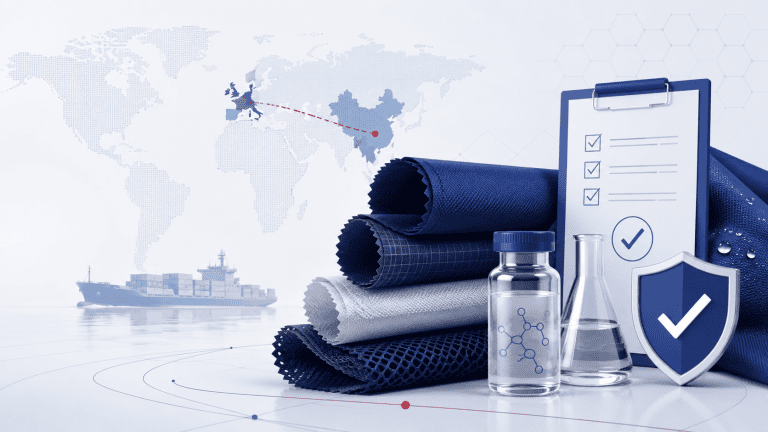
- The China-to–SE Asia detour does not remove REACH risk. REACH restrictions apply to articles placed on the EU market, including imported articles. A garment sewn in Vietnam or Bangladesh from Chinese greige, coated fabric, or membrane-backed fabric can still fail at EU market entry if the final article exceeds Entry 79 limits. [3]
- Ask for evidence by style, color, lot, and material layer. The minimum serious package is: supplier PFAS declaration, SDS/TDS for finishes, ISO/IEC 17025 third-party testing, target-PFAS testing to EN 17681:2025, total fluorine screening, membrane declarations where relevant, and chain-of-custody paperwork for recycled claims. [4]
- For Western buyers, this is a margin issue before it becomes an enforcement issue. A non-compliant article is not a “documentation gap.” It is blocked sell-through, re-testing, delayed deliveries, replacement fabric, and brand legal exposure on the EU market. That commercial risk follows directly from the Annex XVII placing-on-the-market restriction. [5]
Regulation at a glance
| Effective Date | Threshold or Limit | Affected Products | Exemptions |
| 10 October 2024 | Entry 79 enters into force; substantive limits remain 25 ppb for the sum of PFHxA and its salts and 1,000 ppb for the sum of PFHxA-related substances, measured in homogeneous material. | The law is already on the books; transition periods began running from this date. [6] | Transitional periods apply by product category. [6] |
| 10 October 2026 | 25 ppb PFHxA + salts; 1,000 ppb PFHxA-related substances. | Textiles, leather, furs and hides in clothing and related accessories for the general public, plus footwear for the general public. The same date also covers certain paper/cardboard food-contact materials, cosmetics, and mixtures for the general public. [7] | Exemptions include specified Category III PPE, medical devices, in-vitro diagnostic devices, and articles or mixtures already placed on the market before the application date. [8] |
| 10 October 2027 | Same limits. | Other general-public textiles, leather, furs and hides outside clothing/accessories, including categories the Commission identified such as carpets, rugs, curtains, blinds, upholstery, tablecloths, bed linen, and similar coverings. [9] | Construction textiles are exempt, and articles already placed on the market before the application date are carved out by derogation. [10] |
What matters commercially is simple: if you are buying Chinese finished fabric for EU-bound consumer apparel, footwear, bags, or related accessories, the legal clock is no longer abstract. It is already running. [11]
Table of Contents
ToggleWhat changed in the last two years
| Date | What changed | What it means in practice |
| September 2024 | The European Commission adopted Regulation (EU) 2024/2462 and chose a targeted consumer-use restriction for PFHxA uses where alternatives were considered available, rather than waiting for a full all-PFAS package. [10] | Brands lost the last serious argument that short-chain C6 chemistry was a stable medium-term compliance solution for mass-market consumer textiles. [12] |
| October 2024 | Entry 79 entered into force. Transitional periods of 24 months for consumer clothing/accessories/footwear and 36 months for other consumer textiles began. [6] | Sourcing teams that kept buying legacy C6 programs in 2025 effectively used up their own exit runway. [6] |
| April to June 2025 | CEN published EN 17681-1:2025. SGS and UL both highlighted the method shift to alkaline hydrolysis, which improves detection of side-chain fluorinated polymers and can report higher PFAS findings than older methods. [13] | Old “pass” reports based on older extraction logic became much less comforting. A factory that passed in 2024 can fail in 2025–2026 under better chemistry detection. [13] |
| January 2025 onward | Major scheme and buyer ecosystems tightened. SGS noted that from January 2025, bluesign APPROVED and bluesign PRODUCT items must be free from intentionally added PFAS, with limited exceptions. OEKO-TEX also states that intentional PFAS use is banned in all its certifications, while stressing it does not certify products as “PFAS-free.” [14] | Compliance expectations moved upstream into chemistry approval, not just final-garment policing. Buyers now expect cleaner input control, not just a last-minute test report. [15] |
| October 2026 | The first EU textile application date arrives for general-public apparel, related accessories, and footwear. [16] | By that point, late-season remediation is fantasy. If the bulk is wrong, the PO is wrong. [10] |
The bigger strategic point: the Commission’s own text says other PFHxA uses sit alongside the pending broader PFAS dossiers. In plain English, Entry 79 is not the end of the story. It is the consumer-textile beachhead. [17]
Why this matters for Chinese fabric suppliers
Shengze and the wider Suzhou synthetic-fabric belt are not standing still. Local and national reporting shows a clear push toward green production, intelligent upgrading, advanced printing/dyeing parks, wastewater reuse, and more recycled and bio-based material development. Shengze has also been promoted as a hub for functional and sustainable fabric innovation, not just volume. [18]
But Western buyers should not confuse cluster modernization with universal lot-level compliance discipline. Even recent reporting on Shengze’s green transition notes that many SMEs still operate in fragmented “spinning–weaving–post-processing” supply chains with limited information sharing. That is exactly the kind of structure where a mill can say “fluorine-free” while lacking hard control over the upstream yarn oil, the borrowed coating line, the shared stenter, or the membrane source. [19]
This is where the real market gap sits: saying compliant versus testing compliant. Inditex’s PFAS-free manufacturing guidance says there is no single test method that ensures compliance with all PFAS regulations, recommends combining total fluorine screening with target PFAS testing, and explicitly warns that cross-contamination can occur in facilities that previously used PFAS products or receive contaminated raw materials. SGS and UL both note that the updated EN 17681-1:2025 method detects more of the chemistry buyers actually care about in treated textiles. [2]
So the uncomfortable truth for Chinese mills is this: the commercial edge is no longer just lab-dip speed, greige availability, or FOB price. It is chemical process control. Mills that still run C6 and C0 on shared lines without disciplined cleaning, segregation, and verification are betting the buyer’s EU risk budget, not their own. Inditex’s guidance is blunt on that point: PFAS above regulated limits can still appear in final textiles even when intentional PFAS use has supposedly been eliminated, if contamination control and whole-chain verification are weak. [20]
There is also a second-order issue the cluster should take seriously: the European Environment Agency says textiles are one of the biggest sources of PFAS pollution in Europe, that PFAS in textiles are a barrier to circularity, and that most textile PFAS use is not technically necessary. That matters because Western brands are now linking RSL, recyclability, and product-passport readiness into one sourcing conversation. A supplier who treats PFHxA as an isolated chemical issue is behind the market. [21]
Direct impact on performance apparel and stretch-fabric sourcing
For brands sourcing finished fabric from China
If you buy finished Chinese fabric for EU-bound apparel, your first mistake is focusing only on the face fabric. Entry 79 applies by homogeneous material. In practice, that means a “pass” on the shell does not automatically clear a laminated construction, a membrane-backed article, a coating, or another distinct material layer in the final article. That is why membrane programs and performance shells are higher-risk than plain-dyed commodity woven fabric. [22]
Your second mistake is trusting old testing logic. The 2025 version of EN 17681-1 uses alkaline hydrolysis and is specifically designed to reveal PFAS that older extractive methods could miss, including residues associated with side-chain fluorinated polymers. SGS says the updated approach can identify significantly higher levels of analytes such as fluorotelomer alcohols in treated textiles. [13]
Your third mistake is overspecifying old C6 performance under a new chemistry regime. The outdoor and technical-textile literature is consistent: fluorine-free systems can deliver solid water repellency, but oil repellency is the hard part, and performance still depends heavily on the exact chemistry, construction, and end use. bluesign notes that PFAS-free oil repellency is one of the hardest unsolved problems in textiles, while research and official Swiss communication both highlight active work on alternative chemistries rather than a universal drop-in replacement. [23]
That is why sourcing teams should stop buying performance-language placeholders. If the spec sheet still quietly assumes legacy C6 behavior on spray, stain, handfeel, crocking, or wash durability, the cost will show up later as claim disputes and margin leakage. The right move is to re-spec the article honestly, then build a compliant finish around the real end use. [24]
For brands manufacturing in Southeast Asia using Chinese greige or yarn
This is the classic third-country compliance trap. A lot of brands assume the risk disappears if the final garment is cut and sewn in Vietnam or Bangladesh. It does not. REACH governs what is placed on the EU market, and national authority guidance makes clear that the same obligations apply to EU-made and imported articles. [25]
The trap has two common forms. First, the Chinese input already carries the problem: contaminated greige, fluorinated membrane stock, legacy DWR chemistry, or recycled input that has trace fluorinated contamination. Second, the Chinese input is clean enough, but the third-country finishing step reintroduces PFAS through lamination, coating, water repellency, or contaminated equipment. Inditex’s guidance says both scenarios happen: regulated PFAS can still be found in final textiles if the raw material is contaminated, and cross-contamination in facilities is a high risk during PFAS phase-out. [20]
This matters most for brand teams running split supply chains: yarn from China, weaving in China, dyeing in China, garmenting in Vietnam, then shipment to the EU. If documentation is broken across that chain, the EU importer is left trying to prove compliance with stitched-together evidence from different countries, test methods, and production dates. That is not a compliance strategy. It is a customs and retail-risk generator. [26]
A related misconception is that recycled paperwork solves chemistry risk. It does not. A GRS Transaction Certificate proves certified chain of custody for the shipment and is issued each time goods change ownership, matching invoices and shipping documents. It says nothing by itself about PFHxA, side-chain fluorinated polymers, or shared-line contamination. A GRS TC is valuable, but it is not a PFAS passport. [27]
Compliance evidence package you should request
Below is the package a serious Western buyer should ask for before approving EU-bound consumer textile articles from China.
- A supplier PFAS declaration tied to the exact style, quality, color, and lot. Inditex provides a model declaration requiring the supplier to state that the finishing agents used for water repellency do not contain PFAS and to attach supporting chemical information. [20]
- SDS and TDS for every chemistry that can touch repellency or lamination. Inditex’s guidance specifically flags fluoropolymer, fluoroacrylate copolymer, fluorocarbon resin, and similar wording as obvious red flags, while also warning that some ambiguously named chemicals still need testing. [20]
- A third-party ISO/IEC 17025-accredited test report, not just an internal mill report. ISO says ISO/IEC 17025 demonstrates laboratory competence and valid results and supports wider acceptance of reports across countries. [28]
- Target-PFAS testing to EN 17681:2025 for textiles. SGS and UL both explain that the new 2025 method improves detection of PFAS associated with side-chain fluorinated polymers and is replacing older logic. [13]
- Total fluorine screening by EN 14582:2016 or ASTM D7359-23 as a screening layer, not as your only legal proof. Inditex explicitly recommends combining TF with target-PFAS testing because no single method covers all PFAS regulations. [29]
- Membrane-specific declarations and tests for laminated or coated constructions. Inditex notes that membranes based on PTFE or other fluoropolymers can contribute to total fluorine and create PFAS risk even where target PFAS appear low. [20]
- OEKO-TEX documentation with the correct scope, plus clarity on Annex 4 versus Annex 6. Hohenstein explains that Annex 6/7 has stricter criteria than Annex 4/5, and OEKO-TEX also says certification does not mean the item is certified as “PFAS-free.” Buyers should request the actual certificate and confirm the product is within scope. [30]
- ZDHC MRSL or equivalent chemistry-input evidence for mills and finishers. ZDHC MRSL conformance is about chemicals banned from intentional use in processing. That is necessary input control, but it does not replace final-article REACH proof. [31]
- GRS Transaction Certificates where recycled content is claimed. Textile Exchange says TCs verify that goods shipped from one company to the next conform to the standard and are issued each time ownership changes. [32]
- Process-control evidence for contamination prevention. Ask for line segregation policy, cleaning logs for stenters and coating/lamination equipment, and stock segregation controls. Inditex specifically warns about cross-contamination from previous PFAS use and stresses stricter contamination control under updated testing. [20]
One non-negotiable point: total fluorine alone is not legal proof of Entry 79 compliance. UL notes that total fluorine methods in consumer products typically have detection limits in the 10–20 mg/kg range, while the legal PFHxA limit under Entry 79 is 25 ppb. That is why a TF screen is good for red-flag screening, but not enough for release-to-market on its own. [33]
How FabricsTrades is preparing
Based on its public materials, FabricsTrades positions itself as a GRS-certified supplier focused on stretch fabrics, recycled materials, and direct factory-level fabrication control, with recent technical content centered on PFAS transition risks in China’s fabric supply chain. [34]
The strongest signal in FabricsTrades’ public guidance is that it is treating PFAS as a process-control issue, not a marketing-label issue. Its recent PFAS content focuses on shared-line contamination, the weakness of “C0” claims without testing, and the need to distinguish recycled documentation from lot-by-lot PFAS evidence. That is the right direction. It matches what Inditex, SGS, and UL are all telling the market. [35]
For a supplier in the 4-way stretch and technical woven segment, the credible preparation path is straightforward. First, push fluorinated chemistries out of finishing and laminating workflows. Second, tighten line-cleaning and segregation around stenter curing, commissions, and membranes. Third, validate with both TF screening and target PFAS methods that reflect the new detection reality. Fourth, invest in fluorine-free alternatives that preserve stretch recovery, water repellency, and acceptable handfeel instead of pretending every old C6 performance promise survives intact. That workflow is consistent with public FabricsTrades positioning and with current brand-side guidance on PFAS-free manufacturing. [36]
In plain sourcing language: if FabricsTrades can pair factory-direct control with lot-level testing discipline and realistic C0 R&D for stretch constructions, that is exactly the supplier profile Western buyers should want in 2026. Not because the copy sounds green, but because the chemistry file is starting to matter as much as the fabric hand. [37]
FAQ about EU REACH PFHxA Restriction
Is the PFHxA restriction already in force, or does it only start in October 2026?
Both statements are true, and mixing them up causes expensive mistakes. The regulation entered into force on 10 October 2024, but for general-public clothing, related accessories, and footwear, the restriction starts to apply on 10 October 2026. [11]
Does “fluorine-free” always mean PFAS-free?
No. Inditex states directly that “PFC free” does not imply PFAS free, and OEKO-TEX says it does not certify a product as “PFAS-free.” “Fluorine-free” is a useful technical signal, but it is not a legal conclusion without the right testing and contamination controls. [38]
Can I trust a supplier’s internal lab report?
Use it for process control, not for final release decisions. For commercial acceptance, ask for a report from an ISO/IEC 17025-accredited laboratory using the relevant PFAS methods. ISO’s own guidance says ISO/IEC 17025 exists to demonstrate competence and valid results. [28]
Is an OEKO-TEX certificate enough proof for EU PFHxA compliance?
No. OEKO-TEX is useful and often worth having, but Hohenstein says OEKO-TEX does not certify a product as “PFAS-free,” and the certificate must match the product scope. OEKO-TEX is one file in the package, not the whole package. [39]
Do GRS Transaction Certificates prove PFAS compliance?
No. Textile Exchange says a TC verifies certified chain of custody for the shipment and matches invoices and shipping documents. It proves the recycled-claim transaction, not the PFHxA chemistry status of the article. [32]
If my garment is sewn in Vietnam from Chinese fabric, who owns the risk for the EU market?
The EU-market operator does. REACH restrictions apply to imported articles placed on the EU market, and authorities note that the same requirements apply to EU-made and imported articles. The sewing country does not neutralize the chemistry risk. [25]
Should I test only the shell fabric?
Not for performance products. Entry 79 is written on a homogeneous material basis, and Inditex separately warns that membranes can create PFAS risk even where target PFAS appear low. If the article has lamination, coating, or other distinct material layers, test accordingly. [22]
What is the biggest sourcing mistake brands are making right now?
Treating PFAS as a declaration exercise instead of a factory-control exercise. Updated EN 17681-1:2025 can surface side-chain fluorinated residues and contamination that older methods missed, and cross-contamination remains a known risk during phase-out. In 2026, paperwork without process discipline is theater. [40]
Last Updated April 2026
Written by the FabricsTrades Technical Compliance Team – Experts in High-Performance Stretch Fabrics and Global Regulatory Standards.