TL;DR
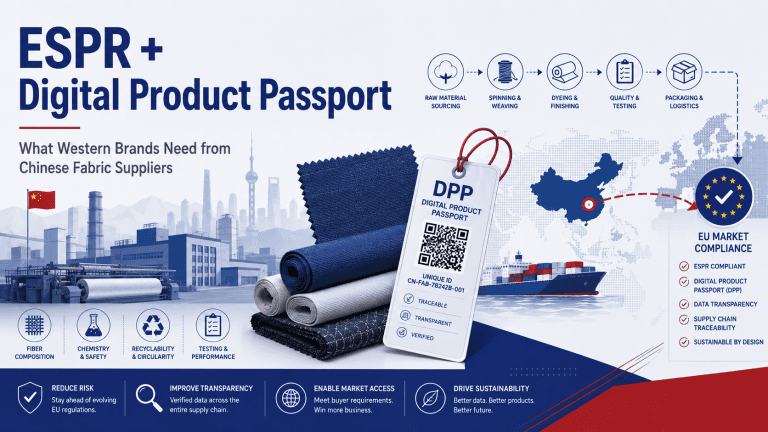
- This is no longer a “watch this space” issue. The ESPR entered into force on 18 July 2024, textiles and apparel were put in the first ESPR Working Plan with an indicative 2027 adoption timeline, and the Commission’s textile preparatory work moved deeper into delegated-act development during 2026. If your mill cannot deliver product-level data now, you are already behind. [1]
- PFAS risk becomes hard law before DPP becomes routine operations. For clothing, related accessories, and footwear for the general public, the EU PFHxA restriction applies from 10 October 2026, with limits of 25 ppb for the sum of PFHxA and its salts and 1,000 ppb for the sum of PFHxA-related substances. Other general-public textiles follow on 10 October 2027. [2]
- The core sourcing mistake is trusting declarations without method-matched testing. There is no single PFAS test that covers every regulatory angle. Current best practice is a combination of targeted PFAS testing using EN 17681:2025 and total halogen screening using ISO 20999:2026, backed by ISO/IEC 17025-accredited labs. [3]
- The “third country” workaround does not exist. Sewing in Vietnam or Bangladesh does not cleanse fluorinated chemistry introduced in Chinese yarn, greige, coating, membrane, or wet finishing. ESPR and DPP logic follows the product placed on the EU market, and textile DPP thinking already focuses on tracing weaving, knitting, dyeing, printing, and other high-impact wet processes. [4]
- Your solution is an evidence package, not a slogan. Ask for shipment-specific test reports, chemical input evidence, chain-of-custody records, and product/process traceability that can survive customs scrutiny, market surveillance, and brand legal review. “Fluorine-free” or “OEKO-TEX certified” on its own is not enough. [5]
Regulation at a Glance
| Regulation | Effective Date | Threshold or Limit | Affected Products | Exemptions or Notes |
| ESPR framework and DPP for priority product groups | ESPR in force 18 Jul 2024; textiles/apparel in first Working Plan with indicative 2027 adoption | No substance threshold in the framework itself; obligations will be fixed in product-specific delegated acts | Almost all physical products placed on the EU market; for textiles, the current policy track clearly prioritises apparel/textiles first | DPP information will be set in delegated acts and will include value-chain traceability and product information; every ESPR-regulated product will generally need a DPP unless an equivalent system applies. [6] |
| REACH Annex XVII restriction on PFHxA, its salts and PFHxA-related substances | Regulation entered into force 10 Oct 2024; applies to clothing/accessories/footwear 10 Oct 2026; other general-public textiles 10 Oct 2027 | 25 ppb for the sum of PFHxA and its salts; 1,000 ppb for the sum of PFHxA-related substances, measured in homogeneous material | Clothing textiles, related accessories, footwear for the general public; later other general-public textiles | Exemptions include certain Category III PPE, medical devices, and construction textiles; articles already placed on the market before the application date are derogated. [2] |
| REACH Article 33 and SCIP communication for SVHCs in articles | Article 33 is ongoing under REACH; SCIP notification has applied since 5 Jan 2021 | Trigger at >0.1% w/w SVHC in an article | All articles placed on the EU market, including finished coated or laminated textile articles | Retailers supplying directly and exclusively to consumers are not subject to SCIP submission; the duty is still highly relevant for importers and upstream suppliers. ECHA added two more SVHCs in Feb 2026, bringing the Candidate List to 253 entries. [7] |
| ESPR unsold apparel destruction ban | Applies to large companies from 19 Jul 2026 | Not a chemical threshold; it is a product stewardship and disclosure obligation | Apparel, clothing accessories, footwear | Not a fabric-composition rule, but it shows the ESPR has already moved from framework law into product-sector enforcement. [8] |
What Changed in the Last 2 Years
The big shift is that ESPR moved from policy language into an implementation machine. The framework entered into force in July 2024, making DPP a real legal instrument rather than a conference slide. In April 2025, the Commission adopted the first 2025–2030 ESPR Working Plan, formally putting textiles and apparel into the first wave, with an indicative 2027 timeline for adoption. At the same time, the Commission launched consultation work on how the DPP system itself should function, including data carriers, service-provider rules, and access architecture. [9]
Table of Contents
ToggleThe second shift is chemical, not digital. In September 2024 the EU finalized the PFHxA restriction, and for textile buyers that matters more immediately than broad “future PFAS” headlines. The law is specific, enforceable, and dated: clothing and related accessories for the general public are hit in October 2026, and other textiles for the general public in October 2027. This is why mills that quietly switched from legacy C8 to “shorter fluorine” chemistry years ago are not safe by default. [10]
The third shift is operational detail. During 2025 and 2026, the Commission’s JRC and related policy work started translating DPP from concept into data governance: substances of concern, recycled content, product composition, conformity documentation, traceability logic, and role-based access for authorities, businesses, and consumers. In parallel, the Commission’s textile preparatory study continued through stakeholder work in early 2026, which is exactly what happens before product-specific delegated acts get teeth. [11]
One more point Western sourcing teams should not miss: ESPR already reached the apparel sector in another way. In February 2026, the Commission adopted the acts needed to implement the ban on destroying unsold apparel, clothing accessories, and footwear, with application to large companies from July 2026. That matters because it confirms the Commission is willing to act on textiles early, not at the back end of the decade. [8]
Why This Matters for Chinese Fabric Suppliers
Public evidence shows that China’s leading textile institutions and clusters are not dismissing DPP. In June 2025, the China National Textile and Apparel Council released a 2025 textile DPP white paper, explicitly linking Chinese textile competitiveness to EU DPP developments; by November 2025, the sector had moved into review of dedicated textile DPP standards covering general rules, terminology, and label technical specifications. That is the right signal: the better Chinese suppliers understand that DPP is a data problem before it becomes a customs problem. [12]
Shengze and the wider Suzhou-Wujiang cluster matter because scale changes the risk profile. Shengze is a deep, full-chain fabric hub with more than 2,500 textile industrial enterprises and a market transaction scale above RMB 200 billion; by 2025 its industrial output reportedly passed RMB 100 billion. Local and national reporting also shows the cluster leaning hard into digital, green, and international upgrading, not just capacity expansion. [13]
But public optimism should not be confused with universal readiness. The leading mills are investing in low-carbon platforms, DPP thinking, and “green” fabric marketing; the long tail of traders, converters, and smaller finishers is another story. That is an inference, but it follows from the public record: the cluster is huge, highly fragmented, and still in transition. For a Western buyer, that means one thing—capability is uneven inside the same town, sometimes inside the same supply chain. [14]
This is where the gap between “saying compliant” and “testing compliant” becomes expensive. Supplier self-declarations still matter, but they do not settle PFAS risk. Inditex’s PFAS-free manufacturing guidance is blunt on this point: “PFC-free” does not mean the chemical product or article is PFAS-free; there is no single test method that ensures compliance with all PFAS regulations; and cross-contamination from previous PFAS-based production can still push a supposedly PFAS-free article into non-compliance. The document goes further: for stenter and padding operations, line segregation and aggressive cleaning matter because fluorinated residues can bleed into later orders. Anyone who has sourced from a busy finishing corridor in Jiangsu knows exactly how real that is. [15]
The same goes for old test methods. Intertek notes that the updated EN 17681-1:2025 uses alkaline hydrolysis and can detect more residual PFAS from side-chain fluorinated polymers than older methods, with results that may be more than 100 times higher than the old 2022 method in some cases. If a supplier is still showing you an old methanol-extraction report and calling the fabric “PFAS-free,” that is not compliance. That is paperwork drift. [16]
Direct Impact on Performance Stretch Fabric Sourcing
For brands sourcing finished fabric directly from China
For performance stretch wovens and knits, the immediate risk sits in the finish stack: C0 DWR claims, stain resistance, coatings, membranes, prints, and any chemistry-heavy wet processing. The legal trigger is not whether the supplier calls the article “eco” or “fluorine-free.” The trigger is whether the finished article placed on the EU market complies with the applicable limits and can be supported by verifiable data. Under the DPP logic now being built, brands will not just need a composition callout; they will need defensible information on substances of concern, recycled content where claimed, and traceability for the relevant production stages. [17]
Performance buyers should also stop pretending that a chemistry swap is a plug-and-play exercise. Available evidence shows non-fluorinated repellents can work, but they do not always match fluorinated systems on oil repellency and often require more development work to hit the same durability window. That is why the best mills are not merely swapping out a chemical drum; they are reworking resin systems, cure conditions, add-on levels, and lamination compatibility. For stretch shells and commuter fabrics, the problem is usually not getting a good spray rating on Day 1. The problem is keeping water repellency, handfeel, stretch recovery, and bond integrity after washing and wear. [18]
A second direct-export risk is method mismatch. Finished-fabric PFAS verification increasingly needs both targeted PFAS testing and total-fluorine or total-halogen screening, because membranes and coatings can hide risk that a narrow targeted screen misses. ISO 20999:2026 now gives the industry a standardized combustion-ion-chromatography route for total halogens in textile products, while EN 17681:2025 is the updated targeted PFAS method for textiles. If your supplier cannot tell you which method was used, on what matrix, and under which accreditation scope, assume the evidence is weak until proven otherwise. [19]
For brands manufacturing in Southeast Asia with Chinese greige or yarn
This is the classic third-country compliance trap. Western buyers often focus their compliance documentation on the cut-and-sew factory in Vietnam or Bangladesh because that is where the garment is assembled and where the import paperwork is easiest to collect. That is the wrong center of gravity for chemical and DPP risk. The risky chemistry may have entered the product at the Chinese yarn plant, knitting mill, dyehouse, coater, membrane laminator, or finishing line. DPP thinking for textiles already points to tracing weaving, knitting, dyeing, printing, and other impactful wet processes, not just Tier 1 sewing. [20]
The bottom-line consequence is simple: country-of-origin on the customs invoice does not replace upstream chemical evidence. If a Benghazi or Ho Chi Minh City CMT facility buys Chinese stretch woven with legacy fluorinated DWR, the regulatory exposure travels with the fabric into the final garment. ESPR rules apply to products placed on the EU market whether they come from EU or non-EU companies, and DPP traceability is being designed precisely to make upstream opacity harder to hide. [21]
Commercially, this means the compliance file must travel with the roll. Western brands should require the Southeast Asian assembler to hold and pass through the Chinese upstream evidence package—not merely a mill TDS, but batch linkage, test reports, chemistry declarations, and transaction-level certification where recycled claims are involved. If that handoff is missing, your brand is taking blind liability on someone else’s wet process. [22]
Compliance Evidence Package You Should Request
Below is the document set that separates a serious supplier from a PowerPoint supplier:
- Shipment-linked PFAS test reports on the finished fabric using EN 17681:2025 for targeted PFAS, plus ISO 20999:2026 or equivalent total-halogen screening where relevant, especially for coated, laminated, waterproof-breathable, or stain-resistant articles. Ask for the exact method, date, lab scope, and lot reference. There is no single PFAS test that covers every rule. [23]
- ISO/IEC 17025 accreditation proof for the testing lab, ideally under an ILAC MRA signatory body. Technically valid results and internationally trusted acceptance matter more than whether the supplier says its in-house lab is “advanced.” [24]
- Full chemistry disclosure pack for finish and coating inputs: SDS, TDS, trade name, supplier name, functional use, and a written declaration covering DWRs, stain blockers, membranes, print systems, binders, and auxiliaries. Inditex specifically recommends asking for SDS/TDS and written upstream PFAS absence statements because PFAS may not be obvious from generic product naming. [15]
- ZDHC evidence for the actual formulations used, not just a logo on a slide. Ask for the ZDHC Gateway Chemical Module record and the conformance certificate from a ZDHC Approved MRSL Certifier. If the product is critical to repellency, push for the highest available confidence level. Also remember: MRSL conformance helps control chemical inputs, but it is not the same as finished-goods legal compliance. [25]
- OEKO-TEX documentation that states which appendix was used. Ask whether the article was certified to Appendix 4 or Appendix 6, because Annex 6 is the expanded criteria set used only when specifically requested and was built for brands with stricter Detox-style requirements. Useful evidence, yes. Complete ESPR/DPP proof, no. [26]
- A chain-of-custody file for recycled or preferred-fiber claims, including Scope Certificate, Transaction Certificate, and invoice/shipping-document alignment. A GRS or RCS scope certificate tells you the company is approved; a Transaction Certificate tells you the specific shipment conforms to the standard and matches buyer and shipment details. [27]
- Process traceability map by production stage, at minimum for spinning, knitting or weaving, dyeing, printing, coating, lamination, and finishing, including site names and locations. That is not overkill; it is where textile DPP design is already heading. [28]
- SVHC declaration for articles and components stating whether any Candidate List SVHC exceeds 0.1% w/w, plus SCIP-related support where relevant. This matters for trims, membranes, coatings, and composite constructions just as much as for the main shell fabric. [29]
- A contamination-control statement for PFAS phaseout, especially from wet-finish mills and laminators. Ask whether the facility has dedicated PFAS-free lines, line-cleaning protocols, separate inventory, and batch segregation. If the mill cannot answer that cleanly, do not trust the “PFAS-free” claim. [15]
- A DPP-ready data sheet covering product identification, fiber composition, substances-of-concern information, recycled content if claimed, safe-use and end-of-life notes, and supporting conformity documents. Authorities are expected to need deeper access than consumers, including technical documentation, test reports, and certificates. [30]
How FabricsTrades Is Preparing
Because no company-specific records were provided here, the only defensible way to write this section is as substantiated positioning language—the kind of claim FabricsTrades should publish only if it can back every line with records, test reports, and batch traceability.
A credible FabricsTrades posture should sound like this: FabricsTrades is building compliance upstream, not decorating it downstream. That means selecting PFAS-free or fluorine-free chemistry only from controlled inventories, validating finished fabrics with external accredited testing, tightening batch-level traceability from yarn or greige through wet processing, and preparing product data in a format that can support DPP-style disclosure when textile delegated acts arrive. That posture matches where the law is going and where leading textile practice is already moving. [31]
For high-performance stretch fabrics, the strongest commercial message is not “we can replace fluorine.” Plenty of suppliers say that. The stronger message is: we are engineering compliant alternatives without wrecking stretch recovery, handfeel, wash durability, or commercial lead times. That is what buyers actually care about. Existing evidence shows fluorine-free systems are viable, but they demand more disciplined development and validation, especially where water repellency, membrane performance, and durability must coexist. [18]
If FabricsTrades wants one sentence that carries weight with Western compliance directors, it should be this: “We do not ask customers to trust a PFAS claim on faith; we support it with method-matched testing, controlled chemistry inputs, and traceable production records.” That is not marketing fluff. That is the standard this market is moving toward. [32]
FAQ about ESPR and Digital Product Passport
Can I trust a supplier’s internal lab report?
Use it for process control, not for final release risk. The report that matters commercially is the one issued by a lab with the right ISO/IEC 17025 accreditation scope and international recognition under the ILAC system. Otherwise you are relying on an internal quality check as if it were independent compliance evidence. They are not the same thing. [24]
Does “Fluorine-free” always mean PFAS-free?
No. Inditex’s PFAS-free manufacturing guidance states this directly: “PFC free” does not imply the chemical product or the article is PFAS free. In practice, “fluorine-free” usually describes the intended chemistry choice for a finish or membrane system. It does not guarantee the final article passes finished-goods testing, and it does not eliminate cross-contamination risk. [15]
Do I need both targeted PFAS testing and total-fluorine screening?
If you buy coated, membrane, stain-resistant, or performance water-repellent textiles, the prudent answer is yes. Current industry guidance says there is no single method that covers all international PFAS requirements; targeted PFAS analysis and total-fluorine or total-halogen screening answer different risk questions. ISO 20999:2026 is now the standardized textile method for total halogens by combustion and ion chromatography. [33]
If my garment is sewn in Vietnam, can EU authorities still ask about Chinese dyeing and finishing?
That is exactly where this is going. Textile DPP work already identifies weaving, knitting, dyeing, printing, and major wet processes as traceability points, and the ESPR framework applies to products placed on the EU market whether they come from EU or non-EU producers. Tier 1 sewing is no longer the whole story. [34]
Is OEKO-TEX STANDARD 100 enough for ESPR and DPP compliance?
No. It is useful and often commercially valuable, but it is not the whole file. OEKO-TEX itself notes that STANDARD 100 is a harmful-substances certification and not a broad legal-product-compliance label; it does not replace the need for complete conformity evidence, certificates, correct product information, or DPP-ready traceability. Also, buyers should check whether testing was done under Appendix 4 or Appendix 6, because Annex 6 is stricter and not automatic. [35]
Does a GRS Scope Certificate prove my shipment is certified?
No. A Scope Certificate proves the company is approved to make certified products. A Transaction Certificate proves that the specific shipment conforms to the standard and matches the named buyer and shipment details. If your sourcing team is still accepting a scope certificate as shipment proof, tighten the SOP. [27]
What is the fastest way for a Chinese supplier to fail a PFAS review in 2026?
Showing an old test report, a vague “PFAS-free” declaration, and no explanation of what happened on the stenter, padding line, or membrane lamination step. Updated EN 17681 testing is more aggressive than older methods, and current guidance is explicit that PFAS-free production requires contamination control, batch segregation, and upstream verification—not just a chemistry change on paper. [36]
What should I ask the supplier in the first email, before sampling?
Ask for four things immediately: the claimed finish chemistry and membrane type; the latest finished-fabric PFAS test reports with methods named; proof of lab accreditation; and whether the supplier can provide process-stage traceability through knitting or weaving, dyeing, finishing, and lamination. If the answers are fuzzy before sampling, the compliance file will be worse after booking. [37]
Last Updated April 2026
Written by the FabricsTrades Technical Compliance Team – Experts in High-Performance Stretch Fabrics and Global Regulatory Standards.