TL;DR
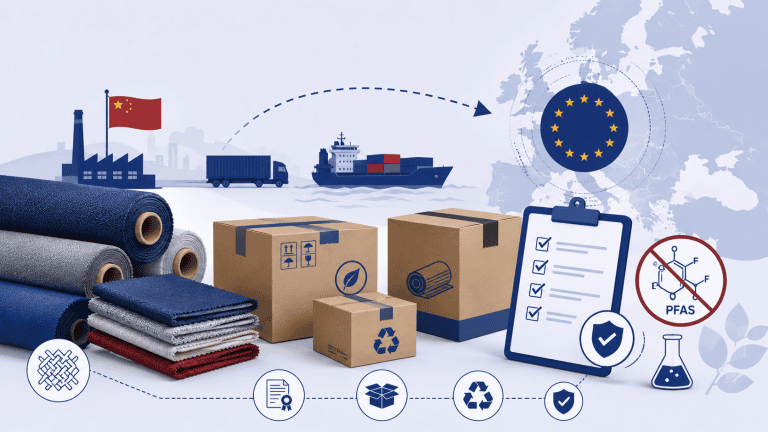
- PPWR is not a textile chemistry law, but it is a packaging market-access law. For most fabric exporters, the immediate exposure is not the face fabric on the roll; it is the carton, polybag, pallet wrap, and any other packaging placed on the EU market with that fabric. From 12 August 2026, PPWR generally applies, and manufacturers/importers must be able to support packaging conformity with technical documentation and an EU Declaration of Conformity. [1]
- Do not overreact to the PFAS headline. The numeric PFAS ban in Article 5 is aimed at food-contact packaging, not standard apparel-fabric export packaging. For non-food textile shipments, the bigger near-term issue is documentation, heavy metals, minimization, and future recyclability rules. [2]
- The real China risk is the paperwork gap, not the sales pitch. Under the Commission’s guidance, the manufacturer is the sole economic operator legally responsible for packaging compliance with Articles 5–12, even if suppliers or third parties generated parts of the file. A supplier saying “fluorine-free,” “recyclable,” or “GRS” is not the same thing as holding a defensible PPWR file. [3]
- The Southeast Asia route does not solve a China packaging problem. If garments are cut and sewn in Vietnam or Bangladesh using Chinese packaging inputs or Chinese-sourced packaging specifications, the packaging still has to comply when it is first placed on the EU market, and the EU importer must verify that the conformity assessment and documentation exist. [4]
Regulation at a Glance
For fabric supply chains, the rows below are the ones that matter first. The table focuses on the PPWR provisions most likely to affect fabric exporters, apparel brands, and sourcing teams managing China-origin packaging around textile shipments.
Table of Contents
Toggle| Effective Date | Threshold or Limit | Affected Products | Exemptions |
| 12 August 2026 | PFAS: 25 ppb for any individual PFAS by targeted analysis; 250 ppb for the sum of PFAS by targeted analysis; 50 ppm for total PFAS including polymeric PFAS | Food-contact packaging only | This is a scope-limited rule: standard non-food textile export packaging is outside this PFAS ban |
| 12 August 2026 | Heavy metals: combined maximum of 100 mg/kg for lead, cadmium, mercury, and hexavalent chromium | All packaging and packaging components | No general textile-export exemption |
| 12 August 2026 | Conformity file: technical documentation under Annex VII plus EU Declaration of Conformity under Annex VIII; records generally retained 5 years for single-use packaging and 10 years for reusable packaging | Packaging subject to applicable Articles 5–12 requirements | Role-specific duties vary, but EU importers cannot ignore missing files |
| 1 January 2030 | Empty space ratio: maximum 50% | Grouped, transport, and e-commerce packaging | Product protection still applies; methodology is to be set by the Commission |
| 1 January 2030 | Reuse target: 40% reusable packaging within the EU for transport packaging and sales packaging used for transporting products; 100% for same-company and B2B within the same Member State; 70% within the EU by 2040 is aspirational | Pallets, foldable plastic boxes, boxes, trays, plastic crates, IBCs, pails, drums, canisters, flexible formats, pallet wrapping, and straps | Micro-enterprises and operators with under 1,000 kg of packaging per year can be exempt; additional exemptions may apply in specific cases |
| 2030 and 2035 | Recyclability: all packaging recyclable by 2030; effectively recyclable by 2035 | All packaging on the EU market, with limited exceptions | Some sector-specific exceptions exist, especially where safety-critical packaging is involved |
The dates and thresholds above come from Regulation (EU) 2025/40, the European Commission’s PPWR overview, the Commission’s implementation materials, and the Commission-linked DG ENV presentation. [5]
What Changed in the Last 2 Years
PPWR moved from “watch this file” to “build the dossier now” surprisingly fast.
| Date | What changed | What it means commercially |
| 24 April 2024 | PPWR text was provisionally agreed in trilogue | The law was no longer theoretical; serious packaging workstreams should have started here |
| 19 December 2024 | Final adoption | The compliance direction was locked in |
| 22 January 2025 | Regulation (EU) 2025/40 was published in the Official Journal | PPWR became a real planning deadline, not a draft talking point |
| 11 February 2025 | Entry into force | The countdown to general application started |
| March 2026 | The Commission published guidance and a first FAQ package to support interpretation | The market moved from legal debate to implementation detail |
| June 2026 | Final Commission Notice guidance was published | Brands and importers now have less room to claim ambiguity in core responsibility questions |
One transition nuance matters: packaging already placed on the market before 12 August 2026 may remain on the market and does not need to be withdrawn. That helps old stock. It does not help new shipments entering the EU after the application date. [6]
Why This Matters for Chinese Fabric Suppliers
If you are sourcing fabric from Greater China, PPWR matters for a simple reason: the EU regulates packaging placed on its market, regardless of whether that packaging comes in empty form or arrives wrapped around imported goods. That means the packaging on a roll of woven nylon-spandex, a pallet of greige, or an e-commerce sample shipment is not commercial decoration. It is part of the product’s legal landing zone in Europe. [7]
For most mills in Suzhou and Shengze, this is an indirect compliance issue, but not a minor one. Shengze is one of the world’s largest textile clusters, with more than 2,500 textile enterprises and over 7,000 trade companies, annual textile output capacity of 13 billion meters, and massive printing/dyeing capacity. Wujiang’s eco-industrial setup is engineered around spinning, weaving, printing, dyeing, finishing, and centralized wastewater handling. In other words, the cluster is structurally optimized for fabric manufacturing excellence, not for producing Annex VII packaging files on demand. [8]
That is why the practical risk is not whether a Shengze mill can talk fluently about C0 DWR, GRS yarns, or lab-dip timing. Many can. The risk is whether the same supplier can produce a defensible packaging bill of materials, third-party heavy metal evidence, a packaging-specific conformity file, and—where food contact is involved—PFAS data tied to the actual packaging unit, including coatings, inks, varnishes, and adhesives. PPWR turns “saying compliant” into “show me the file.” [9]
There is also a broader strategic backdrop. Chinese textiles are already under pressure to document sustainability more credibly, and UNEP-backed work in 2025 pushed a new ecolabel standard aimed at China’s textile sector. In public materials from Wujiang and related institutions, the recurring themes are green upgrading, circular processing, and intelligent manufacturing. PPWR slots into that trend—but from the packaging side. Western buyers should expect fast verbal alignment from suppliers, and slower documentary maturity behind it. [10]
My blunt view: if your mill can ship a perfect 4-way stretch article but cannot document the PE bag, carton print, and pallet wrap around it, you do not have a Europe-ready shipment. You have a sourcing blind spot. The law is moving responsibility downstream, but the data still has to be pulled upstream. [11]
Direct Impact on Fabric Sourcing
For Brands Buying Finished Fabric from China
For direct fabric imports into the EU, the first PPWR exposure is the packaging around the fabric, not the fabric itself. Standard non-food export packaging is not the primary PFAS target in Article 5(5); however, it is still in scope for the broader PPWR conformity model, for heavy metal limits, and later for packaging minimization, recyclability, and in some cases transport/e-commerce packaging rules. If your team is spending all of its time debating PFAS in outerwear fabric finishes while ignoring the shipment packaging file, you are pointing your budget at the wrong risk first. [12]
The immediate sourcing playbook for China-origin finished fabric is operationally simple. Freeze your packaging BOM by packaging type. Identify which elements are single-use and which may become reusable. Separate primary bagging, grouped packaging, carton systems, and pallet stabilization materials. Then ask a harder question than buyers usually ask: who actually owns the evidence package for each component? Under PPWR, the manufacturer must be able to demonstrate conformity, and importers must ensure that the assessment exists before placing packaging on the EU market. [11]
This is where textile companies often stumble. A fabric mill may buy cartons from one converter, PE bags from another, pallet film from a third, and printing from a fourth. That commercial fragmentation is normal. Under PPWR, it becomes a documentation problem. One missing component-level file can weaken the dossier for the full packaging unit. That is not theoretical; it is exactly how market-access failures happen in multi-supplier packaging systems. [13]
For Brands Cutting and Sewing in Vietnam or Bangladesh with Chinese Inputs
This is the third-country trap. The garment may be made in Vietnam or Bangladesh, but if Chinese suppliers provided the fabric packaging specifications, Chinese-origin polybags, Chinese cartons, or packaging materials selected upstream by the brand or its nominated vendors, the packaging still has to comply when the packaged product is first placed on the EU market. The EU importer must verify that the conformity assessment and supporting file exist. Country of assembly does not reset the packaging obligation. [4]
In practice, this trap shows up when compliance workstreams are split by country. The Bangladesh factory thinks packaging is “customer nominated.” The China vendor thinks the finished pack-out happens elsewhere, so the file is somebody else’s problem. The EU buying office assumes the importer or distributor will sort it out. Under PPWR, that is a bad operating model. The chain needs a clean documentary handoff from upstream material/packaging suppliers to the final packer and then to the EU economic operator carrying the legal burden. [14]
For Western sourcing managers, the fix is not complicated, but it must happen early. Build the packaging compliance request into the procurement pack before bulk booking, not at final audit. Ask for the packaging file at the same time you ask for shade bands, test standards, and shipment marks. If you wait until ex-factory week, you are already negotiating from the wrong side of the leverage curve. [15]
Compliance Evidence Package You Should Request
Below is the minimum file I would ask for from any China-linked supplier chain shipping packaged textile goods into Europe. Not everything is legally required in every scenario, but if you want a sourcing file that survives pushback from your own legal team, importer, or customs-side auditor, this is the level to aim for.
- A packaging BOM by packaging type and SKU family. Include material type, layer structure, component weights, colorants, inks, adhesives, coatings, and resin identifiers where relevant. This is the backbone for Annex VII technical documentation and for any credible Article 5 review. [16]
- A supplier declaration mapped to PPWR Articles 5–12, not a generic “RoHS/REACH compliant” statement. PPWR introduces its own packaging conformity logic. A one-page generic compliance letter is not enough. [16]
- Heavy-metal test reports on packaging or packaging components covering lead, cadmium, mercury, and hexavalent chromium against the 100 mg/kg combined threshold. Ask for component-level evidence where inks, pigments, coatings, or recycled inputs elevate risk. [17]
- For food-contact packaging only: PFAS evidence from an ISO/IEC 17025-accredited laboratory. The file should show targeted PFAS results, the sum of targeted PFAS, and total fluorine or total PFAS methodology as appropriate, with analyte list, LOQs, sample photos, and the exact method reference used. PPWR sets the thresholds, but harmonized testing methodology is still evolving, so the method detail matters. [18]
- If total fluorine is above 50 mg/kg, ask for the follow-on proof package. The regulation explicitly contemplates proof where fluorine is above that level, so “we are fluorine-free” is not an acceptable stopping point. [19]
- A draft or final EU Declaration of Conformity following PPWR Annex VIII, backed by an Annex VII technical file. If the supplier says “we comply,” the next question should be “show me the DoC structure and the evidence stack behind it.” [20]
- If you make recycled-content claims on bags, mailers, or textile-related packaging, ask for chain-of-custody evidence. GRS or RCS transaction certificates are useful because they verify the certified goods shipped between parties and match shipment-level details. They support recycled claims. They do not replace PPWR packaging conformity documents. [21]
- Treat OEKO-TEX correctly. OEKO-TEX STANDARD 100 Annex 6 is stricter than Annex 4 for many parameters and is useful for textile chemical due diligence. It is not a legal substitute for PPWR packaging evidence. For packaging claims, you still need the PPWR-specific file. [22]
- A change-control and chain-of-custody template. No substitution of bag film, inks, coatings, carton board, or pallet wrap without written approval and document refresh. This is not legal theater; it is the only way to prevent a clean pre-production file from being invalidated by late sourcing substitutions. The need for supplier data continuity is built directly into the PPWR manufacturer/supplier obligation structure. [23]
How FabricsTrades Is Preparing
Based on its public materials, FabricsTrades positions itself as a Wujiang-based, factory-linked, GRS-certified supplier specializing in stretch fabrics and recycled polyester/nylon offerings, with manufacturing presence in Wujiang and a recent editorial focus on PFAS control, C0 finishes, and source-level compliance discipline. That is the right starting point for a market that increasingly punishes vague sustainability language and rewards document-ready execution. [24]
What matters commercially is not whether a supplier can say “sustainable,” “recycled,” or “fluorine-free.” What matters is whether factory-direct control translates into faster packaging data collection, cleaner change management, and more credible testing workflows. FabricsTrades’ recent technical content emphasizes source-level fluorine control, segmentation of risk, and C0 development for performance fabrics. If that discipline is carried into packaging procurement and shipment documentation, it is exactly the sort of operating model Western buyers should prefer. [25]
For PPWR specifically, the strongest supplier play is straightforward:
- keep packaging SKUs standardized and documented;
- pair any recycled claim with traceable transaction evidence;
- use external accredited testing where chemical or food-contact risk exists;
- lock down change control at converter level;
- and, on the textile side, continue R&D into compliant alternatives such as C0 finishes that do not create a second compliance headache elsewhere in the product file. [26]
That is also the soft sales point FabricsTrades can credibly own without overselling: factory-direct control is valuable only when it reduces compliance noise for the buyer. In 2026, that means fewer unsupported claims, fewer document chases, and fewer surprises between lab approval and landed cargo. [27]
FAQ about EU PPWR
Does PPWR regulate the fabric itself?
Not in the way REACH or a future PFAS textile restriction would. PPWR regulates packaging placed on the EU market. For textile companies, that means the packaging around the fabric shipment is the immediate legal subject. The PFAS concentration limits in Article 5 are specifically aimed at food-contact packaging. [28]
Do cartons, pallet wrap, and export polybags really count as packaging?
Yes. PPWR covers all packaging placed on the EU market, and the Commission-linked implementation materials explicitly discuss grouped, transport, and e-commerce packaging, as well as transport formats like boxes, trays, flexible formats, pallet wrapping, and straps. [29]
Can I trust a supplier’s internal lab report?
As a screening tool, yes. As a final market-access file, no—not by itself. PPWR is built around technical documentation and demonstrable proof, and ISO/IEC 17025 exists precisely to show that a laboratory operates competently and generates valid results. For anything high-risk, especially food-contact packaging, ask for accredited external evidence. [30]
Does “fluorine-free” always mean PFAS-free?
No. “Fluorine-free” is a commercial statement unless it is backed by measurement. Under PPWR, compliance for food-contact packaging is determined against numeric thresholds and supporting technical documentation. In practical sourcing terms, the legal question is not what the supplier calls the packaging; it is what the report shows. [31]
If my garment is sewn in Vietnam using Chinese packaging inputs, who carries the PPWR risk?
The packaging still has to comply when it is first placed on the EU market, and EU importers must verify that the conformity assessment and documentation exist. The assembly country does not erase upstream packaging exposure. [4]
Are GRS transaction certificates enough to prove PPWR compliance?
No. A GRS or RCS transaction certificate helps prove a recycled-content chain-of-custody claim for the certified goods moving between companies. It does not replace the PPWR conformity assessment, technical documentation, or the EU Declaration of Conformity for packaging. [32]
Is OEKO-TEX Appendix 6 enough for this topic?
Useful, yes. Sufficient, no. OEKO-TEX Annex 6 is stricter than Annex 4 for many textile parameters, which can make it valuable for broader chemical due diligence. But PPWR packaging compliance still requires packaging-specific documentation and evidence. OEKO-TEX is not a substitute for an Annex VII/Annex VIII PPWR file. [22]
Do I need to recall packaging that was already on the EU market before 12 August 2026?
The Commission’s guidance says packaging placed on the market before 12 August 2026 may remain on the market and does not need to be withdrawn. That relief is about existing stock. It should not be misread as a grace period for new non-compliant shipments after the application date. [33]
Author Note
Last Updated: April 2026
Written by the FabricsTrades Technical Compliance Team – Experts in High-Performance Stretch Fabrics and Global Regulatory Standards.