TL;DR
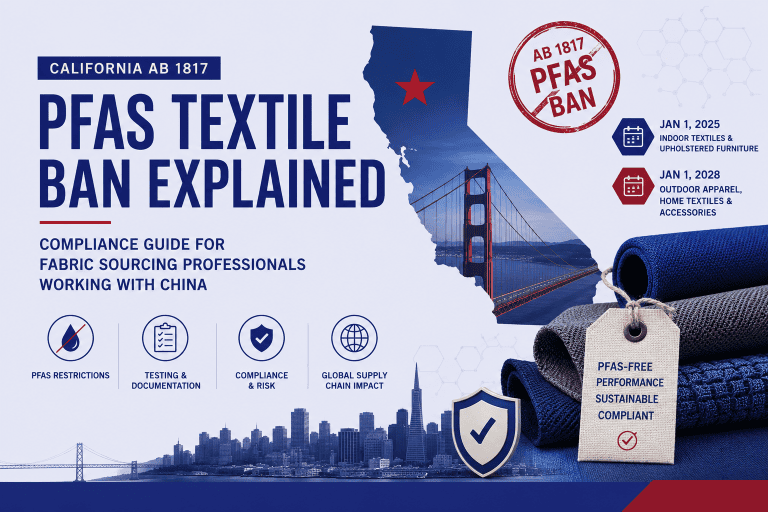
- The 2028 date is widely misunderstood. California already banned most new textile articles with intentionally added PFAS on January 1, 2025, and it already applies a 100 ppm total organic fluorine threshold. Only the narrow category of outdoor apparel for severe wet conditions got a temporary carve-out until January 1, 2028. Accessories, handbags, backpacks, upholstery, draperies, bedding, towels, and tablecloths were not given that grace period. [1]
- “C6” is not a compliance strategy. California defines PFAS as a class of fluorinated organic chemicals with at least one fully fluorinated carbon atom, so short-chain fluorinated finishes are still PFAS. If a mill is still selling you fluorocarbon DWR as the “safer option,” it is selling you legal exposure, not a transition plan. [2]
- A supplier saying “fluorine-free” is not the same as proving AB 1817 compliance. AFIRM warns that “C0” or “no PFAS-based DWR” does not rule out a PFAS-based membrane such as PTFE, and contamination can still show up in testing even when PFAS were not intentionally used. California’s TOF threshold makes that testing gap commercially dangerous. [3]
- Your evidence package needs to be stronger than a marketing claim. At minimum, ask for a mill-signed California AB 1817 certificate of compliance, third-party fluorine screening from an ISO/IEC 17025 lab, targeted PFAS testing for the textile construction in question, and upstream chemical declarations for finish, membrane, coating, and lamination. California’s AB 347 gives DTSC the power to demand technical documentation and analytical test results later in the enforcement cycle. [4]
- The market is already moving below the legal minimum. NRDC’s 2026 product testing found 79% of 115 textile products were below California’s current 100 ppm threshold, 70% were below 10 ppm, and 60% were below 5 ppm. If your supplier is talking like “under 100 ppm” is good enough, that supplier is already behind the market. [5]
Regulation at a Glance
The table below condenses the statutory trigger points in California Health and Safety Code §§108970–108971, with later registration, testing, and enforcement milestones from AB 347. [6]
Table of Contents
Toggle| Effective Date | Threshold or Limit | Affected Products | Exemptions |
| January 1, 2025 | No intentionally added PFAS; 100 ppm TOF threshold | New textile articles sold, distributed, manufactured, or offered for sale in California, including apparel, accessories, handbags, backpacks, draperies, shower curtains, furnishings, upholstery, bedding, towels, napkins, and tablecloths | Severe-wet-condition outdoor apparel is temporarily carved out from the sale ban, but only until 2028 |
| January 1, 2025 | Mandatory disclosure: “Made with PFAS chemicals” | Outdoor apparel for severe wet conditions that still contains regulated PFAS, including online listings | Applies only to a narrow expert-use category, not mainstream outdoorwear |
| January 1, 2027 | 50 ppm TOF threshold | Same covered textile articles | No broader scope relief; this is a tightening of the threshold, not a new product ban |
| January 1, 2028 | Severe-wet-condition carve-out ends | Outdoor apparel for severe wet conditions becomes fully subject to the ban and threshold | Exemption disappears |
| January 1, 2029 | DTSC must publish regulations and accepted test methods and third-party accreditation criteria under AB 347 | Covered PFAS product categories including textile articles | Does not delay the underlying 2025 AB 1817 ban |
| July 1, 2029 | Manufacturer registration and statement of compliance to DTSC | Covered products including textile articles | DTSC may request technical documentation and analytical test results |
| July 1, 2030 | DTSC enforcement begins under AB 347 | Covered products including textile articles | AB 347 adds enforcement architecture; it does not erase earlier compliance duties |
A few exclusions matter in practice. California excludes carpets and rugs already handled under the Safer Consumer Products Program, PFAS treatments for converted textiles or leathers, vehicles and vehicle components, vessels and boat covers, industrial filtration media, textile articles used in laboratory analysis and testing, aircraft and aircraft components, and stadium shades or architectural fabric structures. PPE and clothing for exclusive U.S. military use sit outside the statute’s apparel definition. [1]
The commercial takeaway is blunt: AB 1817 is broader than many market summaries suggest. New York’s PFAS apparel law is narrower, but California expressly reaches non-apparel textile categories such as bags, shoes, accessories, and home textiles, which is one reason California is acting as a de facto national market standard for mills that want one exportable chemical recipe. [7]
What Changed in the Last Two Years
Late 2024 brought enforcement architecture, not a delay. On September 29, 2024, California enacted AB 347, which requires the Department of Toxic Substances Control to adopt PFAS enforcement regulations by January 1, 2029, requires manufacturers to register covered products by July 1, 2029, allows DTSC to request technical documentation and analytical test results, and sets a minimum $10,000 administrative penalty for a first violation under that framework. The mistake some sourcing teams made was assuming this meant they could wait. They cannot. AB 1817’s underlying product ban was still set to start on January 1, 2025. [8]
January 1, 2025 was the real cliff edge. From that date, California prohibited new textile articles containing intentionally added PFAS and also swept in any product or component at or above 100 ppm TOF, regardless of whether that fluorine came from intentional use or contamination. Severe-wet-condition outdoor apparel kept only a temporary carve-out, and even then California required the blunt disclosure statement “Made with PFAS chemicals.” [1]
The testing conversation matured in 2026. ISO now has ISO 20999:2026, a textile method for determining total halogens in textile products by combustion and ion chromatography, which is useful for fluorine screening. That matters because AB 347 requires DTSC to publish accepted testing methods later, but the market cannot wait until 2029 to build screening discipline. Brands need working protocols now. [9]
The market has also shown that lower numbers are technically achievable. NRDC’s 2026 testing of 115 products found most were already well below California’s 100 ppm threshold, with a majority below 5 ppm. The same report found problem categories still existed, especially in tablecloths, pet products, and reusable diapers. That is exactly why a Western buyer should stop rewarding vague declarations and start rewarding verifiable low-fluorine control. [5]
Why This Matters for Chinese Fabric Suppliers
Shengze and Suzhou are not peripheral to this story
Shengze is one of the core decision points in the global synthetic-fabric trade. The Wujiang government describes the cluster as home to more than 2,500 textile enterprises and over 7,000 trade companies, with annual production capacity of 13 billion meters of textiles and 3.8 billion meters of printing and dyeing capacity. In a cluster of that scale, California’s PFAS rules do not hit one factory. They hit development calendars, chemistry books, finishing lines, and quote sheets across an ecosystem. [10]
That matters because Shengze’s export-facing suppliers are disproportionately concentrated in the exact product families PFAS laws destabilize most: waterproof-breathable shells, coated bag fabrics, upholstery, outdoor synthetics, and DWR-treated constructions. Shengze-linked suppliers still market waterproof, breathable, coated, laminated, and DWR-heavy fabrics as core capabilities, while finish suppliers are simultaneously pushing fluorine-free repellency as the replacement path. In other words, the cluster is not debating whether the shift is real. It is debating how to maintain performance and margin after fluorochemistry. [11]
The real gap is not knowledge; it is proof
Most serious Chinese mills now know the vocabulary. They know how to say C0 DWR, fluorine-free finish, PFAS-free, no intentional use, and compliant with California. The problem is that these terms are not interchangeable.
AFIRM’s phaseout guidance is unusually clear on this point. A claim of “no PFAS- or PFC-based DWR finishing”, often shortened by development teams to C0, means the product is not treated with a PFAS-based DWR finish, but it does not rule out a PFAS-based membrane like PTFE. AFIRM also notes that contamination can still drive detectable PFAS in materials that were not intentionally treated, especially where recycled inputs, shared equipment, lubricants, sprays, or mixed chemical inventories are involved. [12]
This is why the “say compliant / test compliant” gap is now costing real money. California’s law is written two ways at once: it bans intentional use, and it separately bans TOF above a threshold. So a mill can fail AB 1817 even if it argues the fluorine was accidental. The statute does not care why fluorine got there once the product or component is above the threshold. [1]
Why development is harder than mills admit
Replacing fluorocarbon chemistry is not a one-to-one chemical swap. TANATEX notes that fiber type, fabric construction, application method, and curing conditions all influence fluorine-free water repellency results. A 2017 outdoor-apparel substitution study found non-fluorinated finishes delivered no oil repellency and were clearly inferior to PFAS-finished fabrics on that property. bluesign now frames PFAS-free oil repellency as one of the hardest unsolved problems in textile finishing. [13]
That is the boots-on-the-ground reality in Shengze and Suzhou. Mills can usually get to acceptable water beading on many constructions with well-tuned C0 systems. What they struggle to replace is the old package of water + oil + stain repellency + wash durability + easy process window. For Western brands, that means more lab-dip iterations, more bulk approval discipline, and far less tolerance for casual terms like “same handfeel, same performance.” On PFAS transition projects, that sentence is usually salesperson English for “we have not validated it properly yet.” The process sensitivity is real. [14]
Direct Impact on Performance Fabric Sourcing
For brands sourcing finished fabric from China
If you import upholstery fabric, drapery fabric, bedding fabric, shower-curtain fabric, towel programs, table linens, bag materials tied to finished goods, or California-bound fabric-by-the-yard programs, you should treat AB 1817 as a current legal requirement, not a future discussion. California’s scope already includes apparel, accessories, backpacks, handbags, furnishings, upholstery, beddings, towels, napkins, and tablecloths. Waiting for 2028 in those categories is simply a misread of the statute. [1]
The narrow severe-wet-condition carve-out should not be abused as a comfort blanket. California defines that category as extreme and extended use apparel designed for outdoor sports experts, protecting against extreme rain or immersion, and not marketed for general consumer use. On the statute’s face, that is a tight exemption. Offshore sailing gear for experts is one thing. A mainstream rain shell, ski jacket, or athleisure windbreaker sold through ordinary retail channels is a very different case. [1]
Financially, the risk is bigger than claim failure. Once a PFAS-treated bulk lot lands in your development pipeline, you do not just have a compliance issue. You have stranded fabric, repeated testing, re-approval of alternative finishes, potential color/handfeel shifts, and delayed shipment. That is especially painful in coated, laminated, and stretch programs where repellency performance is already process-sensitive. [14]
U.S. buyers are already operationalizing this. Home-furnishings and bedding players have circulated AB 1817 compliance letters, and PALECEK explicitly states it will not process COM orders until it receives a mill letter of compliance on manufacturer letterhead signed by an authorized official. Tempur Sealy’s AB 1817 certificate is another live example of how downstream buyers are pushing proof upstream. [15]
For brands manufacturing in Southeast Asia using Chinese greige or yarn
This is the third-country compliance trap: the cut-and-sew country is not where the chemical risk starts, and it does not wash the chemical problem away.
California’s law attaches to the new textile article sold or offered for sale in California, not to the nationality of the sewing floor. If your brand uses Chinese greige, yarn, membrane, coating, backing, or finishing chemistry and turns that material into garments or bags in Vietnam or Bangladesh, the final California-bound product still has to comply. Sewing in Ho Chi Minh City does not neutralize fluorinated chemistry introduced in Shengze. [6]
This is not a hypothetical sourcing edge case. WTO’s 2024 global value-chain profile estimates that Vietnam had 64.2% foreign inputs in textiles and clothing exports in 2022, reflecting its strong dependence on imported raw materials. Reuters in 2024 likewise described Vietnam’s U.S. export surge as heavily reliant on Chinese imports. Bangladesh also showed rising foreign value-added dependence in the same WTO profile. For compliance directors, the message is simple: origin diversification is not chemistry diversification. [16]
The practical implication is severe. A Vietnam or Bangladesh factory can be excellent at sewing, bonding, quilting, seam sealing, and final packing, yet still have zero visibility into the original fluorinated chemistry embedded upstream in a Chinese membrane, DWR, or stain guard. If your supplier map stops at the final garment maker, your PFAS due diligence is incomplete. [17]
Compliance Evidence Package You Should Request
The right package is not “some lab report.” It is a chain of evidence that links the article, the chemistry, the test method, and the shipment. AFIRM explicitly says there is no single test method that can both validate all global PFAS restrictions and prove PFAS were not intentionally used, so buyers need a combined documentation-and-testing approach. [12]
| Document | Why it matters | What a serious buyer should check |
| California AB 1817 Certificate of Compliance | California requires the manufacturer to provide a signed CoC stating the textile article complies and does not contain regulated PFAS | Manufacturer letterhead, authorized signature, article/style numbers, PO or shipment linkage, issue date, electronic copy acceptable if traceable [18] |
| Third-party fluorine screening report | California’s threshold is written in TOF ppm; screening is the first hard check against hidden fluorinated chemistry | ISO/IEC 17025 lab, method disclosed, sample identity clear, component-level testing where appropriate, not just “pass” language. ISO 20999:2026 is a strong current reference point for combustion-ion-chromatography halogen screening. [19] |
| Targeted PFAS test report | Needed because total fluorine alone does not tell you which PFAS are present or whether a membrane / side-chain polymer is involved | For textiles, ask for targeted PFAS testing aligned to EN 17681-1:2025; for leather or coated leather, ISO 23702-1:2023 is relevant. [20] |
| SDS and TDS for all finishing chemistry | AFIRM recommends collecting up-to-date SDS/TDS for finishes and notes PFAS may not always be obvious from generic product names | DWR, coating, print paste, stain release, softener, lubricant, mold spray, membrane adhesive, lamination chemistry; any “fluoro-”, “C4”, “C6”, or “C8” language is a red flag. [12] |
| Upstream non-use declaration | A mill may be PFAS-free in its DWR but still use a PFAS membrane or PFAS-containing auxiliary chemistry | Written declaration from chemistry and membrane suppliers confirming no PFAS substances, no PTFE-type membrane, and no PFAS formed during manufacturing. [12] |
| OEKO-TEX STANDARD 100 certificate | Helpful supporting evidence, but not a substitute for AB 1817 proof | Ask for the valid certificate, confirm scope, and note whether it is Annex 4 or Annex 6. Annex 6 is stricter for environmental-production concerns, but OEKO-TEX itself says it does not certify a product as “PFAS-free.” [21] |
| GRS or GOTS scope and transaction certificates | Necessary where recycled or organic claims are part of the commercial program and where upstream traceback matters | Verify the scope certificate, then require shipment-specific transaction certificates. Textile Exchange and GOTS both maintain authenticity tools or databases for this purpose. [22] |
| Lot and shipment mapping file | California’s future enforcement framework allows DTSC to request technical documentation and analytical results | Link article number, colorway, mill lot, finish batch, test report number, shipment date, and factory of origin. If the supplier cannot map those fields, the documentation is not audit-grade. [8] |
Two buyer-side judgments are worth stating directly.
First, do not treat an internal lab report as primary evidence. Internal QC is fine for development screening. It is weak for regulatory defense. ISO/IEC 17025 exists precisely because buyers and regulators need confidence that the lab operates competently and produces valid results. [23]
Second, do not confuse certification with proof of shipment compliance. Hohenstein’s OEKO-TEX FAQ says a product label alone is not sufficient proof for B2B buyers; buyers should request the valid certificate and verify the certified scope. GOTS says the supplier should provide a shipment-specific transaction certificate, and Textile Exchange provides a database to authenticate transaction certificates. In plain English: logos are not documentation. [24]
How FabricsTrades Is Preparing
The direction FabricsTrades has outlined—proactive testing, factory-direct control, and R&D into compliant alternatives such as C0 finishes for 4-way stretch—is the right one for this law.
Why? Because AB 1817 is not just a chemistry ban. It is a documentation ban and, increasingly, a proof ban. California requires a signed certificate of compliance now, and AB 347 sets the stage for test methods, technical documentation requests, registration, and enforcement later. A fabric business that controls development, finishing, and upstream chemistry directly is in a much stronger position than a trader working from disconnected mill promises. [6]
For stretch and performance fabrics, the R&D point matters even more. Fluorine-free repellency is technically viable, but it is more process-sensitive than legacy fluorocarbon systems, and oil repellency remains the hardest property to replicate. That makes factory-direct trial control—the boring work of finish selection, application tuning, curing discipline, retesting, and lot consistency—a competitive advantage, not just a compliance chore. [13]
The smart message to buyers is not “trust us, we are PFAS-free.” The smart message is: we know where the chemistry sits, we test it, we control it, and we are already engineering the next finish package before the law forces your hand. That is the kind of supplier posture compliance directors remember when vendor rationalization starts. [25]
FAQ about California AB 1817 PFAS Textile Ban
Can I trust a supplier’s internal lab report?
Not as your primary evidence. Internal lab data is useful for development screening, but California’s present and future framework points toward formal documentation and analytical proof, and ISO/IEC 17025 exists to establish confidence in laboratory competence and validity of results. If the article is California-bound, use internal data for speed and third-party accredited data for release decisions. [26]
Does “fluorine-free” always mean PFAS-free?
No. AFIRM says a claim like no PFAS-based DWR finishing or C0 does not rule out a PFAS-based membrane such as PTFE. AFIRM also warns that contamination can yield detectable PFAS even when there was no intentional treatment. In California, that distinction matters because the law regulates both intentional addition and TOF threshold exceedance. [3]
Is an OEKO-TEX STANDARD 100 certificate enough for AB 1817?
No. It is good supporting evidence, but not enough on its own. OEKO-TEX states that it tests to its listed substances and that it does not certify a product as “PFAS-free.” It also says B2B buyers should not rely on the label alone and should always ask for the valid certificate and verify scope. [21]
Should I ask for Annex 4 or Annex 6 on OEKO-TEX?
If the supplier already holds OEKO-TEX, Annex 6 is the stronger supporting document because OEKO-TEX describes it as the expanded criteria catalogue with stricter limit values for many parameters and better alignment with Detox-style environmental expectations, whereas Annex 4 is the more common human-ecology baseline. But neither annex replaces California-specific PFAS proof. [21]
Does the 2028 deadline give my outdoor jackets a free pass until then?
Only if the product genuinely fits California’s very narrow definition of outdoor apparel for severe wet conditions: extreme and extended use, intended for outdoor sports experts, protective against severe rain or immersion, and not marketed for general consumer use. That is a far smaller bucket than “technical outerwear.” Generic hiking shells and mass-market ski jackets should not assume they qualify. [1]
If the garment is sewn in Vietnam or Bangladesh, does California still care about Chinese greige or yarn?
Absolutely. California regulates the textile article sold in the state, not the passport of the sewing line. WTO data show Vietnam’s textile and clothing exports are heavily dependent on foreign inputs, and Reuters has described Vietnam’s export boom as reliant on Chinese imports. If the Chinese upstream material carries PFAS risk, the California-bound final good carries it too. [27]
What test methods should I specify today?
For current best practice, specify third-party fluorine screening by an ISO/IEC 17025 lab, ideally using a combustion-ion-chromatography approach aligned with ISO 20999:2026 for textile halogen screening, plus targeted PFAS analysis aligned with EN 17681-1:2025 for textiles. For leather or coated leather, ISO 23702-1:2023 is relevant. Also write your purchase contract so methods can be updated once DTSC publishes its accepted list under AB 347. [28]
Are GRS or GOTS transaction certificates relevant to PFAS compliance?
They do not prove PFAS compliance by themselves, but they are highly relevant when you need real upstream traceability. GOTS says suppliers should provide shipment-specific transaction certificates, and Textile Exchange provides database tools to authenticate certified companies and transaction certificates. In a third-country supply chain, that traceability helps you identify where the chemistry and responsibility actually sit. [22]
Last Updated and Author Credentials
Last Updated: April 2026
Written by the FabricsTrades Technical Compliance Team – Experts in High-Performance Stretch Fabrics and Global Regulatory Standards.