Table of Contents
ToggleElastane is a synthetic, highly stretchable fiber based on segmented polyurethane. In the United States it is commonly called spandex; Lycra® is a trademark, not the generic name for every elastane fiber. Elastane is rarely made into a conventional fabric by itself. Instead, a relatively small proportion is combined with cotton, polyester, nylon, viscose, wool, or other fibers to give a knitted or woven fabric stretch and recovery.
For buyers, the useful question is not simply whether a fabric “contains elastane.” Performance depends on the elastane percentage, yarn system, construction, fabric weight, heat setting, dyeing and finishing, garment pattern, and test method. Two fabrics with the same fiber-content label can therefore behave very differently.
| Quick fact | Buyer-oriented answer |
| Generic names | Elastane is the ISO/EU name; spandex is the established U.S. generic name. U.S. guidance permits either elastane or spandex. |
| Chemical family | An elastofiber made principally from segmented polyurethane. |
| Typical role | Adds stretch, recovery, close fit, shape retention, and freedom of movement to a blend. |
| Common partners | Cotton, polyester, nylon/polyamide, viscose/rayon, and wool. |
| Common applications | Activewear, swimwear, leggings, underwear, socks, denim, fitted shirts, medical or compression products, and stretch home textiles. |
| Main vulnerabilities | Excess heat, chlorine, some oxidizing chemicals, prolonged UV exposure, hydrolysis in certain systems, and poor process control. |
| Care principle | Follow the finished-garment label; moderate heat and gentle laundering generally help protect elastic recovery. |
Elastane, spandex, and Lycra: what is the difference?
Elastane and spandex describe the same broad fiber category in different naming systems. “Elastane” is widely used internationally and is the listed fiber name in the EU textile-fiber regulation. “Spandex” is the conventional U.S. generic name. The U.S. Federal Trade Commission (FTC) also recognizes ISO fiber names and states that elastane may be used for spandex on U.S. labels.
Lycra® is a registered fiber trademark. A fabric should not be described as Lycra merely because it contains generic elastane. Buyers should confirm the actual fiber supplier and authorization before using any trademark in product descriptions or labels.
Key properties of elastane fabric
High stretch and elastic recovery
Elastane can elongate far beyond the practical stretch expected from most apparel fabrics and then recover substantially toward its original length. The EU definition identifies elastane as an elastofiber composed of at least 85% by mass of segmented polyurethane that recovers rapidly and substantially after being stretched to three times its original length. That regulatory definition is not a guarantee that every finished fabric will meet the same garment-performance target.
Low addition levels can change fabric behavior
A small functional amount can create comfort stretch, while a higher or differently engineered content can support close-fit, swim, shaping, or compression applications. Percentage alone is not a design rule: knit structure, yarn plating, covered-yarn construction, direction of stretch, and finishing all matter.
Lightweight and blend-compatible
Elastane filaments are fine and are commonly combined with other yarns. The companion fiber still drives many characteristics—including hand feel, moisture management, abrasion behavior, opacity, dye affinity, and thermal comfort—so “elastane fabric” is a family of blends rather than one fixed textile.
Heat and chemical sensitivity
Elastic recovery can deteriorate when processing or care conditions exceed the tolerance of the specific elastane system. Heat setting, dyeing temperature, pH, chlorine exposure, finishing chemistry, ironing, and tumble drying should be validated against the nominated yarn and end use.
Advantages and limitations
| Advantages | Limitations and controls |
| Improves mobility and fit | Stretch must be engineered with the garment pattern; excessive stretch can reduce support or opacity. |
| Helps garments recover after movement | Growth, bagging, and permanent set still require testing after relaxation and laundering. |
| Works in knit and woven constructions | Woven stretch often needs careful heat setting and dimensional control. |
| Supports body-contouring products | Compression is a measurable product claim and should not be inferred from elastane content alone. |
| Useful at relatively low blend percentages | Small content differences and lab tolerances can affect labeling, costing, and performance. |
| Enables broad styling options | Elastane complicates some fiber-to-fiber recycling pathways and should not automatically be called sustainable. |
How is elastane made?
Industrial routes vary, but most elastane is produced by polymer chemistry followed by solution spinning. A simplified supply-chain sequence is:
Prepolymer formation: reactive ingredients are combined to create the soft and hard segments that give the polymer its characteristic stretch and recovery.
Chain extension: the prepolymer reacts further to form a long-chain polyurethane or polyurethane-urea polymer.
Spinning solution preparation: the polymer is dissolved in a suitable solvent and filtered to control contamination and viscosity.
Dry spinning: the solution is extruded through spinneret holes into a heated spinning cell. Solvent is removed and recovered as the filaments solidify.
Filament combination and finishing: multiple fine filaments may be joined, lubricant or finish is applied, and the yarn is wound under controlled tension.
Yarn conversion: bare elastane may be covered, air-covered, core-spun, twisted, or directly knitted with another yarn before fabric formation.
Fabric formation and finishing: knitting or weaving is followed by scouring, dyeing, heat setting, washing, and finishing appropriate to the blend.
This sequence is intentionally general. Exact reactants, solvents, catalysts, temperatures, emissions controls, and recovery systems are supplier-specific. Buyers assessing environmental performance should request site- and product-specific documentation instead of relying on the assumption that all elastane follows one process.
How elastane is incorporated into fabric
In knitted fabrics, e
In woven fabrics, stretch yarn is commonly placed in the weft for one-way stretch or in both warp and weft for two-way/biaxial behavior. “Four-way stretch” is a commercial description, not a fiber composition; see the four-way stretch fabric manufacturing process for construction and process context.
For product selection, buyers can review FabricsTrades’ stretch fabric category or the more specific nylon-spandex fabric range. Final suitability still depends on the approved specification and test results.
Common elastane blends and applications
| Blend or structure | Typical applications | What to verify |
| Cotton/elastane jersey or rib | T-shirts, underwear, cuffs, fitted basics | Shrinkage, spirality, pilling, recovery, colorfastness, hand feel. |
| Polyester/elastane knit | Activewear, leggings, uniforms | Moisture management if claimed, opacity, sublimation fastness, pilling, recovery. |
| Nylon/elastane knit | Swimwear, yoga, dance, lingerie | Chlorine or seawater exposure, UV/colorfastness, snagging, stretch and recovery. |
| Cotton/elastane denim or twill | Jeans, chinos, fitted jackets | Growth after wear, skew, washing shrinkage, seam performance. |
| Polyester/nylon/elastane woven | Pants, outdoor apparel, workwear | Directional stretch, tear/abrasion strength, seam slippage, finish chemistry. |
| Power mesh or warp knit | Shapewear, support panels, sports bras | Modulus/power, elongation, recovery, burst strength, edge curling. |
| Compression textile | Sports or medical products | Pressure profile and applicable product-specific standards; do not infer performance from composition. |
Elastane vs. mechanical stretch and T400-type stretch
Elastane creates stretch through an elastomeric polyurethane-based fiber. Mechanical stretch can be created through yarn texturing, crimp, knit geometry, weave engineering, or finishing without conventional elastane. T400-type bicomponent polyester stretch uses differential shrinkage and helical crimp. Each system trades off power, recovery, heat resistance, hand, dyeing behavior, recyclability, and cost differently.
For a focused comparison, see T400 vs. spandex polyester fabric. Confirm the actual generic fiber name and composition; a trade or product name should never replace required fiber-content disclosure.
Quality tests buyers should specify
A purchase order should identify the test method, specimen direction, conditioning, number of cycles, load or extension, recovery interval, and acceptance tolerance. “Good stretch” is not a measurable specification.
- Fiber composition or quantitative analysis, with the required label tolerance and method agreed for the destination market.
- Elongation, modulus or stretch under specified load in warp/course and weft/wale directions.
- Elastic recovery, permanent set, and growth after a defined extension and relaxation period.
- Dimensional stability and appearance after the agreed laundering or dry-cleaning cycles.
- Fabric weight, usable width, construction, yarn count, density, and elastane yarn route.
- Bursting or tensile strength, tear strength, seam strength or seam slippage as appropriate.
- Pilling, abrasion, snagging, spirality, skew, and edge curling where relevant.
- Colorfastness to washing, rubbing, perspiration, light, seawater, chlorinated water, or sublimation according to use.
- Restricted-substance or finish-specific testing for the destination market and buyer specification.
FabricsTrades’ fabric quality inspection guide provides additional procurement context. Sampling should include lab dips or strike-offs where relevant, a representative handloom or yardage sample, and an approved bulk standard.
Sourcing checklist for elastane fabric
- Define the end use, fit, garment pattern, target stretch direction, target recovery, and acceptable growth.
- Specify fiber percentages, generic fiber names, yarn type, construction, weight, usable width, color, finish, and performance methods.
- Clarify whether elastane is bare, covered, core-spun, plated, or otherwise incorporated.
- State the intended markets and required labeling, chemical, packaging, and documentation requirements before quotation.
- Approve color, hand, stretch, recovery, opacity, and dimensional stability on representative samples—not only a small swatch.
- Set lot-to-lot tolerances and an inspection plan for width, weight, shade, defects, roll length, and laboratory results.
- Confirm care-label testing on the actual finished fabric or garment, because the companion fiber and finish affect care.
- Keep material declarations, test reports, batch references, and supplier records aligned with the final bill of materials.
Care guidance
The finished product’s care label takes priority. As a general risk-control approach, use moderate washing temperatures, a gentle cycle, and limited mechanical stress; avoid unnecessary chlorine bleach and excessive drying or ironing temperatures. Swimwear should be rinsed after chlorine or salt exposure. These are general precautions, not a substitute for care testing on the specific blend, dye, finish, and garment construction.
Environmental considerations
Conventional elastane is fossil-derived and can be technically difficult to separate from companion fibers at end of life. Adding elastane may extend garment use when it preserves fit and recovery, but it can also complicate recycling. Neither a low elastane percentage nor a “recycled” claim for another component proves that the finished fabric is sustainable.
Buyers evaluating lower-impact options should compare durability, retained recovery after laundering, recycled-content chain of custody where claimed, process solvent management, chemical inputs, energy data, and realistic end-of-life routes. Environmental claims should be specific, evidenced, and scoped to the product or process being described.
Current Regulatory and Market Update
Fiber naming and labeling. EU Regulation (EU) No 1007/2011 lists elastane as an elastofiber composed of at least 85% by mass of segmented polyurethane and sets rules on textile-fiber names and composition labeling. In the United States, FTC guidance requires generic fiber names and percentages by weight in descending order for covered products, while allowing a fiber below 5% to be named when it has definite functional significance—such as spandex used for elasticity. The FTC states that either “spandex” or the ISO name “elastane” may be used. Buyers must verify the exact rule, language, tolerances, country-of-origin marking, and responsible-party information for each selling market.
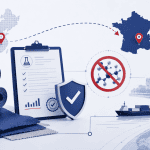
PFAS-related finishes. Elastane itself should not be equated with PFAS. However, stretch textiles marketed as water-, oil-, or stain-repellent may use finish chemistry that falls within destination-market restrictions. Commission Regulation (EU) 2024/2462 adds a targeted REACH restriction for PFHxA, its salts, and related substances, including specified consumer clothing, accessories, footwear, and other textiles, with different transition dates and exemptions. Buyers supplying treated stretch fabrics to the EU should review the EU REACH PFHxA restriction and China fabric supply-chain implications and confirm scope, thresholds, test methods, exemptions, and application dates against the official regulation before bulk production.
Traceability and product data. The EU Ecodesign for Sustainable Products Regulation entered into force in 2024 and creates a framework for product-specific ecodesign and information requirements, including Digital Product Passports. It does not mean that every elastane fabric already carries a DPP. Brands preparing EU textile programs should nevertheless organize composition, supplier, chemical, durability, recycled-content, and batch data. FabricsTrades’ overview of ESPR and Digital Product Passports for Chinese fabric supply chains can support planning, while the final delegated rules and buyer-specific obligations must be checked when applicable.
Documentation needs vary by jurisdiction, product category, finish, production batch, and date of sale. Communicate the intended market and testing requirements before sampling and quotation; no supplier statement or internal article should be treated as legal advice or automatic proof of compliance.
Frequently asked questions
Is elastane a fabric or a fiber?
Elastane is a synthetic elastomeric fiber. The term “elastane fabric” usually means a knit or woven fabric containing elastane together with one or more other fibers.
Are elastane and spandex the same?
Yes. They are generic names used for the same broad fiber category. Elastane is widely used internationally; spandex is the common U.S. term.
Is all elastane Lycra?
No. Lycra® is a trademark. Generic elastane or spandex from another producer should not be marketed under that trademark.
Does more elastane always mean more stretch?
No. Fiber percentage matters, but yarn form, fabric construction, finishing, direction, and test load can matter just as much. Compare test results under the same method.
Is elastane breathable?
Elastane content alone does not determine breathability. Air permeability and comfort depend mainly on the complete fabric structure, weight, companion fibers, finishes, and garment design.
Can elastane fabric be recycled?
Some routes are developing, but separating small amounts of elastane from blended textiles remains difficult in many conventional recycling systems. Buyers should verify the actual collection and recycling route before making recyclability claims.
What percentage of elastane should a buyer specify?
There is no universal percentage. The right level depends on the end use, construction, target modulus, fit, recovery, opacity, laundering, and cost. Specify performance targets and approve a tested sample instead of relying only on composition.
Conclusion: source to a measurable performance target
Elastane is valuable because it can add stretch, recovery, fit, and movement to many textile constructions. Its name, however, does not define finished-fabric quality. Reliable sourcing starts with the end use and converts that need into a measurable specification covering composition, yarn system, construction, stretch direction, recovery, dimensional stability, colorfastness, care, restricted substances, and documentation.
FabricsTrades operates in Wujiang District, Suzhou and supports stretch-fabric sourcing, product development, customization, sampling, testing coordination, and supply-chain communication. Buyers should share the garment application, target market, performance methods, finish requirements, and approval standard at the inquiry stage so that sampling and quotation can be aligned with the intended product.