TL;DR
- Immediate Regulatory Threat: The EU REACH Entry 79 restriction on PFHxA takes effect on October 10, 2026, establishing a 25 ppb limit for PFHxA and its salts.1 This aligns with California’s AB 1817, which drops its total organic fluorine ceiling to 50 ppm on January 1, 2027.3
- The Shared Line Contamination Trap: Sourcing fabric marketed as “C0” or “fluorine-free” from Chinese suppliers does not guarantee compliance.5 High-temperature stenter curing processes on shared production lines volatilize residual PFAS, causing cross-contamination that routinely exceeds legal detection thresholds.5
- Mandatory Testing Evolution: Legacy methanol-only extraction methods fail to detect bound polymeric PFAS.8 Brands must enforce the new EN 17681-1:2025 testing standard, which utilizes alkaline hydrolysis to chemically cleave polymers and prevent costly border seizures.7
- Traceable Sourcing Solutions: Compliance requires transitioning from superficial end-product testing to comprehensive source-level chemical audits, requiring suppliers to run dedicated fluorine-free stenter lines and provide verified Global Recycled Standard (GRS) Transaction Certificates to mitigate recycled-stream contamination.9
PFAS Regulation at a Glance
Global chemical regulations have transitioned from targeting individual substances to implementing broad, class-based restrictions on all per- and polyfluoroalkyl substances (PFAS).11 Sourcing directors must navigate a complex, multi-jurisdictional patchwork of laws with highly sensitive detection thresholds.13
| Regulation / Jurisdiction | Effective Date | Threshold / Limit | Affected Products | Key Exemptions |
| EU REACH Annex XVII Entry 79 (PFHxA) 1 | October 10, 2026 | < 25 ppb for PFHxA & salts; < 1,000 ppb for PFHxA-related substances. | Apparel, footwear, accessories, cosmetics, and general consumer mixtures.2 | Category III PPE, medical devices, and construction textiles.2 |
| EU REACH Annex XVII Entry 79 (Other Textiles) 15 | October 10, 2027 | < 25 ppb for PFHxA & salts; < 1,000 ppb for PFHxA-related substances. | Non-apparel consumer textiles (upholstery, carpets, curtains, outdoor gear).15 | Professional protective wear; technical membranes in specified industrial uses.15 |
| French National PFAS Ban (Decree 2025-1376) 1 | January 1, 2026 | < 25 ppb individual PFAS; < 250 ppb sum of PFAS; < 50 ppm total PFAS (including polymers).17 | Apparel, footwear, and cosmetics placed on the French market.14 | Civil Personal Protective Equipment (PPE).17 |
| Danish National PFAS Ban 14 | July 1, 2026 | < 50 mg/kg (50 ppm) Total Organic Fluorine (TOF).14 | Consumer clothing, footwear, and retail waterproofing agents.14 | Professional and industrial protective wear. |
| California Assembly Bill 1817 (Phase 1) 3 | January 1, 2025 | < 100 ppm Total Organic Fluorine (TOF).3 | General consumer textile articles, apparel, and luggage.3 | Professional protective wear (PPE); temporary exemption for severe wet weather apparel.3 |
| California Assembly Bill 1817 (Phase 2) 3 | January 1, 2027 | < 50 ppm Total Organic Fluorine (TOF).3 | General consumer textile articles, apparel, and accessories.3 | Temporary exemption for severe wet weather apparel continues.3 |
| California Assembly Bill 1817 (Phase 3) 3 | January 1, 2028 | < 50 ppm Total Organic Fluorine (TOF).3 | Severe wet weather outdoor apparel (exemption expires).3 | Professional protective wear (PPE) only. |
| EU Packaging & Packaging Waste Regulation (PPWR) 1 | August 12, 2026 | < 25 ppb single PFAS; < 250 ppb sum of PFAS; < 50 ppm Total Fluorine.14 | Food-contact packaging and paperboard.1 | Non-food industrial packaging. |
What Changed in the Last 2 Years
The regulatory framework governing fluorinated chemistry in performance apparel and technical textiles has experienced a rapid contraction. Sourcing departments can trace this transformation through several critical milestones:
- October 2024 (REACH Entry 79 Codified): The European Commission formally amended REACH Annex XVII, introducing Entry 79 to restrict PFHxA, its salts, and related precursor substances.1 This targeted shorter-chain “C6” chemistry, which the textile industry had widely adopted as a supposedly safe alternative to legacy “C8” (PFOA/PFOS) formulations.2 Sourcing departments must recognize that the transition window for general public clothing is locked to October 10, 2026.2
- January 2025 (California AB 1817 Enforcement Begins): California began enforcing its landmark 100 ppm TOF threshold on general textiles, establishing the first class-based, organic-fluorine restriction in the United States.3 This effectively set a national baseline for brands operating in North America due to California’s massive market size.19
- April 2025 (EN 17681-1:2025 Published): The European Committee for Standardization (CEN) published the updated.8 This standard introduced a mandatory alkaline hydrolysis extraction method designed to chemically cleave fluorinated side-chain polymers, exposing bound polymeric PFAS that previously escaped detection.7
- August 2025 (Universal PFAS Scope Expansion): Five EU member states submitted an updated background document to the European Chemicals Agency (ECHA).21 Following the integration of public consultation data, the scope of the proposed Universal PFAS Restriction was expanded to include eight new sectors, explicitly listing “technical textiles”.21
- January 2026 (French Apparel Ban and TSCA Reporting): France implemented its national ban on PFAS-treated apparel and footwear.16 Concurrently, the US EPA opened the TSCA Section 8(a)(7) reporting submission period, requiring comprehensive historical reporting on PFAS manufacture and import with no de minimis thresholds.19
- March 2026 (RAC Delivers Stricter Stance): ECHA’s Committee for Risk Assessment (RAC) adopted its final opinion, endorsing a full, group-wide PFAS ban under Restriction Option 1 (RO1), which supports an 18-month transition with minimal exceptions.24 This diverged from the draft opinion of the Committee for Socio-Economic Analysis (SEAC), which favors use-specific derogations (Restriction Option 2).24 SEAC noted that the difference between the options represents an estimated 700,000 tonnes of additional PFAS emissions over a 30-year period.24
- July 2026 (Incoming French ESPR Ban): Under the EU Ecodesign for Sustainable Products Regulation (ESPR), large apparel brands face a strict ban on the destruction of unsold clothing, accessories, and footwear starting July 19, 2026.16 This forces brands to prioritize circularity, which in turn amplifies the risk of carrying forward legacy PFAS contaminants through recycled textile streams.10
Why This Matters for Chinese Fabric Suppliers
The regulatory pressure cooker in the West is causing immediate operational challenges within the key technical textile clusters of Greater China. Wujiang District in Suzhou, specifically the Shengze Town cluster, represents the global epicenter of synthetic filament weaving, functional coating, and lamination.27 With an annual output reaching billions of meters of polyester and nylon fabrics, this cluster is experiencing a massive disruption.28
The Shengze Cluster Under Pressure
Shengze is a highly integrated textile hub where vertical giants and specialized commission dyehouses operate in close proximity.28 For decades, the cluster relied on C8, and subsequently C6, fluorinated chemistry to deliver Durable Water Repellent (DWR) performance.12 The hydrophobic properties of these chemicals made them the default choice for the outdoor apparel, luggage, and sportswear markets.12
To comply with the strict, class-based regulations of 2026, many Shengze mills have quickly marketed “C0 DWR” or “fluorine-free” fabrics.31 However, there is a substantial gap between a mill’s verbal declaration of compliance and the empirical reality of laboratory testing.5
The Chemistry of Stenter Cross-Contamination
Sourcing directors regularly experience sudden testing failures on fabric shipments certified by suppliers as “C0” or “PFC-free”.5 This issue is rarely caused by the intentional addition of PFAS in the pad bath.5 Instead, it is driven by systemic cross-contamination on the production floor, specifically during the high-temperature stenting (heat-setting and curing) process.5
│
▼
┌───────────────────────┐
│ Weaving / Preparation│ (Cross-contamination from recycled sizing agents)
└───────────┬───────────┘
│
▼
┌───────────────────────┐
│ Chemical Padding │ (C0 DWR emulsion applied to the fabric)
└───────────┬───────────┘
│
▼
┌───────────────────────┐
│ Stenter Heat-Curing │ <── (Residual PFAS from prior
│ (150°C – 180°C) │ C6 runs volatilizes from ducts)
└───────────┬───────────┘
│
▼
Most commission dyehouses in Shengze run both fluorinated finishes (for domestic markets or jurisdictions without active bans) and fluorine-free finishes on the same machinery.5 Fluorinated side-chain polymers require high curing temperatures, typically between 150°C and 180°C.9 At these temperatures, residual volatile fluorotelomer alcohols (FTOHs), such as 6:2 FTOH and 8:2 FTOH, volatilize from the fabric and deposit onto the internal steel walls, exhaust ducts, and air nozzles of the stenter drying frame.5
When a subsequent batch of “C0” fabric is run through the same stenter, these volatile PFAS compounds re-condense onto the clean fabric.5 Because PFAS are highly stable and resistant to thermal degradation, they accumulate in the stenter environment.5 Even a highly efficient fluorine-free treatment, such as(https://www.archroma.com/press-releases/archroma-presents-low-impact-durable-and-long-lasting-garment-solutions-at-china-interdye-2025) 33 or(https://www.aictc.org/wp-content/uploads/2017/08/05-Laura-Radice-Huntsman-High-IQ-Repel-Intelligent-durable-water-repellency.pdf) 35, will fail California’s 50 ppm TOF threshold if processed on a contaminated stenter line.5
The Failure of Standard Machine Cleaning
Dyehouses often attempt to clean their stenter lines by running “blank” polyester fabrics through the machine to collect residues.5 However, the strong bond of fluoropolymers to the metal surfaces of the equipment makes standard cleaning procedures highly ineffective.5 To achieve a true 50 ppm TOF limit, a factory must follow strict, labor-intensive cleaning protocols.5
This includes high-pressure washing of the drying chambers, complete replacement of air filters, manual cleaning of the ductwork, and utilizing dedicated, isolated pipelines for the chemical feed.5 These requirements carry high labor costs and lead to significant machine downtime.5 As a result, commission dyehouses often bypass these steps unless closely audited.5
Cost and Lead-Time Realities
Transitioning to verified PFAS-free production directly impacts a brand’s bottom line.37 The physical chemistry of C0 DWR finishes requires longer curing times and precise temperature control, directly affecting mill throughput.9
- Processing Surcharges: Mills typically apply a 15% to 20% surcharge for processing functional fabrics without fluorinated chemistry.38 This covers the higher cost of raw C0 chemical formulations and the energy consumption required for low-temperature curing (150°C to 170°C) or post-wash fixation.31
- Testing and Monitoring Costs: Continuous environmental and product monitoring carries significant operational costs.39 A typical technical textile dyehouse in Shengze must spend roughly $36,000 annually solely on routine water and wastewater testing to verify that its effluent discharge does not re-contaminate processed fabric.40 Sourcing teams must also factor in the cost of accredited product testing, which averages $400 or more per sample.40
- Lead-Time Extensions: Lab-dip lead times and bulk production schedules are expanding.38 Applying C0 DWR requires highly sensitized pre-treatment to clear the greige fabric of sizing agents, spinning lubricants, and alkaline residues, all of which impair the performance of fluorine-free finishes.35 This specialized pre-treatment and the subsequent post-wash fixation add up to 48 hours of processing time, extending standard lead times from a typical 5-day rush schedule to at least 7 to 10 days for complex technical fabrics.38
Direct Impact on Sourcing of Fabric Product Categories
The transition away from PFAS chemistry has directly impacted three major technical fabric categories. Each category presents unique performance challenges and requires specific, compliant alternative materials.
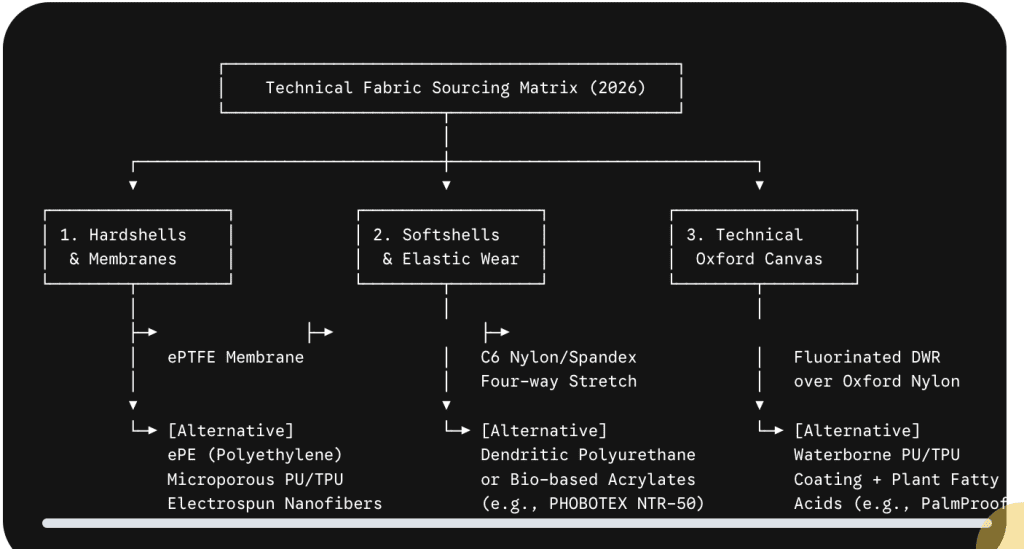
1. Hardshell Rain Shells & Waterproof-Breathable Membranes
This product category is the most vulnerable to PFAS regulations.41 Traditionally, the gold standard for hardshell laminates was expanded polytetrafluoroethylene (ePTFE), famously used in legacy Gore-Tex and similar high-performance membranes.42 However, PTFE is a fluoropolymer, making it a regulated PFAS compound under all modern definitions.5
Sourcing Alternatives
Sourcing managers must transition to non-fluorinated membranes.42 The primary alternatives include:
- Expanded Polyethylene (ePE): Pioneered by W. L. Gore & Associates, ePE is a microporous, non-fluorinated film that delivers high breathability and hydrostatic head protection at approximately half the thickness of traditional ePTFE.42 To ensure long-term durability, ePE is typically combined with a thin polyurethane (PU) protective barrier.42
- Hydrophilic and Microporous Polyurethane (PU/TPU) Membranes: These standard, non-fluorinated films are highly versatile and compatible with polyester and nylon face fabrics.28 They are highly cost-effective but can suffer from reduced breathability under high humidity gradients compared to microporous membranes.42
- Electrospun Nanofiber Membranes: Utilizing electrospinning technology, manufacturers can produce non-fluorinated polymeric nanofiber webs.43 These membranes offer excellent air permeability and customizable pore sizes, providing a direct performance alternative to ePTFE.43
2. Softshells & Elastic Fabrics (Nylon/Polyester Spandex Blends)
Softshells generally feature a three-layer bonded construction, combining a woven elastomeric face fabric (e.g., 91% Nylon, 9% Spandex) with a functional membrane and a fleece or tricot backing.28 These stretch fabrics require high-performance DWR finishes to prevent the face yarn from wetting out, which would block air permeability and cause rapid cooling.28
Sourcing Alternatives
The replacement of C6 fluorinated finishes with C0 DWR coatings has introduced several performance trade-offs 31:
- Hyperbranched Dendritic Polyurethanes: These non-fluorinated finishes provide the highest water repellency and wash durability currently available, often maintaining an excellent spray rating (ISO 4920 Grade 4–5) through 20 or more wash cycles.13 However, they can impart a firmer hand-feel, requiring mills to optimize their drying and stenter tension parameters to preserve fabric stretch.9
- Bio-Based Acrylates and Plant-Derived Fatty Acids: Products like(https://www.archroma.com/press-releases/archroma-brings-super-systems-solutions-to-china-interdye-2024) (made from 50% sustainably sourced renewable feedstock) 45 or palm-derived fatty acid technologies 37 offer excellent water repellency while maintaining fabric softness.37 Sourcing managers must note that these finishes do not provide oil or stain repellency.13 Under the new regulations, brands must accept that “oil and stain resistance” is no longer achievable on consumer apparel.12
3. Technical Oxford Fabrics & Heavy Canvas (Luggage, Outdoor Gear, Tents)
Heavyweight woven synthetics, such as 330D to 1000D Cordura-type nylon or 600D polyester Oxford, are commonly used in tactical gear, backpacks, and camping equipment.41 These fabrics rely on thick backings, such as polyurethane (PU) or polyvinyl chloride (PVC), combined with a durable face water repellent.46
Sourcing Alternatives
- Waterborne Polyurethanes (WBPU) and Silicone Coatings: Traditional solvent-based coatings often utilized fluorinated additives to improve chemical stability and water resistance.5 Sourcing managers should mandate the use of waterborne, fully polymerized polyurethane dispersions or pure silicone backings, which are inherently PFAS-free.46
- Pre-Coating Fluorine-Free Repellents: For ultra-thin or high-tensile nylons where coating adhesion is critical, specialized non-fluorinated agents must be used.31 Standard C0 DWR can dramatically lower the surface energy of the fabric, preventing the PU coating from bonding and leading to delamination.10 Utilizing specialized, non-ionic, fluorine-free agents ensures both water repellency on the face and high peel strength on the coated reverse side.31
Technical Verification & Testing Playbook
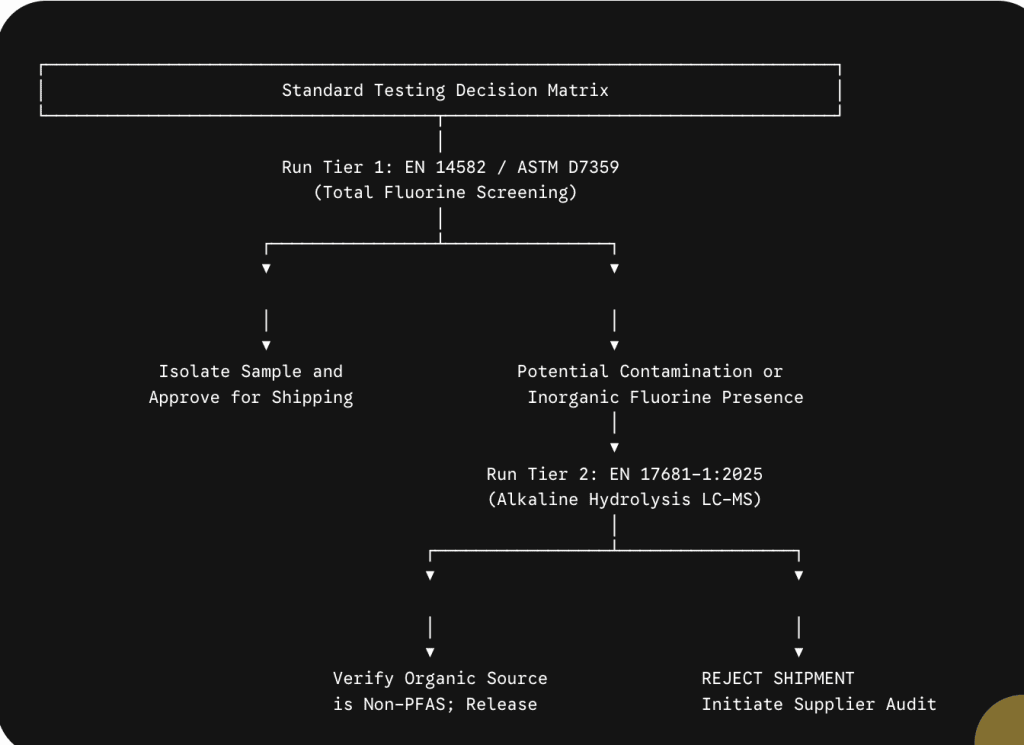
Relying on a supplier’s written declaration of compliance is a significant risk under the strict enforcement regimes of 2026.5 Western compliance directors must implement a two-tiered testing protocol to verify the PFAS-free status of all incoming shipments.7
Tier 1: Total Fluorine (TF) / Total Organic Fluorine (TOF) Screening
Sourcing directors should use Total Fluorine or Total Organic Fluorine testing as an initial, cost-effective screening tool during the material selection and product development phases.17
- Standard Method: EN 14582:2016 or ASTM D7359-23 using Combustion Ion Chromatography (CIC).23
- Mechanism: The fabric sample is combusted in a closed chamber at temperatures exceeding 1,000°C, converting all organically and inorganically bound fluorine into hydrogen fluoride (HF) gas.49 The gas is then absorbed into an aqueous solution and analyzed using ion chromatography.49
- Interpretation:
- Result < 50 ppm: The fabric is highly likely to be compliant with California’s AB 1817 and Denmark’s national limits.3 No further testing is required for bulk shipments unless specified by target brand RSLs.23
- Result ≥ 50 ppm: The material fails the upcoming 2027 California threshold and is presumed to contain intentionally added PFAS.19 However, because CIC measures all fluorine, a failure can sometimes be caused by harmless, inorganic fluorides, such as clay-based flame retardants or inorganic minerals.39 If a sample fails, the brand must initiate Tier 2 targeted testing to verify if the fluorine source is organic.23
Tier 2: Targeted PFAS and Polymeric Extraction
To verify compliance with EU REACH Entry 79 (PFHxA) and other compound-specific bans, brands must conduct targeted testing.12
- The Mandatory Standard: EN 17681-1:2025.8
- The Critical Risk of Outdated Standards: Many Chinese laboratories still offer testing under the legacy EN 17681-1:2022 standard.8 Sourcing directors must refuse these reports.8 The 2022 standard utilized a simple methanol solvent extraction, which only dissolves “free” or unbound PFAS compounds on the fabric surface.8
- The Power of Alkaline Hydrolysis: The updated introduces alkaline hydrolysis.8 This process uses an alkaline solution to chemically break down the polymeric side-chains of fluorotelomer-based acrylates, releasing bound fluorotelomer alcohols (FTOHs) and carboxylates.7 Laboratory data shows that fabrics that easily passed the legacy 2022 standard can fail the 2025 standard by up to 500%, as the bound polymeric PFAS are released and detected.8
- Analytical Instrument: Liquid Chromatography-Tandem Mass Spectrometry (LC-MS/MS) and Gas Chromatography-Mass Spectrometry (GC-MS) are used to target 30 to 50 specific restricted PFAS compounds, including PFOS, PFOA, PFHxS, and PFHxA, reaching detection limits down to single-digit parts-per-billion (ppb) levels.8
FAQ Section
Is ePTFE banned under EU REACH and California AB 1817?
Yes. Expanded polytetrafluoroethylene (ePTFE) is a fluoropolymer composed entirely of carbon and fluorine atoms, which classifies it as a PFAS compound under the OECD and California statutory definitions.5 Under California’s AB 1817, textile articles containing ePTFE are prohibited if the Total Organic Fluorine (TOF) content exceeds 100 ppm (dropping to 50 ppm on January 1, 2027).3 Under the EU’s proposed Universal PFAS Restriction, ePTFE will face a phased ban, though temporary derogations are under discussion for specific technical and protective applications.24
What is the difference between total fluorine and total organic fluorine testing?
Total Fluorine (TF) measures the absolute sum of all fluorine present in a sample, including both inorganic fluorides (such as calcium fluoride or soil minerals) and organic fluorine compounds.39 Total Organic Fluorine (TOF) specifically isolates the organically bound fluorine atoms, which are typical indicators of synthetic PFAS chemistry.39 While TOF is the exact parameter regulated by U.S. state laws like AB 1817 3, TF screening via Combustion Ion Chromatography (CIC) is widely used as a faster and more cost-effective testing proxy.49
Why does “C0 DWR” fabric often fail California PFAS testing?
“C0” or “fluorine-free” fabric often fails testing due to cross-contamination during the finishing and heat-setting phases at the mill.5 When a mill uses a shared stenter drying frame to process both fluorinated (C6) and non-fluorinated (C0) finishes, residual volatile fluorotelomer alcohols (FTOHs) from the C6 runs accumulate in the machine’s exhaust and air ducts.5 During subsequent high-temperature runs of C0 fabric, these volatile compounds re-condense onto the fabric surface, driving the TOF levels well above the 50 ppm or 100 ppm threshold.5
How do recycled materials impact PFAS compliance in textile sourcing?
Recycled polyester (rPET) and recycled nylon often carry a high risk of legacy PFAS contamination.5 Because post-consumer plastic bottles and textile waste are sourced from historical waste streams, they frequently contain residual fluorinated coatings and finishes.5 During the recycling and mechanical extrusion processes, these substances are blended into the new polymer melt.10 Consequently, even if a mill uses zero virgin PFAS chemistry, recycled-content fabrics can fail TOF screening.5
How does the EU ESPR destruction ban on unsold textiles interact with PFAS compliance?
The EU Ecodesign for Sustainable Products Regulation (ESPR), taking effect on July 19, 2026, bans large brands from destroying unsold apparel, footwear, and accessories.16 Brands must channel returns and deadstock into recycling or donation streams rather than disposing of them.26 This circular mandate, however, dramatically increases compliance risks, as older, PFAS-treated apparel is re-introduced into the mechanical recycling loop, systematically contaminating new “recycled polyester” or “recycled nylon” yarns.10
Actionable Sourcing Recommendations
To insulate a brand’s supply chain from legal, financial, and reputational risks, compliance directors should implement the following four-step action plan 7:
1. Require Dedicated Fluorine-Free Production Lines
Sourcing managers must audit all fabric mills in the Shengze and Greater Suzhou clusters to map their stenter configurations.5 Contractual agreements should mandate that all fabrics destined for Western markets are processed on dedicated, fully isolated “fluorine-free” stenter lines.9 These dedicated lines must have independent chemical feed systems, separate padding bowls, and dedicated hydro-extraction equipment to prevent physical cross-contamination.5 Mills must provide documented run logs showing that the assigned machinery has not processed fluorinated chemistry.9
2. Implement a Strict Testing Standard Protocol
All supplier test reports must be scrutinized.36 Compliance teams should reject any PFAS chemical analysis conducted using the legacy EN 17681-1:2022 method.8 Sourcing agreements must explicitly state that raw materials will only be accepted upon the provision of a certified test report from an ISO 17025 accredited laboratory using the updated method with alkaline hydrolysis, alongside a Total Fluorine (TF) Combustion Ion Chromatography (CIC) report showing less than 50 ppm.7
3. Track and Audit Recycled Feedstocks
For all recycled polyester or nylon fabrics, sourcing directors should require complete traceability down to the polymer stage.10 Suppliers must present verified Global Recycled Standard (GRS) Transaction Certificates (TCs) for every batch of yarn sourced, confirming that the chemical inputs utilized during the recycling process meet GRS Restricted Substance List (RSL) criteria.10 Random spot-testing for TOF must be performed on incoming recycled yarns to capture and isolate legacy PFAS contamination before weaving begins.5
4. Transition to Validated Alternative Chemries
Work proactively with chemical suppliers to implement certified, non-fluorinated water repellents.12 Sourcing teams must ensure that any alternative chemistries—such as dendritic polyurethanes or bio-based acrylates—are selected from verified positive lists, such as the(https://afirm-group.com/wp-content/uploads/2025/11/AFIRM_Phaseout_PFAS_2025_1031.pdf) or(https://www.performancedays.com/news/detail/pfas-phaseout-guidance.html) databases, which restrict the intentional use of fluorinated compounds and minimize occupational exposure risks during application.6 Ensure that mills optimize their stenter curing temperatures and compound application levels to maintain fabric performance without compromising physical quality.31
Works cited
- PFAS Regulations & Compliance Testing in the EU – Measurlabs, accessed May 25, 2026, https://measurlabs.com/blog/pfas-testing-in-the-eu/
- PFHxA added to REACH Annex XVII – SATRA, accessed May 25, 2026, https://www.satra.com/bulletin/article.php?id=3407
- California AB 1817 PFAS Textile Ban: What the 2027 Threshold Step-Down Means for Manufacturers and Retailers – Certivo, accessed May 25, 2026, https://www.certivo.com/blog-details/california-ab-1817-pfas-textiles-ban-compliance-requirements-manufacturers
- An overview of PFAS legislation – SATRA, accessed May 25, 2026, https://www.satra.com/spotlight/article.php?id=593
- PFAS-Free Manufacturing Guidelines | PDF | Textiles | Chemical Substances – Scribd, accessed May 25, 2026, https://www.scribd.com/document/836491347/PFAS-free-Manufacturing-Guidance
- AFIRM Phaseout Guidance for PFAS Compliance – 2023 Edition – Studocu, accessed May 25, 2026, https://www.studocu.vn/vn/document/ho-chi-minh-city-university-of-technology-and-education/textile-materials/afirm-phaseout-pfas-2023-0831/114668622
- PFAS-free Manufacturing Guidance – Edition 2.0 – INDITEX, accessed May 25, 2026, https://www.inditex.com/itxcomweb/api/media/5b480a53-9437-4420-956e-e3c05372ac77/PFAS-free+Manufacturing+Guidance.pdf?t=1693235637676
- EU PFAS Restrictions: Key Deadlines, Testing Standards, and Topumbrella’s Compliance Advantage, accessed May 25, 2026,
- Inside a PFAS-Free Umbrella Manufacturer Fabric Workshop – Topumbrella, accessed May 25, 2026,
- Eco-Friendly Oxford Fabrics: Recycled & Certified Options Guide, accessed May 25, 2026, https://szoneierfabrics.com/eco-friendly-oxford-fabrics-recycled-yarns-and-oeko-tex-certified-options/
- Addressing the risks from Perfluoroalkyl and Polyfluoroalkyl Substances (PFAS), accessed May 25, 2026, https://publications.parliament.uk/pa/cm5901/cmselect/cmenvaud/852/report.html
- Phaseout Guidance for Per- & Polyfluoroalkyl Substances (PFAS) – AFIRM Group, accessed May 25, 2026, https://afirm-group.com/wp-content/uploads/2025/11/AFIRM_Phaseout_PFAS_2025_1031.pdf
- PFAS in Clothing: 2026 Bans, Health Risks, and Safer Alternatives | bluesign, accessed May 25, 2026, https://www.bluesign.com/pfas-in-clothing
- Which EU PFAS Ban Applies to Your Brand?: A Quick Guide | Tocco.Earth, accessed May 25, 2026, https://tocco.earth/article/which-eu-pfas-ban-applies-to-your-brand
- EU REACH: Restriction of PFHxA – Bureau Veritas CPS, accessed May 25, 2026, https://www.cps.bureauveritas.com/newsroom/eu-reach-restriction-pfhxa
- Footwear Regulatory Updates 2026: Compliance Timelines Brands Must Know – Eurofins, accessed May 25, 2026, https://www.eurofins.com/textile-leather/articles/footwear-regulatory-updates-2026-compliance-timelines-brands-must-know/
- PFAS Testing, Certification & Compliance – Hohenstein.US, accessed May 25, 2026, https://www.hohenstein.us/en-us/textile-testing/quality/chemical-tests/pfas
- PFAS Regulations and Travel Goods – News, accessed May 25, 2026, https://www.luggage-factories.com/news-detail/108860
- PFAS Regulations Overview 2026 for Consumer Products, accessed May 25, 2026, https://sustainabilityservices.eurofins.com/news-vi/pfas-regulations-overview-2026-for-consumer-products/
- Total Fluorine and PFAS Compliance for U.S. & EU Markets – Hohenstein, accessed May 25, 2026, https://www.hohenstein.vn/fileadmin/user_upload/Downloads/Customer_Information/Total_Fluorine_and_PFAS_Compliance_for_US_and_EU_Markets_EN.pdf
- Universal PFAS Restriction – CHEM Trust, accessed May 25, 2026, https://chemtrust.org/universal-pfas-restriction/
- The evolving European PFAS Restriction Proposal: where we stand in 2025 – Ricardo, accessed May 25, 2026, https://www.ricardo.com/en/news-and-insights/industry-insights/the-evolving-european-pfas-restriction-proposal-where-we-stand-in-2025
- Per-and Polyfluoroalkyl Substances (PFAS) in Textile and Leather – UL Solutions, accessed May 25, 2026, https://www.ul.com/resources/per-and-polyfluoroalkyl-substances-pfas-textile-and-leather
- EU: universal PFAS restriction process enters its decisive phase …, accessed May 25, 2026, https://sustainablefutures.linklaters.com/post/102mp62/eu-universal-pfas-restriction-process-enters-its-decisive-phase-seac-draft-opin
- Latest Updates on Per- and Polyfluorinated Substances (PFAS) – Sustainability in Business, accessed May 25, 2026, https://www.sustainabilityinbusiness.blog/2025/09/latest-updates-on-per-and-polyfluorinated-substances-pfas-4/
- Regulatory compliance and sustainability for clothing and textiles in 2026 | Osborne Clarke, accessed May 25, 2026, https://www.osborneclarke.com/insights/regulatory-compliance-and-sustainability-clothing-and-textiles-2026
- About Us – styledfabrics, accessed May 25, 2026, https://styledfabrics.com/pages/about-us
- Waterproof Breathable Softshell Fabric Manufacturers, Suppliers, accessed May 25, 2026, https://www.fuhuafabric.com/product/clothes-fabrics/softshell-fabric/
- Top Fabric Markets in China for Clothing Manufacturing, accessed May 25, 2026, https://idcustomapparel.com/top-fabric-markets-in-china-for-clothing-manufacturing/
- Exhibitor List – Functional Fabric Fair, accessed May 25, 2026, https://www.functionalfabricfair.com/portland-spring/en-us/For-Visitors/exhibitor-list.html?page=3
- Water Repellent Agents – Chemicals Manufacture – Textile Dyeing and Finishing Solutions, accessed May 25, 2026, https://zezsy.com/water-repellent-agents/
- Woven Fabric Manufacturer | Functional Fabric Supplier | YUNLAN Textile | YUNLAN Textile – Functional & Woven Fabric Supplier, accessed May 25, 2026, https://www.yl-fabric.com/
- Archroma Showcases Sustainable Textile Solutions at China Interdye 2025, accessed May 25, 2026, https://textilevaluechain.in/archroma-showcases-sustainable-textile-solutions-at-china-interdye-2025
- Archroma presents low impact, durable, and long-lasting garment solutions at China Interdye 2025, accessed May 25, 2026, https://www.archroma.com/press-releases/archroma-presents-low-impact-durable-and-long-lasting-garment-solutions-at-china-interdye-2025
- High IQ Repel – AICTC, accessed May 25, 2026, https://www.aictc.org/wp-content/uploads/2017/08/05-Laura-Radice-Huntsman-High-IQ-Repel-Intelligent-durable-water-repellency.pdf
- PFAS – Phaseout & Guidance – PERFORMANCE DAYS functional fabric fair, accessed May 25, 2026, https://www.performancedays.com/news/detail/pfas-phaseout-guidance.html
- PalmProof – PFAS-Free Water Repellent for Textiles – AGS-TEX, accessed May 25, 2026, https://ags-tex.com/palmproof-pfas-free-water-repellent-for-textiles/
- Digital Textile Printing Market Size & Growth | Industry Forecast, 2031 – Mordor Intelligence, accessed May 25, 2026, https://www.mordorintelligence.com/industry-reports/global-digital-textile-printing-market
- PFAS Testing Methods & Standards – Measurlabs, accessed May 25, 2026, https://measurlabs.com/blog/pfas-testing-methods-and-standards/
- The price of PFAS: ‘Forever chemicals’ generate boundless costs – The Maine Monitor, accessed May 25, 2026, https://themainemonitor.org/the-price-of-pfas-forever-chemicals-generate-boundless-costs/
- Lean Textile Co., Limited.-Leading Fabric Manufacturer and Factory from China, accessed May 25, 2026, https://www.leantex.com/
- PFAS and Waterproof Membranes: Risks, Alternatives, and the Future of – Foehn Clothing, accessed May 25, 2026, https://wearfoehn.com/blogs/journal/pfas-and-waterproof-membranes-risks-alternatives-and-the-future-of-outdoor-gear
- PFAS-Free Nanofiber Solution: The Future of ePTFE Replacement – Matregenix, accessed May 25, 2026, https://www.matregenix.com/blog/pfas-free-nanofiber-solution-the-future-of-eptfe-replacement
- Stretch Double Weave Nylon Fabric | Synthetic Fibers | | Durable & Eco-Friendly Textile Fabric by FlexFeng, accessed May 25, 2026, https://www.flexfeng.com/stretch-double-weave-nylon-fabric
- Archroma brings Super Systems+ Solutions to China Interdye 2024, accessed May 25, 2026, https://www.archroma.com/press-releases/archroma-brings-super-systems-solutions-to-china-interdye-2024
- 70D 2.51 oz Waterproof Rip-Nylon Fabric, accessed May 25, 2026, https://flagshipfabric.com/product/70d-2-51-oz-waterproof-rip-nylon-fabric/
- How to Make Fabric Waterproof – hawwintex, accessed May 25, 2026, https://www.hawwintex.com/news/HowtoMakeFabricWaterproof
- Potential Alternatives to PFASs in Treatments for Converted Textiles or Leathers – Department of Toxic Substances Control, accessed May 25, 2026, https://dtsc.ca.gov/wp-content/uploads/sites/31/2022/05/Public-PFAS-Treatments-Alternatives-Summary_accessible.pdf
- PFAS Testing Methods – PFAS.com, accessed May 25, 2026, https://pfas.com/pfas-testing/
- Total Fluorine Analysis | EN 14582 or EN 15408 – Measurlabs, accessed May 25, 2026, https://measurlabs.com/products/total-fluorine-content-in-plastic/
- NFPA 1950-2025 Edition Standard on Personal Protective Equipment for Technical Rescue Incidents, Emergency Medical Operations, a, accessed May 25, 2026, https://docinfofiles.nfpa.org/files/AboutTheCodes/1950/NFPA_1950_Proposed_TIA_1819.pdf
- 2 Overview on PFAS analytical methods – Publications, accessed May 25, 2026, https://pub.norden.org/temanord2024-510/2-overview-on-pfas-analytical-methods.html
- KUSTOM KIT® – pm7, accessed May 25, 2026, https://pm7.it/catalogo/fornitori/KustomKit_EN/files/kustomkit-brochure-2026-EN.pdf