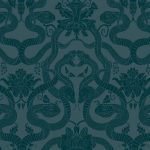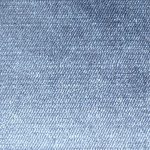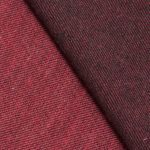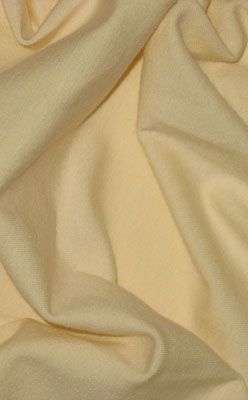
Soy fabric is a manufactured textile fiber made from regenerated soy protein. It is commonly marketed as soy protein fiber, soy silk, vegetable cashmere, or vegan cashmere, although those marketing names do not mean the material is silk or cashmere. Commercial fabrics are often blends rather than 100% soy protein fiber, so buyers should verify the declared fiber composition, construction, finishes, and test results before selecting it for a product.
Key Takeaways
Soy fabric is a regenerated protein-based manufactured fiber, not a conventional natural fiber spun directly from soybean hulls.
A typical process isolates soy protein, modifies it into a spinnable solution, extrudes filaments, applies stabilization or finishing steps, and then spins or blends the fiber into yarn.
Soft hand, drape, moisture comfort, and blend versatility are plausible benefits; durability, pilling, colorfastness, stretch, UV protection, and antimicrobial performance depend on the exact product and require testing.
A byproduct feedstock can improve material utilization, but it does not by itself prove low environmental impact, biodegradability, non-toxicity, or deforestation-free sourcing.
For procurement, request exact fiber percentages, the legally appropriate fiber name for the destination market, chemical and performance test reports, traceability evidence, and care instructions.
Soy Fabric at a Glance
| Attribute | Practical description |
| Common names | Soy protein fiber, soy fabric; “soy silk” and “vegetable cashmere” are marketing terms. |
| Fiber family | Manufactured regenerated protein fiber; U.S. rules define regenerated naturally occurring protein fibers under the generic name azlon. |
| Typical form | Staple fiber or yarn, frequently blended with cotton, wool, viscose/rayon, or synthetic fibers. |
| Typical strengths | Soft hand, fluid drape, lightweight comfort, and blend compatibility. |
| Typical limitations | Variable wet strength and abrasion resistance; pilling, shrinkage, creasing, and colorfastness depend on construction and finishing. |
| Common uses | T-shirts, knit tops, dresses, underwear, loungewear, babywear, bedding, and selected upholstery or suiting blends. |
| Care | Follow the finished-product care label; cool or warm gentle washing is common, but no universal temperature applies. |
What Is Soy Fabric?
Soy fabric is produced by converting naturally occurring soy protein into a manufactured fiber. The protein feedstock may come from soy-processing streams such as meal or other protein-rich residues, but the exact raw material varies by producer. Because the protein must be dissolved or chemically modified, extruded, stabilized, and converted into textile fiber, soy fabric is better described as a regenerated or manufactured protein fiber than as a natural fiber.
The original article described soy fabric as soft, lightweight, lustrous, breathable, elastic, wrinkle resistant, and easy to dye. These characteristics may occur in a particular yarn or blend, but they are not universal specifications. Fabric construction, soy percentage, companion fibers, yarn count, knitting or weaving method, dye class, and finishing treatment can change the result substantially.

A Brief History of Soy Protein Fiber
Experiments with regenerated protein fibers expanded during the early twentieth century. Henry Ford promoted industrial uses for soybeans and publicly wore garments containing “soy wool.” Ford-related development also explored soy-containing automotive upholstery around the early 1940s. Wartime material priorities, the rise of durable synthetic fibers, and technical limitations prevented soy protein textiles from becoming a mainstream fiber category.
Newer soy protein fibers reappeared commercially around the turn of the twenty-first century, supported by improved spinning and modification processes and renewed interest in bio-based inputs. The category remains niche. Buyers should therefore expect fewer standardized offerings and wider supplier-to-supplier variation than with cotton, polyester, nylon, or viscose.
How Is Soy Fabric Made?

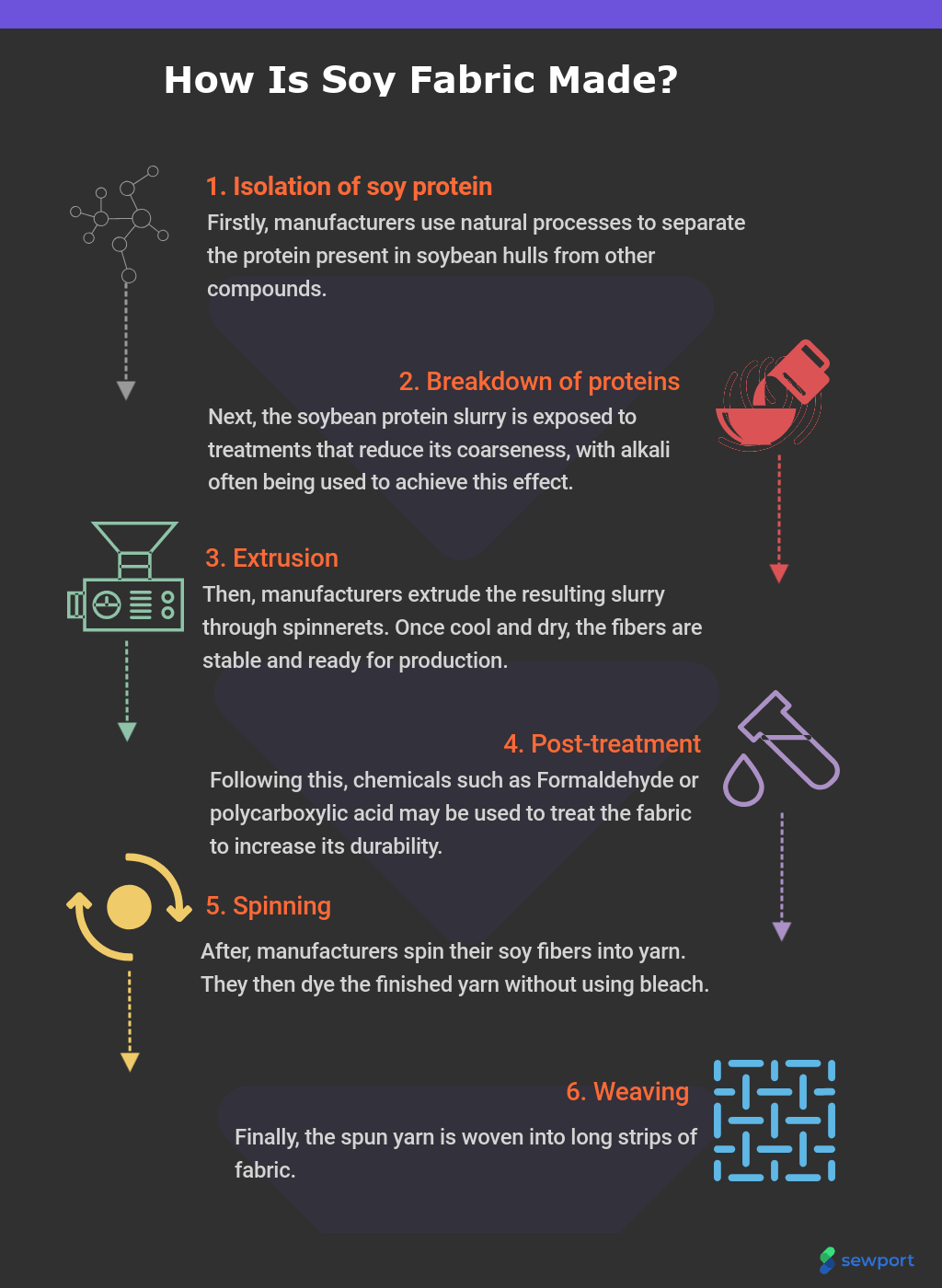
There is no single universal manufacturing recipe. Patents, additives, and finishing systems differ, and some commercial “soy” fibers may contain substantial non-soy components. A representative process includes the following stages:
1. Protein feedstock preparation: A producer obtains a soy-derived, protein-rich input and separates or concentrates the protein. The claim that all soy fiber is made only from otherwise valueless hull waste should not be assumed without supplier evidence.
2. Dissolution or modification: Heat, alkali, enzymes, reducing agents, crosslinking chemistry, or other treatments may be used to modify protein structure and prepare a spinnable solution. Chemical recovery and wastewater treatment are important environmental variables.
3. Filtration and extrusion: The solution is filtered and forced through spinnerets to form filaments, commonly into a coagulation bath.
4. Drawing and stabilization: Filaments are stretched to orient the material and may be crosslinked or otherwise stabilized to improve strength and wet performance. The exact chemistry matters for both durability and restricted-substance control.
5. Washing, drying, and cutting: Residual processing chemicals are removed; filaments may be dried, crimped, and cut into staple length.
6. Yarn and fabric production: Soy staple can be spun alone or blended with cotton, wool, viscose, polyester, or other fibers. Yarn is then knitted or woven, dyed, finished, and converted into garments or home textiles.
Soy Fabric Properties: What Buyers Can Expect
Softness and drape
Soy-containing fabrics are frequently selected for a smooth, soft hand and fluid drape. These qualities suit next-to-skin apparel, but they should be judged on the actual lab dip, handloom, or production sample rather than inferred from the fiber name.
Breathability and moisture comfort
Air permeability is mainly controlled by fabric structure, density, weight, and finishing. Moisture regain and wicking are different properties: a fiber can absorb moisture without transporting liquid efficiently across a fabric. Specify the required test method when moisture management matters.
Stretch and recovery
The original article rated soy fabric as highly stretchable. In practice, stretch is often created by knit construction or elastane rather than soy protein alone. Measure stretch and recovery on the final fabric, especially for fitted garments and activewear.
Pilling, abrasion, and dimensional stability
Pilling and durability vary widely. Blend ratio, staple length, yarn twist, fabric surface, and finishing can matter more than the presence of soy fiber. Relevant testing may include pilling, Martindale abrasion, bursting or tensile strength, shrinkage, spirality, and appearance after laundering.
Colorfastness
Soy-containing fabrics can be dyed, but first-wash bleeding is not an inherent certainty or an acceptable default. Request colorfastness to washing, rubbing, perspiration, light, and water according to the end use and destination market.
Antimicrobial and UV claims
Do not treat antimicrobial or ultraviolet protection as automatic fiber properties. A supplier should identify whether performance comes from the fiber, fabric construction, dye, or finish and provide a report using a recognized method. Marketing claims should match the tested product and remain valid after the claimed number of care cycles.
Common Uses
Soy protein fiber is used most often where softness and drape are valued: T-shirts, tank tops, dresses, skirts, underwear, loungewear, infant clothing, and bedding. Soy-cotton blends may offer a familiar cotton-like processing route with a softer hand. Soy-wool blends can modify handle and drape in knitwear or suiting. Selected upholstery applications have historical precedent, but contemporary upholstery should be qualified for abrasion, seam performance, lightfastness, flammability, and cleaning requirements.
Soy Fabric Blends and Alternatives
| Option | Why it is used | Key buyer check |
| High-soy or 100% soy protein fiber | Maximum expression of soy-derived content and soft hand. | Verify actual composition, wet strength, pilling, shrinkage, and labeling name. |
| Soy–cotton blend | Combines soy-derived content with cotton processing familiarity and strength. | Confirm blend ratio, cotton origin/claim evidence, and dimensional stability. |
| Soy–wool blend | Softness and drape with wool warmth and resilience. | Confirm wool labeling, animal-fiber declarations, pilling, and care route. |
| Viscose/rayon alternative | More established regenerated-fiber supply chain and labeling conventions. | Compare chemistry, traceability, strength, and sourcing evidence rather than assuming equivalence. |
| Recycled or other bio-based option | May support different circularity or feedstock goals. | Compare verified recycled/bio-based content, performance, chemistry, and end-of-life scenario. |
For adjacent material research, see FabricsTrades’ viscose fabric guide. For commercial exploration, review the recycled fabrics category and cotton-blend fabric category; availability of soy-containing constructions should be confirmed for each project.
Where Is Soy Fabric Produced and What Does It Cost?
The original article identified China as the predominant soy-fabric manufacturer and the United States or China as the largest producer. Public, comparable production statistics for soy textile fiber are not readily available, so a definitive country ranking should not be published without a traceable industry dataset. China has significant man-made-fiber and textile conversion capacity, while soybeans themselves are produced at much larger scale in Brazil, the United States, and Argentina than in China. Raw soybean production does not establish where regenerated soy fiber is manufactured.
USDA data for 2024/25 listed Brazil as the largest soybean producer, followed by the United States, Argentina, and China. See the USDA Foreign Agricultural Service production data.
Soy fabric pricing is project-specific. Fiber novelty, order quantity, blend ratio, yarn count, fabric construction, dyeing, finishing, testing, certification, documentation, and freight can outweigh the feedstock cost. Buyers should compare quotations on the same unit, usable width, weight tolerance, quality level, incoterm, and test scope.
Environmental Impact and Sustainability Questions
Using a soy-processing co-product can improve resource utilization, but it does not automatically make the finished fabric environmentally preferable. A credible assessment should consider agricultural land use and traceability, allocation of impacts between soy products, energy and water consumption, chemical inputs, solvent or alkali recovery, wastewater treatment, blend composition, durability, microfiber release, and end-of-life conditions.
Claims such as “biodegradable,” “non-toxic,” “zero waste,” “chemical-free,” or “the world’s most eco-friendly fabric” require a defined test, boundary, and product specification. Blending soy protein fiber with polyester or elastane changes end-of-life behavior. Even a protein-based component may not biodegrade quickly under ordinary landfill, marine, or home-compost conditions.
Buyers should request a bill of materials, supplier process description, restricted-substance test reports, wastewater or chemical-management evidence where relevant, chain-of-custody documents for claimed inputs, and the exact scope of any third-party certificate. A certificate for a factory or one product does not automatically cover every soy fabric offered.
Current Regulatory and Market Update
Soy fabric is subject to the same destination-market obligations that apply to other textile products, including truthful fiber composition, chemical restrictions, product safety, and substantiation of environmental and performance claims.
In the United States, the FTC Textile Fiber Rule requires covered products to disclose generic fiber names and percentages by weight, the responsible company, and country of origin. The FTC defines “azlon” as a manufactured fiber in which the fiber-forming substance is composed of regenerated naturally occurring proteins. Buyers should confirm the correct legal label for the specific fiber rather than using “soy silk” as the composition name. See the FTC textile labeling guidance.
In the European Union, Regulation (EU) No 1007/2011 permits only the fiber names listed in Annex I for composition descriptions and provides a process for adding a new name. Confirm how the exact soy-derived fiber should be declared before sale. The European Commission textile-labeling overview explains the framework.
Chemical finishing also needs attention. Commission Regulation (EU) 2023/1464 added a REACH restriction on formaldehyde released from articles: from 6 August 2026, covered non-furniture articles may not exceed 0.080 mg/m³ under the specified chamber-test conditions, subject to stated exemptions. This is distinct from existing REACH Entry 72 restrictions for certain substances in clothing and related skin-contact textiles. See the official EUR-Lex regulation and FabricsTrades’ 2024–2026 global textile compliance overview for related reading.
The practical response is not to assume that soy fiber requires formaldehyde or that every soy fabric contains it. Instead, identify the actual crosslinking and finishing chemistry, screen the finished article against the destination-market restricted-substance list, and obtain reports that match the final color, finish, and product category. Regulatory requirements can change, so confirm the rules and effective dates before shipment.
How to Source Soy Fabric
- Define the product: end use, blend ratio, fabric construction, target weight and width, color, finish, hand feel, stretch, and care route.
- Verify identity: request the exact fiber composition, legal labeling name for the sales market, supplier identity, country of processing, and lot traceability.
- Approve performance: test the relevant colorfastness, strength, pilling, abrasion, shrinkage, spirality, stretch and recovery, moisture management, or UPF/antimicrobial claim on the final fabric.
- Review chemistry: request a current restricted-substance report and disclosure of crosslinkers, resins, antimicrobial agents, or other functional finishes relevant to the order.
- Validate sustainability claims: check certificate scope, transaction or chain-of-custody evidence where applicable, feedstock description, blend implications, and the wording intended for consumer marketing.
- Confirm production readiness: approve a lab dip or strike-off, sample yardage, pre-production sample, tolerances, inspection plan, packaging, documentation, and change-control procedure before bulk production.
FabricsTrades is based in Wujiang District, Suzhou and operates its own four-way stretch fabric factory while also working with specialized textile manufacturing and finishing resources. For a soy-fabric project, FabricsTrades can help evaluate available constructions, blends, weights, widths, colors, finishes, samples, testing coordination, and documentation requests. Availability and support depend on the final specification and supplier capability; no compliance status should be assumed until the finished material and documents are reviewed.
Frequently Asked Questions
Is soy fabric a natural fabric?
Not in the same sense as cotton, linen, or wool. Soy protein is naturally derived, but it must be dissolved or modified and regenerated into manufactured fiber.
Is soy fabric the same as silk?
No. “Soy silk” describes a silk-like hand or luster; soy protein fiber does not come from silkworms and should not be labeled as silk.
Is soy fabric always made from soybean waste?
No universal claim can be made. Some producers use soy-processing co-products, but buyers should ask what feedstock was used and how the claim is documented.
Is soy fabric biodegradable?
The soy protein component may be biodegradable under suitable conditions, but the rate and completeness depend on chemistry, finishes, blends, and disposal conditions. Product-specific testing is needed for a marketing claim.
Does soy fabric naturally provide antibacterial or UV protection?
Do not assume it does. Require recognized test results for the actual finished fabric and confirm whether performance remains after laundering.
How should soy fiber be labeled in the United States?
A regenerated naturally occurring protein fiber may fall under the FTC generic name “azlon,” but the responsible business should confirm the exact fiber and label disclosure for the product.
Can soy fabric be certified organic?
An organic agricultural claim for a feedstock is not automatically a textile-fiber or finished-product certification. Confirm the standard, eligible material, certification body, certificate scope, and chain of custody before making a claim.
What should a buyer test before bulk production?
At minimum, test composition and the performance risks relevant to the end use—often colorfastness, dimensional stability, pilling, strength or bursting, abrasion, and restricted substances. Add stretch, moisture, UPF, antimicrobial, flammability, or babywear tests only where the product and market require them.
Conclusion and Commercial Next Step
Soy fabric is a niche regenerated protein textile with an appealing soft hand and potential value as part of a blended material strategy. Its commercial suitability depends less on the “soy” name than on verified composition, manufacturing chemistry, fabric construction, performance, labeling, and documentation. Buyers should sample and test the exact fabric, qualify sustainability statements, and confirm destination-market requirements before placing a bulk order.
FabricsTrades can help international buyers assess available soy-containing or alternative fabric options, refine specifications, arrange samples, coordinate appropriate testing, and request supporting documents. Final availability, test scope, and documentation should be confirmed against the project requirements.