Shantung is a crisp woven fabric with visible irregularities, or slubs, that create fine ribs and a subtly uneven surface. Traditional shantung is silk, but the name is also used commercially for polyester, viscose, acetate, and blended fabrics engineered to produce a similar look. Because the term describes a fabric character rather than a single guaranteed specification, buyers should confirm the exact fiber content, construction, weight, finish, and performance of each quality.
Shantung is especially associated with wedding gowns, eveningwear, dresses, blouses, tailored separates, vests, and decorative applications that benefit from structure, luster, and texture. It can look refined without appearing perfectly smooth, but its comfort, durability, drape, care, and price vary substantially between silk and imitation versions.

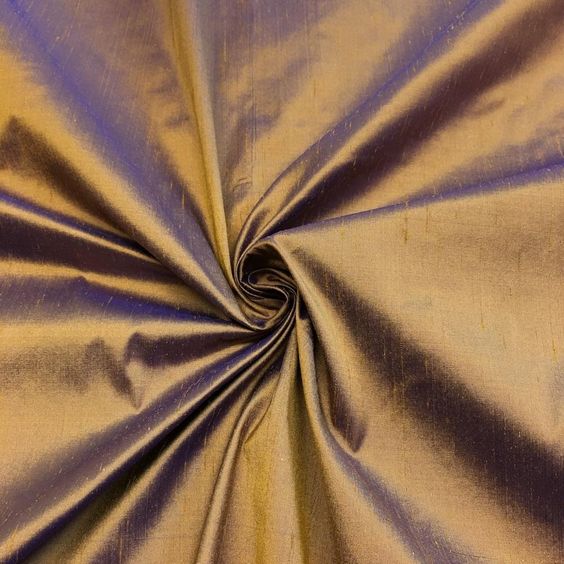
Pure silk shantung showing the fabric’s characteristic irregular surface.
Key Takeaways
- Shantung is usually a plain-woven fabric with intentionally irregular yarns that form visible slubs or ribs.
- Traditional shantung is silk, but “shantung” alone does not prove fiber content; synthetic and blended versions are also sold under the name.
- Crispness, breathability, pilling, opacity, stretch, and care cannot be assigned universally. They depend on the fiber, yarn, weave density, weight, dyeing, and finish.
- Shantung is often lighter and more finely textured than dupioni, while taffeta normally has a smoother, more regular surface.
- Buyers should approve a physical standard and specify composition, weight, width, slub appearance, shade, hand, shrinkage, seam performance, colorfastness, and care requirements before bulk production.
- Destination-market labeling and chemical requirements apply to the actual product and finish, not to the word “shantung.”
Shantung Fabric at a Glance
| Attribute | Practical description |
|---|---|
| Traditional fiber | Silk |
| Other commercial versions | Polyester, viscose, acetate, and blends; composition must be confirmed |
| Typical construction | Plain weave using one or more irregular or slubbed yarns |
| Surface | Fine ribs, nubs, or uneven thick-and-thin effects |
| Hand and drape | Usually crisp and structured; exact stiffness and drape depend on the quality |
| Stretch | Normally low without elastomeric yarn or mechanical-stretch engineering |
| Common uses | Wedding gowns, eveningwear, dresses, blouses, shirts, vests, tailored garments, accessories, and decoration |
| Care | Must follow the supplier’s tested care recommendation; silk and synthetic versions may require different methods |
| Key sourcing point | Approve the slub character and shade in a physical sample because commercial naming is inconsistent |
What Is Shantung Fabric?
Shantung is a textured woven fabric known for deliberate thick-and-thin yarn effects. The slubs catch light differently across the surface, giving the fabric depth and a less uniform appearance than smooth satin or many taffetas. The weave is commonly plain, but yarn selection and finishing largely determine whether the final fabric feels fine and dressy, dry and papery, or coarse and decorative.
The name is historically associated with Shandong, China; “Shantung” is an older romanization of the province’s name. That history does not establish the present-day fiber content or country of origin of a specific fabric. A shantung quality may be woven in China or elsewhere, and its legal origin must be determined from the actual manufacturing and customs facts.

Beige shantung with embroidery; the textured ground remains visible beneath the decoration.
Is shantung always silk?
No. Historically, the term referred to silk fabric, and genuine silk shantung remains the reference quality. In current trade, however, suppliers also use “synthetic shantung,” “faux silk shantung,” and similar descriptions for fabrics made from polyester or other man-made fibers.
The appearance alone is not enough to identify the fiber. Purchase documents should state the generic fiber names and percentages, and fiber identity should be supported by appropriate testing or traceable supplier documentation when it is material to the order.
How Is Shantung Fabric Made?
The production route depends on whether the fabric is genuine silk or an imitation, but the essential design objective is similar: create a woven surface with controlled irregularity.

The manufacturing route changes with fiber and specification, but yarn irregularity and weave control create the recognizable surface.
1. Fiber and yarn preparation
For filament-silk shantung, silk filaments are obtained from cocoons, reeled, combined, and prepared into yarn. Some qualities use yarns with natural or deliberately retained irregularity; others are engineered through yarn selection and twisting to achieve a controlled slub effect.
Synthetic shantung may use filament or spun yarns designed to imitate the thick-and-thin appearance and luster of silk. A polyester imitation can reproduce the visual concept, but it should not be assumed to match silk’s hand, moisture behavior, heat sensitivity, dye response, or drape.
2. Weaving
Shantung is commonly woven in a plain-weave structure. Irregular yarns may be introduced in one direction or, depending on the quality, in both directions. The resulting ribs can therefore appear more crosswise, more lengthwise, or distributed across the surface.
Slubs are part of the approved aesthetic, not automatically defects. However, unusually large thick places, missing yarns, broken picks, reed marks, barre, or excessive variation outside the approved standard can still be quality problems.
3. Dyeing and finishing
Shantung can be yarn-dyed, piece-dyed, printed, or otherwise colored. Finishing determines much of the final luster, stiffness, softness, dimensional stability, and sewing behavior. Silk may be degummed to a selected degree, while synthetic versions may rely more heavily on yarn engineering, heat setting, or chemical finishing.
There is no universal shantung finishing recipe. If a buyer needs stain repellency, water repellency, flame resistance, antistatic behavior, or another functional property, the finish, test method, target result, durability, hand-feel impact, and destination-market restrictions should be specified separately.
4. Inspection and lot control
Shantung requires visual and technical control. Mills should compare bulk fabric with the approved handloom, lab dip, strike-off, or pre-production sample. Buyers should define acceptable slub distribution, shade tolerance, roll-to-roll consistency, width, weight, bow and skew, and defect grading before shipment.
Shantung Fabric Properties
Shantung’s best-known property is its textured, slightly irregular appearance. Other performance descriptions must be treated as quality-specific rather than universal.
Texture and luster
Slubbed yarns produce small ribs and nubs that reflect light unevenly. Silk shantung often has a refined natural sheen, while synthetic versions may range from matte to highly lustrous. Buyers should assess appearance under the lighting used for color approval because texture can change how a shade is perceived.
Crispness, body, and drape
Many shantungs are crisp enough to hold pleats, gathers, bows, and sculpted silhouettes while still draping more softly than very stiff taffeta. Weight, yarn size, weave density, degumming, resin, and heat setting can all change this balance.
Weight and opacity
Shantung is available in lightweight to more substantial qualities. Light colors and low-cover constructions may require lining. Fabric weight in GSM or ounces per square yard, usable width, and opacity are more useful sourcing measures than an unsupported generic thread-count range.
Breathability, moisture, and warmth
Silk shantung may feel comfortable in dresswear, but breathability and moisture transport depend on fabric cover, thickness, finish, lining, and garment construction. Polyester shantung can behave differently. These properties should be tested when comfort performance is a key requirement rather than inferred from the fabric name.
Stretch and recovery
Conventional shantung normally has little stretch other than limited bias give. Stretch requires elastomeric yarn, mechanical-stretch construction, or another engineered solution. Tight garments should be evaluated carefully for seam stress, movement, and recovery.
Durability, pilling, and snagging
Pilling risk depends on the fiber, yarn structure, abrasion, and surface finish. The irregular yarns may also snag or abrade at raised points. Silk can be weakened by prolonged sunlight, perspiration, harsh chemicals, and unsuitable wet processing. Buyers should select performance tests that reflect the intended garment and care cycle.
Advantages and Limitations
Advantages
- Distinctive slub texture adds visual depth without a printed pattern.
- Crisp body supports formal, tailored, pleated, and sculpted silhouettes.
- Silk versions combine luster with relatively light weight.
- A wide range of fibers, weights, colors, and finishes can create different price and performance positions.
- Small natural-looking variations can make garments appear less mechanically uniform.
Limitations
- Commercial definitions vary, so two suppliers’ “shantung” qualities may differ substantially.
- Raised slubs may snag, abrade, or create visual variation that must be controlled against an approved sample.
- Silk versions can be expensive and may require specialist care.
- Fine or light qualities may need lining and careful seam engineering.
- Crisp fabrics can crease, show needle marks, or pucker if sewing parameters are unsuitable.
- Synthetic imitation shantung should not be marketed as silk unless the verified fiber composition supports that claim.
Common Uses of Shantung
Shantung is most effective when the design benefits from controlled body and a visible woven texture.

Shantung is used where crisp structure and a textured surface are part of the design.
Common applications include:
- Wedding gowns, bridesmaid dresses, and formal dresses
- Eveningwear, cocktail dresses, skirts, and structured tops
- Blouses, dress shirts, waistcoats, vests, trousers, and occasion jackets
- Bows, sashes, handbags, and other accessories
- Girls’ occasion dresses
- Decorative panels, cushions, and event décor when the selected quality is suitable for the end use
For fitted garments, confirm movement, seam strength, and fraying. For voluminous gowns, evaluate the fabric together with the intended lining, interlining, boning, fusible, and embellishment. Needle size, point type, thread, stitch density, seam type, pressing temperature, and handling should be trialed on production fabric because punctures and press marks can remain visible.
Shantung vs. Dupioni vs. Taffeta
These names are sometimes used loosely, so the following comparison describes common trade usage rather than a universal rule.
| Feature | Shantung | Dupioni | Taffeta |
|---|---|---|---|
| Surface | Fine to moderate slubs and irregular ribs | Usually larger, more pronounced slubs | Generally smoother and more regular, often with a fine crosswise rib |
| Hand | Crisp but often comparatively light and flexible | Commonly fuller, coarser, and stiffer | Crisp, smooth, and often rustling |
| Traditional fiber | Silk | Silk | Silk; synthetic versions are also widespread |
| Visual effect | Refined, natural-looking texture | Bold, rustic-luxury texture | Clean, polished surface |
| Typical uses | Gowns, dresses, blouses, tailored occasionwear | Structured gowns, jackets, décor | Occasionwear, linings, skirts, jackets, décor |
Dupioni is a close comparison, but shantung is generally selected for a finer and less aggressively slubbed surface. Taffeta fabric is useful when the priority is a smoother, crisper face rather than shantung’s uneven texture. Always compare actual samples because supplier naming, fiber, weight, and finishing can blur these distinctions.

Shantung, dupioni, and imitation qualities should be compared by sample and specification, not by name alone.
Types of Shantung Fabric
Silk shantung
Silk shantung is the traditional version. It is valued for natural luster, crispness, low bulk, and a fine irregular texture. The exact quality depends on silk type, filament or spun-yarn selection, yarn count, weave density, weight, degumming, dyeing, and finish.
Synthetic or faux-silk shantung
Synthetic shantung is designed to reproduce the textured appearance at a different price or care position. Polyester is common, although other man-made fibers and blends may be used. Buyers evaluating polyester fabric options should confirm that the offered construction actually matches the desired shantung appearance; the category includes many fabrics that are not shantung.

Faux-silk shantung can reproduce the visual concept, but its fiber-dependent performance differs from genuine silk.
Blended shantung
Blends can balance luster, cost, crease behavior, strength, dyeing, and care. A blended product should be described by its verified fiber percentages; “silk-look” and “silky” describe appearance or hand and do not establish silk content.
Dupioni as a related fabric
Dupioni is better treated as a related slubbed fabric than as a numbered subtype of shantung. It usually has more prominent irregularities and greater body, although commercial usage varies.
Where Is Shantung Fabric Produced?
Shantung is historically associated with Shandong, but contemporary production is not limited to that province. The International Sericultural Commission’s silk statistics identify China as the world’s largest silk producer and India as the second largest; the same source describes silk as less than 0.2% of the global textile market. This supports the view that silk remains a specialized material, but it does not show that every shantung fabric is Chinese or that all Chinese silk is shantung.

Shantung can be sourced from several textile-producing regions; actual mill, processing, and origin data should be documented for each order.
Silk weaving, synthetic weaving, dyeing, and finishing may occur in different locations. Buyers should request the mill name, processing route, country-of-origin basis, batch records, and supporting commercial documents when traceability or origin claims are important.
How Much Does Shantung Fabric Cost?
There is no reliable universal price for shantung. Quotations can change with:
- Silk, polyester, viscose, acetate, or blended composition
- Yarn quality and slub design
- Fabric weight, usable width, construction, and order quantity
- Greige availability and lead time
- Solid dyeing, yarn dyeing, printing, or custom color development
- Finishes and performance testing
- Shade continuity and inspection grade
- Certification, traceability, and documentation scope
- Packaging, freight, duties, and destination-market requirements
Genuine silk shantung is normally positioned above synthetic imitation qualities because of its raw material and processing route, but the final comparison must use matching specifications. Request quotations with the same composition, weight, width, color, finish, test requirements, inspection standard, MOQ, Incoterm, and delivery terms.
Shantung Fabric Care and Garment Processing
The safest care method is the one validated for the exact fabric, dye, finish, lining, interlining, embellishment, and garment construction. Do not apply a universal “cold wash” instruction to all shantung.
For silk shantung, suppliers commonly recommend professional dry cleaning for structured or strongly colored garments, but some qualities may permit careful wet cleaning. Before approving a care label, check dimensional change, colorfastness, water spotting, surface change, seam appearance, and pressing response. Use a press cloth and conservative temperature during development, and protect stored silk from prolonged light exposure.
Synthetic versions may tolerate easier care, but heat sensitivity, finish durability, trim, and garment construction still matter. Trial laundering or dry cleaning on a finished-garment sample is more informative than testing an isolated swatch alone.
Quality-Control and Sourcing Checklist
Use an approved physical reference plus a written specification. At minimum, confirm:
- Fiber content: Generic fiber names, percentages, tolerance, test method, and supporting documents.
- Construction: Weave, yarn type, yarn count or linear density, ends and picks where relevant, and slub direction.
- Dimensions: Finished GSM or oz/yd², total and usable width, roll length, and dimensional tolerances.
- Appearance: Slub size and frequency, luster, hand, shade, opacity, defects, bow, skew, and roll-to-roll continuity.
- Performance: Dimensional stability, colorfastness, seam slippage, tensile or tear strength, snagging, pilling, abrasion, and care performance as appropriate to the end use.
- Finishing: Softener, resin, heat setting, stain or water repellency, flame-retardant treatment, and restricted-substance declarations where applicable.
- Garment compatibility: Lining, fusible, embroidery, print, needle, seam, pressing, and embellishment trials.
- Bulk control: Lab dip or strike-off approval, pre-production sample, first-bulk review, roll inspection, and shipment documentation.
FabricsTrades’ fabric quality inspection guide provides a broader framework for roll inspection and procurement checks. Project-specific methods, acceptance levels, and destination-market requirements should be agreed before sampling and quotation.
Environmental and Certification Considerations
Shantung is not automatically sustainable or unsustainable. The assessment depends on the actual fiber and supply chain.
Silk is a protein fiber and can biodegrade under suitable conditions, but a finished textile’s end-of-life behavior can change with dyes, coatings, blends, backing, adhesives, and accessories. Silk production also uses land, mulberry cultivation, labor, energy, water, and processing chemicals; impacts vary by farming and manufacturing practice. Conventional reeling generally involves killing the pupa, which is relevant to animal-welfare policies.
Synthetic shantung avoids animal-origin fiber but relies on man-made-fiber production. Polyester versions can persist in the environment and may release microfibers during use and care. Neither fiber choice should be reduced to a single “eco-friendly” label without product-specific evidence.
There is no universal shantung certification. Certification claims must identify the exact standard, certified organization, facility or product scope, certificate number, validity period, and transaction documentation where applicable. OEKO-TEX STANDARD 100, for example, is a product label for textiles tested for harmful substances; it does not by itself prove that a fabric is silk or establish the complete environmental performance of the supply chain.

The intended use, fiber content, finish, and documentation determine which tests or certifications are relevant.
Current Regulatory and Market Update
Research status: August 11, 2026. Shantung’s trade name does not replace legally required fiber information. Buyers should build labeling and compliance data around the actual composition, origin, finish, product category, destination market, and sale date.
For the European Union, official EU textile-label guidance states that textile products marketed to consumers generally need a firmly attached label showing fiber composition; the guidance also explains language and business-to-business documentation considerations. Regulation (EU) No 1007/2011 remains the legal reference for textile fiber names and composition labeling. A product described commercially as shantung should therefore also state whether it is silk, polyester, a blend, or another verified composition.
In the United States, the Federal Trade Commission’s Textile and Wool Acts labeling guidance explains that most covered textile products require fiber content, country of origin, and the identity of the manufacturer or another responsible business. The FTC also requires generic fiber names and percentages by weight in descending order for covered products. Care instructions are governed separately. Buyers should confirm the rules that apply to the specific product, including any exemptions and state requirements.
Chemical and finish requirements are also specification-dependent. Untreated silk shantung should not be assumed to contain a water-, oil-, or stain-repellent chemistry. If a performance finish is requested, buyers should identify its chemistry and review the applicable restricted-substance rules, retailer limits, test methods, and documentation. FabricsTrades’ overview of global textile compliance developments provides related supply-chain context. Programs using repellent finishes may also need to track EU PFAS restriction developments affecting fabric supply chains, while confirming current legal status and scope through official sources before bulk production.
The silk market remains small relative to the global textile market, and China and India remain the leading raw-silk producers according to the International Sericultural Commission. For buyers, the practical response is to confirm genuine fiber content, mill and processing locations, lot traceability, minimum order quantities, lead times, and substitute options rather than relying on the historic Shantung name.
Frequently Asked Questions
Is shantung fabric always made of silk?
No. Traditional shantung is silk, but polyester, viscose, acetate, and blended imitation qualities are also sold as shantung or faux-silk shantung. Confirm the generic fiber names and percentages on the specification and supporting documents.
What is the difference between shantung and dupioni?
Shantung usually has finer, less prominent slubs and a lighter, more flexible hand, while dupioni commonly has larger slubs and greater body. Commercial naming varies, so compare actual samples, weights, constructions, and finishes.
Is shantung suitable for wedding dresses?
Yes. Shantung’s crisp body, light-reflecting texture, and ability to hold pleats and volume make it popular for wedding and occasion gowns. The selected quality should be checked for opacity, lining compatibility, seam performance, snagging, pressing, and care.
Does shantung stretch?
Conventional shantung has little stretch beyond limited bias give. If stretch is required, specify an elastomeric or mechanical-stretch construction and test extension, recovery, seam performance, and appearance after wear.
Can shantung be washed?
Some shantung can be washed, but there is no universal care method. Silk, dye, finish, interfacing, lining, and garment construction can change the result. Validate the complete garment through the intended care process before issuing a label.
Is shantung breathable?
Breathability depends on fiber, weight, weave density, finish, lining, and garment design. A light silk shantung may feel comfortable, while a dense or coated synthetic version can perform differently. Test air permeability or thermal-moisture comfort if it is a critical requirement.
Is shantung sustainable?
The fabric name alone does not establish sustainability. Evaluate fiber origin, farming or polymer production, processing energy and water, dyes and finishes, labor conditions, durability, care, waste, and end-of-life design. Require evidence for any organic, recycled, biodegradable, low-impact, or certified claim.
What should buyers approve before ordering bulk shantung?
Approve a physical standard, composition, weight, usable width, slub character, shade, hand, finish, performance tests, care route, defect tolerance, packaging, and documentation. Also confirm how bulk lots will be inspected and how shade or texture deviations will be handled.
Selecting Shantung for a Sourcing Project
Shantung is best understood as a family of crisp, slub-textured woven fabrics rather than one fixed specification. Silk shantung offers the traditional luster and hand, while synthetic and blended constructions can provide alternative cost, durability, and care profiles. The right choice depends on the design silhouette, target price, required performance, processing route, care method, and destination market.
FabricsTrades is based in Wujiang District, Suzhou, within a major textile manufacturing and supply-chain cluster. The company can help evaluate sourcing routes, alternative fibers and constructions, colors, weights, widths, finishes, samples, testing coordination, and documentation requests. Availability and support should be confirmed against the final shantung specification and project requirements before quotation or production.