Most buyers obsess over spandex percentage. They shouldn’t. By the time the yarn hits the loom, the kind of loom you chose has already decided whether the finished fabric will hold its recovery after fifty wash cycles — or whether it’ll bag at the knees after twenty.
Table of Contents
ToggleThe 4-way stretch industry has a dirty secret: two factories can buy identical spandex from the same supplier, weave to the same construction spec, and ship fabrics that perform differently enough to wreck a brand. The difference lives in steps most sourcing decks skip past. So let me walk you through the actual sequence, from a yarn cone to a packaged roll on a truck — the way it happens on our floor in Suzhou — and flag the moments where corners get cut.
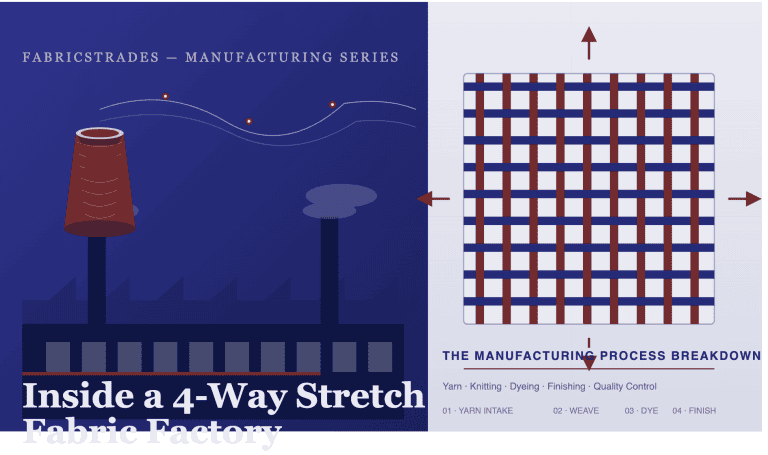
Manufacturing Process Overview
There are two acts: Preparation and Weaving. The finishing belongs to a separate article. Here’s what matters before the fabric ever exists.
Act One: Preparation — Where Most Failures Are Already Baked In
Raw material inspection
Every cone of yarn that enters the building gets tested. Tensile strength, evenness, and — for 4-way stretch — spandex content verification. This is the boring step that separates a real factory from a trading desk pretending to be one. Skip it and a single bad lot of spandex core-spun yarn ruins 5,000 meters of fabric three weeks later, when the customer’s QC team in Portland finds uneven elongation across the roll.
If you’ve never seen this happen, here’s the inspection workflow in real time:
Yarn format: cone yarn vs. spandex core-spun yarn
Two formats matter for our process. Cheese yarn (also called cone yarn) is the standard package — the cylindrical cones you see stacked in any mill. For 4-way stretch specifically, the protagonist is spandex core-spun yarn: a spandex filament wrapped with a sheath of polyester, nylon, or cotton. The spandex gives elasticity. The sheath gives the hand-feel, dye affinity, and abrasion resistance.
This is where the “nude-feel” texture lives or dies. The cover ratio, the twist multiplier, the spandex draft ratio — these decisions made at the yarn stage are doing more for your finished fabric’s softness than any chemical softener applied later.
Warping: getting the warp yarns onto a beam
Warping is the process of winding hundreds — sometimes thousands — of warp yarns in parallel onto a warping beam under controlled tension. Tension consistency at this stage determines whether your fabric will have streaks, barré, or width variation later. There are no second chances.
Two methods, and the right one depends entirely on your order profile:
Sectional warping wins for small batches and high SKU variety. If you’re a D2C brand running custom colorways at modest volumes, this is the process behind your fabric. It’s slower per meter but flexible — perfect for prototype-to-launch scaling.
Direct warping (also called beam warping) is the high-volume answer. Institutional procurement teams ordering 50,000 meters of navy uniform fabric across multiple production runs want this method — it delivers the batch-to-batch consistency that keeps a hospital network from ending up with three subtly different shades of navy scrubs across three regional warehouses.
Beaming
Beaming combines multiple section beams into one weaver’s beam — the beam that actually feeds the loom. Trivial step, mention-worthy only because tension errors here propagate downstream into every centimeter of finished cloth.
Sizing — the step nobody talks about that decides everything
Sizing coats the warp yarns with a polymer film (PVA, modified starch, acrylic blends) to give them the abrasion resistance they need to survive thousands of friction cycles inside the loom. Without sizing, the yarn frays, breaks, and you get a fabric with hidden weak points.
The metric that matters: size pick-up percentage — how much sizing agent the yarn absorbed, expressed as a percentage of yarn weight. For 4-way stretch, this number is a balancing act. Too low and the spandex core-spun yarn breaks under loom tension. Too high and the fabric goes stiff, the dye uptake suffers, and you’ll feel it as a “cardboard” hand-feel in the greige.
This is the single most underrated process variable in the entire supply chain. Ask your supplier their sizing recipe and their target pick-up rate. If they can’t answer in thirty seconds, you’re talking to the wrong people.
Drawing-in and reeding
Once the warp beam is sized and dried, every single warp end has to be threaded — by machine or by hand — through three things: the drop wires (which detect broken yarns), the heddles (which lift and lower yarns to form the shed), and the reed (which spaces the yarns and beats the weft into place).
For a fabric with, say, 4,800 warp ends, that’s 4,800 threading operations. This used to be a manual job that consumed days. Modern factories use automated reeding machines — what some operators in China still call by the colloquial “ba kou ji” — that handle the reed threading at industrial speed.
If you tour a factory and the drawing-in section is a row of women squinting at a frame with hooks, that’s not necessarily bad — it’s just slow, and slow is expensive at scale.
Act Two: Weaving — Where the Loom Choice Defines the Fabric
Here’s the part most sourcing decks get wrong. They list “loom type” as a specification line item, like fiber content. It isn’t. Loom type is a design decision that constrains everything about the fabric — the hand-feel, the defect rate, the achievable density, even the spandex damage.
There are three loom families relevant to 4-way stretch:
Water-jet loom
The water-jet loom uses a high-pressure jet of water to propel the weft yarn across the shed. Fast, cheap to run, ideal for hydrophobic synthetics like standard polyester.
But here’s the catch: spandex doesn’t love water.
It can swell, lose elasticity over time, and in some constructions the spandex draft becomes unstable under the water pressure. Some 4-way stretch fabrics — particularly those with low spandex percentages and hydrophobic sheaths — run fine on water-jets. Many don’t. If a supplier quotes you a suspiciously low price on a 4-way stretch and won’t tell you what loom they used, this is the answer.
Air-jet loom — the mainstream answer for 4-way stretch
For the vast majority of 4-way stretch production, the air-jet loom is the right tool. It uses compressed air to launch the weft, which means no water contact with the spandex.
Air-jets run fast, deliver excellent fabric consistency, and — critically — preserve the integrity of the spandex throughout the weaving cycle.
They’re more expensive to operate (compressed air costs more than recirculated water), and that cost shows up in the per-meter price. If you’re getting quotes that look 20% apart from two suppliers claiming the same construction, the cheaper one is almost always weaving on a water-jet.
Rapier loom
The rapier loom uses a mechanical “rapier” — basically a flexible carrier — to physically hand the weft yarn across the shed. It’s slower than jet looms, but it shines for coarser yarns, high-spandex constructions, and complex weaves where the weft needs gentle, controlled placement. If you’re weaving a heavy 4-way stretch with high elastane content, or a fabric with elaborate structure, the rapier earns its keep.
Shedding mechanisms: dobby and cam
Inside any loom, something has to lift and lower the heddles in patterns to create the weave structure. That mechanism is the shedding system.
Cam shedding is mechanical, simple, fast, and limited to repeating patterns of about 8–10 picks. Fine for plain weave and basic twills, which covers the bulk of athleisure-grade 4-way stretch.
Dobby mechanisms — especially electronic dobby — allow programmable pattern sequences of up to several hundred picks. This is where you get the structural variety: bird’s-eye textures, micro-jacquards, technical patterns for performance apparel.
If a softshell brand wants a proprietary surface structure, electronic dobby is what makes it happen.
The weft side: tension is everything
On the warp side, sizing protects the yarn. On the weft side, there’s no sizing — the weft is laid in raw. And for 4-way stretch, the weft typically contains the spandex.
This is where the spandex weft feeder does the unsung work. It controls the tension and draft ratio of the spandex weft yarn as it enters the shed. Get the draft wrong and your fabric’s stretch and recovery profile is wrong from end to end. The draft setting on the weft feeder is, no exaggeration, one of the three or four most consequential numbers in the entire process.
The two other numbers that define the fabric:
- EPI (ends per inch) — the density of warp yarns
- PPI (picks per inch) — the density of weft yarns
These two values, multiplied by the yarn count, determine your fabric weight (GSM), opacity, and stretch behavior. They’re also where suppliers cheat. A construction spec called “200 GSM, 4-way stretch, 88/12 nylon/spandex” tells you almost nothing about whether two suppliers will ship the same fabric. Demand the EPI and PPI numbers. If they hesitate, walk.
The End of the Line: Greige Fabric and Packaging
Off the loom comes greige fabric — also called grey fabric, though it has nothing to do with the color grey. It just means unfinished: no dyeing, no scouring, no calendering, no chemical finishing. It’s the raw woven structure, and it will look and feel nothing like the final product.
Greige then moves to finishing — heat-setting, dyeing, brushing, calendering, peach-skin treatments, whatever the spec calls for. That’s a whole separate process worth its own article.
Once finished, the fabric is rolled and packaged for shipment.
What This Means for the Three Kinds of Buyers Reading This
If you’re a D2C founder trying to scale past sample stage: the questions that actually matter to you are sectional vs. direct warping (small batches), air-jet vs. water-jet (spandex integrity), and EPI/PPI transparency (so you can spec a signature fabric and not get drift between production runs). MOQ negotiation is a separate fight, but a factory that can run sectional warping is structurally built to take smaller orders.
If you’re a technical sourcing lead for performance apparel: the conversation worth having with your supplier is about size pick-up percentage, spandex weft feeder tension setting, and dobby capability for structural surfaces. These are the variables that move the needle on wear-experience metrics — recovery, abrasion, hand-feel.
If you’re handling institutional procurement — uniforms, scrubs, government contracts: focus on direct warping (consistency at volume), batch-to-batch dye lot tracking (which starts with greige consistency), and the durability spec on the spandex weft. The reason your last supplier’s navy looked slightly different in three shipments isn’t a finishing problem. It started at the warping beam.
The supply chain is full of people who can quote you a price per meter. Far fewer can tell you what’s actually happening inside the building between the yarn delivery and the truck. Now you know what to ask.