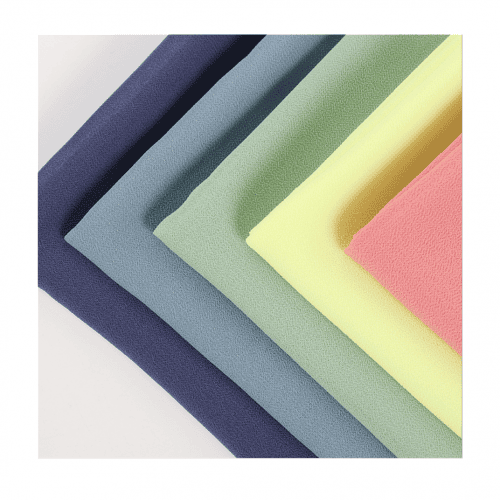
Garment Fabric Sourcing and Custom Development
Located in the heart of Wujiang District, Suzhou, FabricsTrades operates within one of the world’s most concentrated textile manufacturing hubs. We are not limited to the constructions available from a single mill. In addition to owning a 4-way stretch fabric factory, we work as a strategic sourcing partner with direct access to thousands of specialized weaving, knitting, dyeing, printing, coating, laminating and finishing suppliers.
If a garment fabric already exists, our local network helps us locate the appropriate construction and production route. If it does not, we can help develop it by coordinating fiber selection, yarn specification, structure, weight, width, stretch, hand feel, color, surface treatment and functional finishing.
This combination of factory control and regional sourcing capacity supports:
- Custom colors, lab dips and buyer-specific color standards
- Stretch and recovery optimization
- Recycled polyester and recycled nylon programs
- Moisture-management and quick-dry development
- Brushing, coating, lamination, printing and other finishing processes
- Sample evaluation and bulk-production coordination
- Performance testing and compliance-document collection
- Supplier consolidation across multiple garment fabric categories
What Are Stretch Garment Fabrics?
Stretch garment fabrics are engineered to extend under tension and recover toward their original dimensions after the force is removed. Stretch may be created through elastic fibers such as spandex or elastane, mechanically textured yarns, knitted loop structures or specialized elastic polyester systems.
The appropriate construction depends on the garment’s movement profile, fit, support level and care requirements. A compression sports bra requires a different modulus and recovery profile from a wide-leg woven trouser, brushed running jacket or lightweight casual shirt.
Common garment-fabric fiber systems include:
- Nylon/spandex: Smooth, strong and highly elastic, making it suitable for fitted activewear, yoga garments, sports bras, cycling apparel and body-contouring pieces.
- Polyester/spandex: Durable and adaptable, with strong potential for quick-dry performance, printed activewear, training tops and stretch outerwear.
- 100% polyester constructions: Suitable for lightweight fashion garments, wide-leg pants, shirts, dresses, linings and styles where dimensional stability and easy care are priorities.
- Recycled polyester or recycled nylon: Used when a program requires certified recycled inputs, subject to the certification scope and transaction documentation agreed for the order.
- Cotton/stretch blends: Appropriate for casual garments requiring a more natural hand combined with moderate flexibility.
- Ribbed and interlock knits: Frequently selected for bodywear, supportive tops, close-fitting garments, cuffs and structured knit silhouettes.
Properties of Garment Stretch Fabrics
The exact performance depends on fiber content, yarn, construction, weight and finishing. Relevant properties may include:
- Multidirectional stretch for improved mobility
- Elastic recovery and shape retention
- Close body conformity
- Lightweight comfort
- Moisture-wicking and quick-dry performance
- Breathability appropriate to the selected construction
- Wrinkle resistance
- Abrasion resistance
- Dimensional stability
- Smooth or brushed hand feel
- Supportive compression
- Non-see-through coverage in properly engineered constructions
- Color and print compatibility
- Easy-care performance
Any functional claim should be confirmed against the approved specification and tested production sample. Fiber content alone does not guarantee moisture management, UV protection, antibacterial performance, opacity, colorfastness or a particular level of stretch and recovery.
Advantages of Stretch Fabrics for Garments
- Comfort and mobility: Stretch allows a garment to follow body movement during running, cycling, yoga, Pilates, tennis, gym training and everyday activity.
- Improved fit: Elastic constructions can conform more closely to the body and reduce restrictive pressure at high-movement zones.
- Shape retention: Suitable stretch-and-recovery engineering helps garments maintain their intended silhouette after repeated movement and wear.
- Design versatility: Stretch fabrics can support compression garments, fitted fashion, relaxed athleisure, paneled sportswear and hybrid lifestyle products.
- Durability: Nylon and polyester constructions can provide strong resistance to routine wear when the yarn, structure and finishing route are correctly specified.
- Moisture management: Selected polyester and nylon fabrics can be engineered to move perspiration and dry rapidly during activity.
- Production flexibility: Different weights, surfaces, stretch ratios and finishes allow the material to be matched to specific garment zones and performance targets.
How to Specify Garment Fabric for Sampling
A useful sourcing request should define:
- Intended garment and target consumer
- Fiber composition
- Knit or woven construction
- Target weight and usable width
- Two-way or four-way stretch requirement
- Stretch percentage and recovery target
- Desired hand feel and surface appearance
- Opacity requirement under extension
- Moisture-management or quick-dry requirement
- Brushing, coating, printing or lamination needs
- Color standard and light source
- Required test methods
- Restricted-substance requirements
- Recycled-content certification needs
- Sample quantity, bulk volume and delivery destination
Providing an approved reference swatch is especially valuable when hand feel, compression, drape or surface luster is difficult to express numerically.
Garment Fabric Testing and Quality Control
The test plan should be matched to the product’s end use. Typical evaluation may cover:
- Fiber composition
- Fabric weight and width
- Stretch and recovery
- Dimensional change after laundering
- Spirality or skew
- Pilling and abrasion resistance
- Bursting or tensile strength
- Seam slippage or seam strength
- Colorfastness to washing, rubbing and perspiration
- Moisture-management and drying performance
- Opacity under specified extension
- Restricted substances
- Total fluorine or targeted PFAS analysis where relevant
- Recycled-content documentation when a certified claim is required
Testing should identify the article, colorway and production lot. A generic report for a different construction or finish is not reliable evidence for shipment approval.
Frequently Asked Questions
1. What information do you need to recommend a garment fabric?
Send the intended garment, composition preference, target weight, width, stretch direction, stretch and recovery expectations, hand feel, color, functional requirements, estimated volume and destination market. A physical reference swatch or existing garment can make material matching more accurate.
2. Can FabricsTrades source fabrics outside its own factory range?
Yes. We own a 4-way stretch fabric factory, but our Wujiang location also gives us access to specialized weaving, knitting, dyeing, printing, coating and finishing partners. If a suitable fabric already exists, we can help locate it. If it does not, we can coordinate custom development.
3. How should I choose between nylon/spandex and polyester/spandex?
Nylon/spandex is commonly selected for a smooth hand, strength and close-fitting performance garments. Polyester/spandex is widely used when durability, quick drying, printability and cost control are priorities. The final choice should be based on tested construction-level performance rather than fiber names alone.
4. Can recycled garment fabrics be supplied?
The listed range includes products made from recycled polyester, nylon and cottons. Where a certified recycled claim is required, specify the applicable certification and request valid scope and shipment-level documentation. Certification availability should be confirmed for the selected construction and order.
5. How do I verify that a garment fabric is PFAS-compliant?
Request a supplier declaration linked to the exact article and colorway, documentation for coatings, membranes and finishes, and testing appropriate to the destination market. “C0,” “fluorine-free” and “no PFAS-based DWR” are not interchangeable with complete proof that every component meets the applicable legal requirement.
6. Can you guarantee quick-dry, antibacterial, UV-protective or non-see-through performance?
These properties must be defined and verified for the chosen fabric. Product descriptions identify the intended features of specific listings, but bulk acceptance should use agreed test methods, performance thresholds and approved pre-production samples. Opacity should also be evaluated at the extension level expected in the finished garment.